
He Wants to Know What the Bins Are Worth

It started with a friend at school who gets two dollars for the bins.
Now nothing gets done without a price on it. The chart on the fridge has turned into a menu.
Last Tuesday I was asked what I was paying for putting shoes away. In his own house. By a person who lives here for free.
Which sounds tidy until the first week you have to hand over money to a child who did nothing. More on that in a minute, because it is the bit everyone gets stuck on.
Why chores are worth the hassle at all

Because it is faster to do the dishwasher yourself, and every parent knows it, and the only thing that keeps you handing the job over is knowing what it is for.
Marty Rossmann at the University of Minnesota went back through a study that had followed 84 children from preschool into their mid twenties. She was looking for what predicted how they turned out. The strongest single thing she found was whether they had been given household jobs at three and four years old.
Not chores at ten. Chores at three, when they are slow and useless and make more mess than they clear.
Twenty years on, those children were more likely to be doing well at work, doing well at study, and getting on with the people around them.
So the toddler who insists on carrying his own plate to the sink is not being indulged. He is doing the version that counts.
Where the money fits
Which is the argument for paying an allowance and the argument against paying it per chore, in one go.
If the money only arrives when jobs are done, the jobs become a deal. And a child who does not want the money that week is free to skip them.
That is not a hypothetical. It is what nine year olds do the first week they have five dollars saved.
Paid on a fixed day, the money turns into a small weekly lesson in waiting, choosing and running out. Tied to the bins, it turns into wages, and you have become an employer with nothing to bargain with.
Most families end up with three lists. Jobs that are just life, unpaid and not up for debate. A weekly allowance that has nothing to do with them. And a few extra paid jobs, priced in advance so nobody haggles on the day.
If money is tight and the allowance itself is the problem, the wider version of that is in the piece on running the numbers on one income.
How much, and in what form
The usual US starting point is about a dollar per year of age, per week. A seven year old gets seven dollars. It is a starting point, not a rule, and plenty of families run at half of it.
What matters more is that it is small enough to run out and regular enough to plan with. Money that never runs out teaches nothing, and money that arrives unpredictably cannot be saved towards anything.
Cash, in a jar, for anyone under about ten. A physical pile that visibly shrinks is doing something a balance in an app cannot do at that age. Three jars beats one: spend, save, give.
The chart itself is the cheapest part of this and mostly needs to be visible rather than clever. A magnetic board on the fridge outlasts a paper chart by about a year.
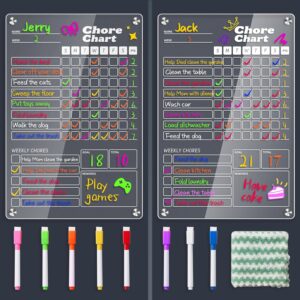
2 pcs Acrylic Magnetic Chore Chart for Kids on Fridge, Chore Board, Dry Erase Chore Chart, 12″x8″…
As an Amazon Associate, Decoded Kids earns from qualifying purchases. Price checked live on Amazon.
For younger children who cannot read the list yet, the sliding versions work better, because moving a tab from to-do to done is the reward and no adult has to be present for it.
If you are choosing between formats rather than deciding about money, we compared the actual boards in the piece on chore charts that survive past February. For a child who cannot hold a list in their head at all, the ADHD version is built differently and works better.
The week it falls apart
The other predictable wobble is nagging. If you are reminding every day, the chart is doing nothing and you have become the chart.
Tie the job to a moment rather than a time. After dinner, not at six. Before screens, not at some point this evening.
A job with a doorway attached gets done far more often than one with a slot in the day. It is the same mechanism behind a morning routine chart.
When it is going well

You will know because the arguing moves. It stops being about whether he has to and starts being about whether it counts as done, which is a much better argument to be having.
Resist the urge to redo his work while he watches. A badly wiped table wiped by a six year old is a success. Going over it again in front of him is the fastest way to end the whole project.
Praise the doing rather than the child, too. “The bins are out, thanks” lands better than “you are so helpful”, for reasons we went into in the piece on praise that backfires.
And expect the system to need rebuilding roughly twice a year, usually in September and again in January, when everything else in the house is being rebuilt anyway.
He gets six dollars on a Saturday now, and the bins are free. He has stopped asking about the shoes.
Leave the first comment
Share your thoughts
Frequently asked questions
Most family finance writers say no, and the reasoning is practical. If the money only comes with the jobs, a child who does not need money that week is free to skip them. Pay allowance on a fixed day, keep basic chores unpaid, and price a few optional extras separately.
A common US starting point is about a dollar per year of age per week, so seven dollars for a seven year old. Plenty of families run at half that. What matters more is that it is small enough to run out and regular enough to save with.
Three or four, going by the research. A University of Minnesota analysis following 84 children into their mid twenties found that starting household jobs at that age was the strongest predictor of how well they were doing later, ahead of other family factors.
It undermines the system. Docking pay turns allowance back into wages and gives your child a genuine choice about whether the jobs are worth doing. Pay it regardless, and handle undone jobs with an ordinary household consequence that has no money attached.
Anything that is the cost of living in the house: their own plate, their own laundry, their own room, their own shoes. Paid work should be genuinely optional and priced in advance, such as washing the car or clearing out a closet.

I'm for the parent about to spend money they're not sure about. I buy the gadget, live with it, and give you the honest verdict - including the 'don't'. I've burned through enough hype to save you the cash, and when something truly earns its place, I'll show you exactly why.
More from TylerWhich tool earned its place - and which was a waste of money?
No right answers here - tell us how it went. Someone reading needs to hear it.
Join the conversation