
The Fifth Night Got the Coins. The Other Seven Got Candles.
You have eight small boxes in the cart, one for each night. The total keeps climbing. Somewhere between the third dreidel and the fifth pair of socks, you wonder who decided that every night needs a present.
Nobody did, at least not for a long time. A memoir by Paulina Wengerov, dated around 1832, describes her mother handing over a few shiny copper coins on the fifth night of Hanukkah. Not on every night. Rabbi David Golinkin, a professor of Talmud and Jewish law, says it seems to be the first written mention of a mother giving her children Hanukkah gelt.
The tradition asks for far less than the shelves do. Once you see how much less, the eight nights get easier to plan.
What are the traditional Hanukkah gifts for kids?
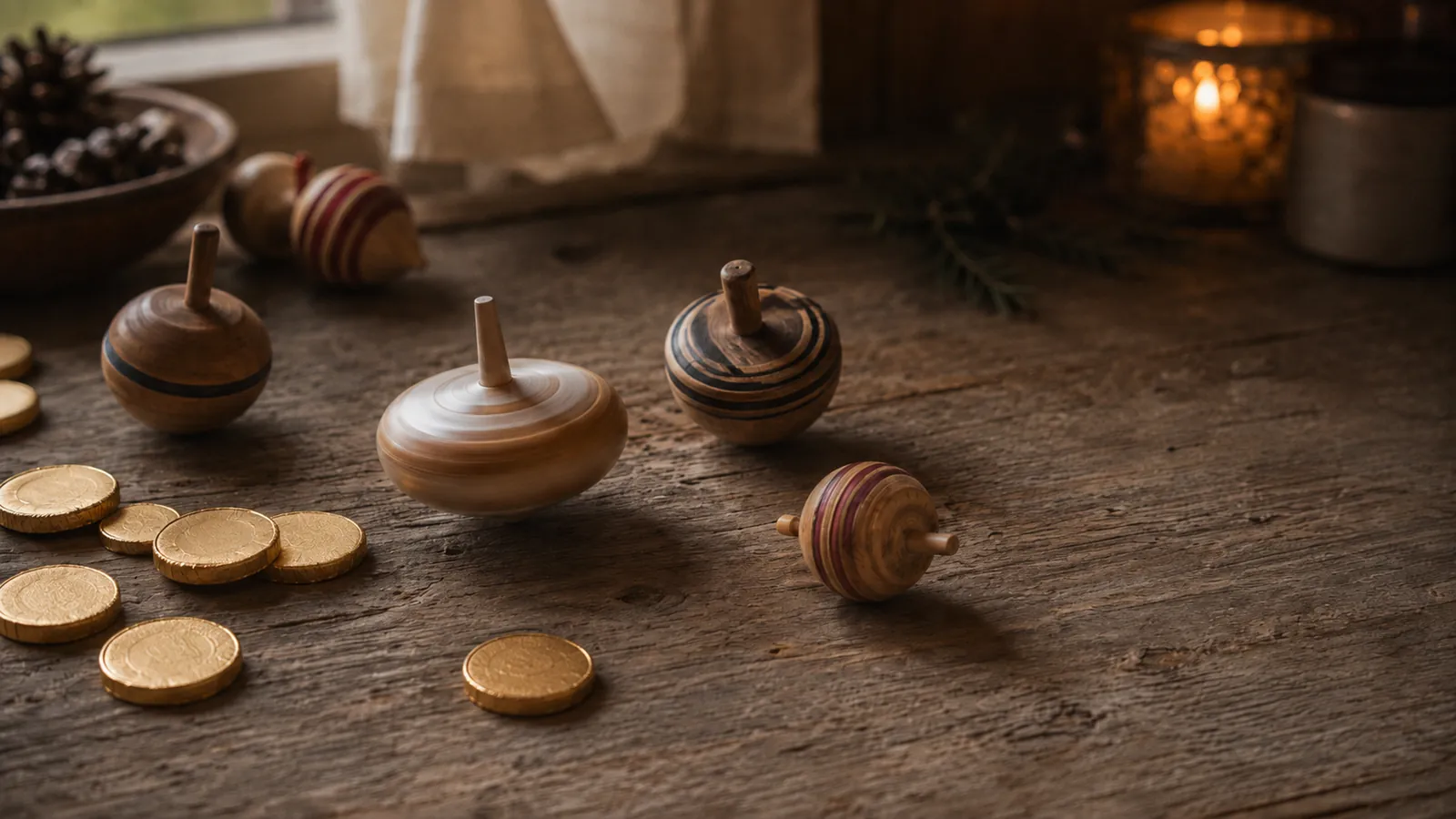
Gelt comes first. The name comes from the Yiddish word for money, and today it usually means chocolate coins in gold foil. According to My Jewish Learning, Jewish schoolchildren started giving their teachers a year-end bonus at Hanukkah sometime in the late medieval or early modern period. Over time, the money went to children too, so they could play dreidel. Some families still give gelt and nothing else.
Wrapped presents came much later. The same article says that for well over 1,000 years, Purim was the holiday for giving gifts and Hanukkah was not. Jews did not start giving children Hanukkah gifts until the late 19th century. Golinkin points to the historians Jenna Weissman Joselit and Dianne Ashton, who showed that Hanukkah presents were invented in the United States in the 19th century to compete with Christmas presents.
None of that makes a present wrong. The tradition never set a number, so nobody handed you a rule about eight.
Is it one small gift a night, or one bigger one?
Both are fine. My Jewish Learning says there are “absolutely no rules about giving gifts on Hanukkah.” Some families give small gifts on all eight nights, and others give one large gift or none at all.
The one-big-gift habit has roots too. Golinkin writes that Wengerov’s fifth-night coins became a common custom in Eastern Europe.
There is a middle path as well. Rabbi Alison Adler, writing for JewishBoston, describes an older gelt custom. It works like this: a dollar the first night, two the second, and so on. The eight nights add up to $36. She suggests that children give some of it to tzedakah, which means charitable giving, and then shop with whatever is left. Our guide to teaching kids about giving explains why children give best when the choice really is theirs.
Small means anything you would buy without a second thought. A pack of good pencils works, and so does a pair of warm socks. Match it to something they already like, and small stops feeling cheap.
What does an eight-night plan look like?

Here is one way to spread it out. Hanukkah 2026 begins at sundown on Friday, December 4, and ends at nightfall on Saturday, December 12, according to the Hebcal calendar. That puts the first and last nights on Fridays, so this plan leaves both without a box.
- Night one, Friday, December 4: Nothing to open. Light the candle and eat dinner.
- Night two, Saturday: A book, maybe one of these books to give instead of a toy. Sunday morning is free, so they can start it in bed.
- Night three, Sunday: Gelt night. Each child gets a small bag and picks how much to give away.
- Night four, Monday: Something warm and useful, like socks or mittens. They will wear it to school tomorrow.
- Night five, Tuesday: The one bigger gift, perhaps from this list of screen-free gifts. The fifth night is the night the old coin custom picked.
- Night six, Wednesday: A game for the whole table, so the gift belongs to everyone.
- Night seven, Thursday: A kit for making something, saved for the weekend.
- Night eight, Friday, December 11: Nothing to open. Light the last candle and eat another plain dinner.
Swap the nights around freely. If a Tuesday feels wrong for the big gift, move it to Saturday and nobody will mind.
Are dreidels and other Hanukkah toys safe for little kids?
It depends on the age. A dreidel is a small spinning top, and loose gelt is a pile of small round things. Anything that fits inside a toilet-paper tube is a choking risk for a child under three, as our toy safety guide explains, so hold both up to one before they reach a toddler.
Battery-powered menorahs need the same check. Button batteries are dangerous when swallowed, and the same guide names fake candles among the everyday items with the worst battery lids. Pick one whose battery door needs a screwdriver. If you think a child swallowed one, go to the hospital right away.
What if your family does Hanukkah and Christmas?
In 2026 the calendar helps. Hanukkah ends on December 12 and Christmas comes on December 25, so the two holidays sit almost two weeks apart.
Interfaith parents interviewed by Kara Baskin for JewishBoston in 2021 describe different fixes. Heidi, a non-Jewish parent, says she tries to “create space for Hanukkah to be the dominant event” so it does not compete with Christmas. Elliot, a Jewish parent, says his in-laws give so many big gifts on Christmas Day that his side saves the big ones for Hanukkah. Jennifer remembers a childhood rule of one night given to charity instead of a gift.
Three habits are easy to copy. Decide which holiday each gift belongs to before you wrap it, and write that on the tag. Then tell the grandparents which night to aim for, using our guide to gifts from grandparents as a starting list. Last, set one total for both holidays before the sales start, the way our guide to how much to spend on kids at Christmas suggests.
Write the eight nights on paper first
Grab a sheet of paper tonight and list December 4 through 11 down the side. Put one word beside each night, like book, gelt, socks or game, and leave the two Fridays blank. Then shop for the words.
Leave the first comment
Share your thoughts
Frequently asked questions
Gelt, a book, something warm to wear, and one bigger gift on a single night make a strong set. Add a night for giving part of the gelt away. Choose the bigger gift by what the child already plays with, such as a building set for a kid who stacks everything.
Gelt, a paperback, a pack of pencils, warm socks or a mini dreidel all work. Keep each one to something you would buy without a second thought. For a child under three, check anything small against a toilet-paper tube first, because whatever fits inside is a choking risk.
A gift that changes the night beats a gift that fills a shelf. Try a giving night, where each child picks where part of the gelt goes, or one game the whole family opens together. Both take almost no wrapping, and both give the night a shape a child can remember.
The same as for boys, because the tradition has no rules about gifts, gendered or otherwise. Choose by age and interest. A girl who draws gets the art set on the big night, a girl who reads gets the paperback, and any child under three skips anything with small parts.
Yes, nothing in the tradition limits where you shop. Order early so every box is in the house before sundown on Friday, December 4, and check the age label on anything small before it goes under the wrapping paper. A late delivery leaves you improvising on the first night.

I started Decoded Kids because the calm, straight answer I needed at 2 a.m. just didn't exist. I'm a parent of two, still figuring it out - and I hold this whole place to one promise: real help, in plain language, with no one talked down to.
More from MayaWhat's the one thing that calmed the chaos in your house?
No right answers here - tell us how it went. Someone reading needs to hear it.
Join the conversation