
Fifteen Minutes on a Very Small Chair, and Three Questions to Spend Them On

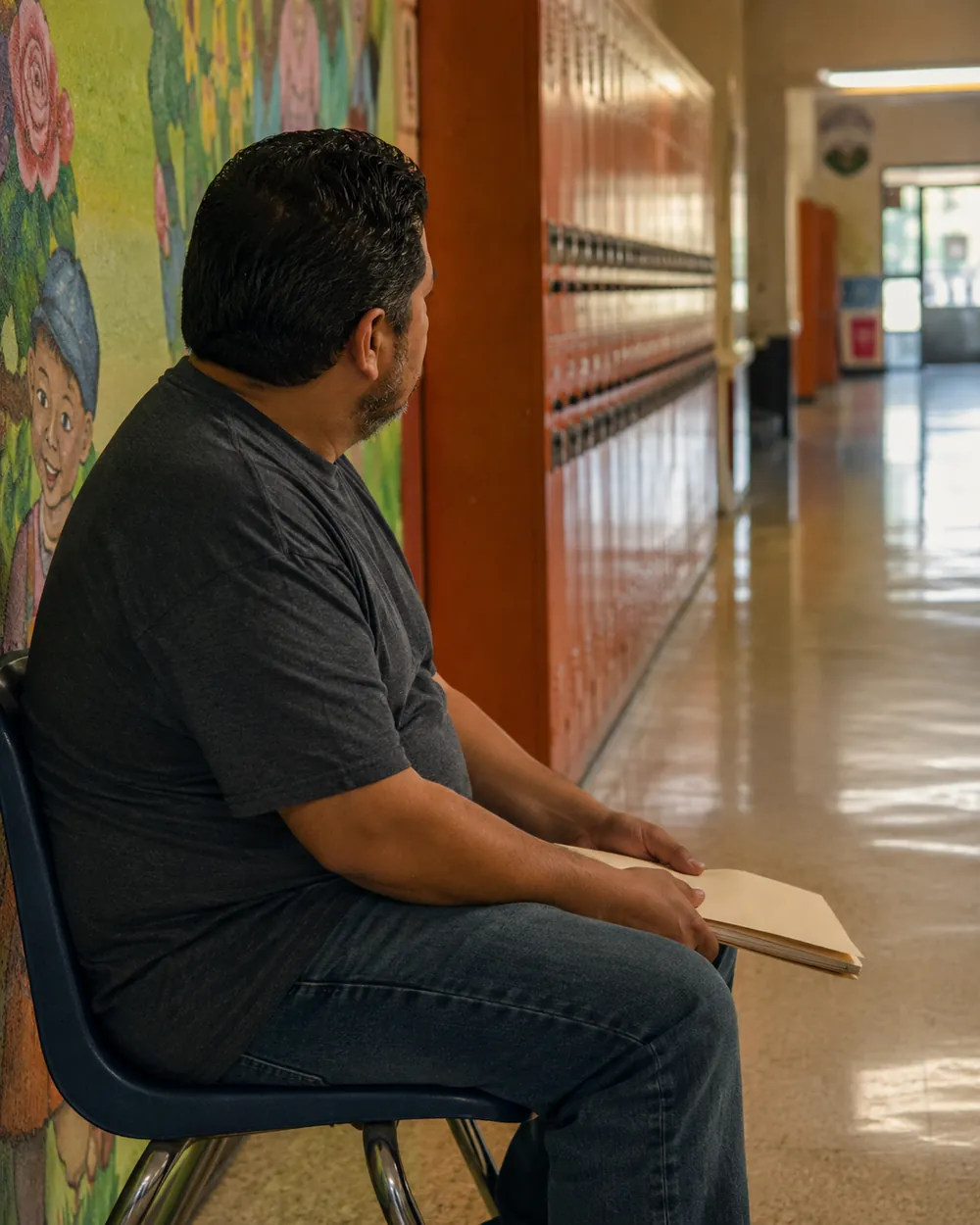
You’re wedged into a chair built for a seven-year-old, and the teacher opens with “She’s a delight.” You smile. Two of your fifteen minutes are gone.
The next family is already waiting in the hall, and you haven’t asked the thing you came to ask.
A short slot needs a short list. Ask three good questions early, and leave with one thing written down.
What are the three questions worth asking at any age?
Start with the blunt one. “Where is my child right now, compared with where you’d expect a child to be at this point in the year?” The Harvard Family Research Project’s tip sheet for parents words it as “Is my child performing at grade level?”
Second, ask to see a piece of work that shows the answer. The same tip sheet says to ask for examples of your child’s work, and a page in your hand settles what a word like “fine” can’t.

Third, ask for one thing you can do at home before you next talk. Make it small enough for a school night, like ten minutes of reading aloud or a backpack checked on Sunday.
Everything else on your list waits behind these three.
How do I prepare for a parent teacher conference?
Plan for the short end. Understood’s conference guide says most conferences last only 10 or 15 minutes, and it suggests being ready about five minutes before your slot.
Bring the latest report card or progress report, plus two pieces of schoolwork. Pick one your child was proud of and one that made homework take an hour.
Many schools hold fall conferences in October or November, so the teacher may have known your child for only a couple of months. Tell them what worked last year. “She does better when she hears the plan for the day before it starts” gives them a head start.
Write your questions on one index card, in order of how much they matter. Add a line about what your child is like at home, and any big change in your family or living situation.
Then ask your child if there’s anything you should bring up, and mention that every family gets a conference, so it doesn’t sound like trouble. If you get a shrug, try these questions for a child who won’t talk about school. If the answer is “My teacher is mean,” write down the exact words and read what to do first before you go.
Which questions change from preschool to high school?
The three stay the same. The follow-ups change with the age.
- Toddler and preschool (ages 2 to 5). Ask how drop-off goes once you’ve left and how long the tears last, because only the teacher sees that part. Ask which words, or which pointing, your child uses to get what they need.
- Kindergarten to fifth grade (ages 5 to 11). Ask for a writing sample from September to set beside one from this week. If the teacher gives a reading level, ask which scale it comes from and where “on track” sits, since a letter means little until you know the alphabet it belongs to.
- Middle school and high school (ages 11 to 18). With five or six teachers, pick the two classes where the grade worries you most and start there. Ask how the grade is worked out, which single assignment could move it most, and where you can see missing work. Ask if your teen can join you, so they hear the plan first-hand.
What if the teacher describes a child I do not recognize?
You hear “calm, polite, no concerns,” and you picture last night’s forty minutes on the bathroom floor. Both can be true. Plenty of children hold it together all day and fall apart at home, and the gap says nothing bad about you.
Bring one scene instead of a label like “she’s anxious.” Say, “The first twenty minutes after school, she can’t answer a single question.” The Harvard tip sheet calls the meeting “a time for the teacher to learn about what your child is like at home.”
Then ask for a second pair of eyes. “Could you watch for that after lunch and after recess, and email me what you see?” Thank them for the calm day, too, because it is real.
Should we both go if we are separated?
You can each book a slot or share one, and the answer usually depends on how the last week of texting went. Our guide to keeping school on track across two homes covers getting the office to list both of you, so start there.
On paper, both of you can usually ask for the same school records. The U.S. Department of Education says the federal privacy law FERPA gives custodial and noncustodial parents alike certain rights to their child’s education records. That changes only if the school has evidence of a court order, a state law or another legally binding document about divorce, separation or custody that says otherwise. If you have an order like that, the school office can tell you what it has on file.
Ask the teacher to send any follow-up to both email addresses, so neither of you becomes the messenger. If you go alone, photograph your notes and send them that night. If you go together, one of you asks and the other writes.
When is one meeting not enough?
When the same worry is still there at the next check-in, or the teacher says “let’s watch it” and gives no date. Ask, “Watch it for how long, and what will we be looking at?” Understood suggests asking “How can we keep talking about this?” and offers an example, weekly feedback for a month, maybe a quick email on Fridays.
Book the next meeting before you leave the room. The Harvard tip sheet asks parents to schedule at least one more time to talk in the next few months.
If a worry has lasted a couple of months, even after changes at home and at school, you can ask the school to consider an evaluation. Put the request in an email so it carries a date. Our IEP vs. 504 comparison and its plain-English companion explain what each plan is for and how the school decides.
Write two lines before you stand up
On the same card, write one thing the teacher will do and one thing you will do, each with a date. Photograph it before you forget. In the car, tell your child one good thing you heard first, and the plan second.
Leave the first comment
Share your thoughts
Frequently asked questions
Ask where your child stands compared with what is expected, ask to see a sample of their work, and ask for one thing to try at home. Lead with your biggest worry, because a conference can be over in 10 minutes, and write down what you and the teacher each agree to do.
Ask which letters, sounds and numbers your child knows now, and which ones come next. Ask how they handle circle time and switching between activities, and what the teacher does when they get upset. A name written in September beside one from this week shows growth better than any label.
Ask how the day runs, who your child plays beside, and what happens when another child grabs a toy. Ask how meals, naps and bathroom trips are going, and which words or gestures they use to ask for help. Teachers watch these moments every day, and you rarely get to.
Ask how the final grade is worked out, which assignments carry the most weight, and where you can check for missing work. Ask what your teen does in class when they get stuck, and whether they can come to the next meeting so the plan reaches them first-hand.
Yes. The Harvard Family Research Project’s tip sheet for parents runs two pages and includes a checklist for before the conference. You don’t need a form, though. One index card with your top three questions, in order, plus room to write down who will do what, is enough for a short slot.
Which book changed something at home - and which did you put back?
No right answers here - tell us how it went. Someone reading needs to hear it.
Join the conversation