
Five Forty in the Morning and She Is Standing Next to Your Bed

Not crying. Just there, breathing near your face, fully ready for the day.
An okay-to-wake clock fixes one specific version of this. It gives a child who cannot read a clock a signal they can read: the light is yellow, so stay in bed, the light is green, so come and get me. It does nothing for night waking, and nothing for a child who genuinely is not tired anymore. What it does is settle the argument about whether it is morning yet, and for a lot of houses that alone is worth it.
One thing to get straight before you spend anything. A clock is not a sleep fix, and it is not supposed to be. If your child is short on sleep, that is a different problem: the AAP supports the sleep guidelines set by the American Academy of Sleep Medicine, and a clock does not move those numbers. It moves what happens in the twenty minutes after they wake. Start with why they are waking at all if that part is unresolved.
- 1
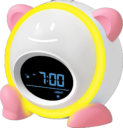 OK to Wake Clock for KidsThe default, and the most proven
 - 2
 ANALOI Cat ClockSame idea, friendlier face
 - 3
 iHoo Sleep Training ClockCheapest way to test the idea
 - 4
 Honesorn 10-Colour ClockIf the room needs a night light too
 - 5
 Yiliaw Pear ClockSoft light, small footprint
 - 6
 Sun & Moon ClockA picture instead of a color
 - 7
 Dreamegg Sunrise ClockLight that comes up slowly, plus white noise
 - 8
 ANALOI with Sleep SoundsFor a light sleeper in a noisy house
 - 9
 Voice Reminder ClockSays the next step out loud
 - 10
 MASHI Dinosaur ClockFor an older one who wants a real clock
Band one
The ones that do one job and do it clearly
Start here. A two-color clock has one thing to understand, and a three year old can learn it in about four days.
What matters is how obvious the change is from across a dark room. Some of the fancier models glow so gently that a half-asleep child cannot tell yellow from green, which defeats the entire point.
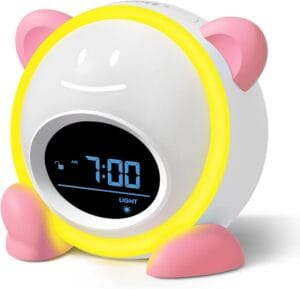
OK to Wake Clock for Kids, Sleep Training Clock with Night Light and Sound Machine, Kids A
As an Amazon Associate, Decoded Kids earns from qualifying purchases. Price checked live on Amazon.
The one most people end up with, and the reviews back it up. Two colors, a clear face, no app. If you want the long version of how these work night to night, our review of the Mella goes through a full week with one.
Same mechanism in a cat. Worth the swap if your child is the sort who will accept a rule more easily from an animal than from a rectangle, which is more of them than you would think.
The cheap way to find out whether your child responds to this at all. If it works, you can upgrade. If it does not, you have lost very little.
Band two
If the room needs a night light anyway
Buying one object instead of two is the obvious move if the room is dark and they mind. The risk is a clock so bright all night that the color signal disappears into it.
So check the dimmest setting, not the brightest. A night light you cannot turn down is a worse night light, and it makes the morning color meaningless.
If the dark itself is the problem rather than the timing, a dedicated lamp is usually better than a clock pretending to be one. We went through those separately in the night light guide.
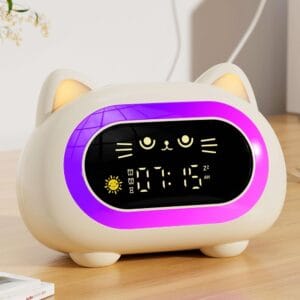
Honesorn Kids Alarm Clock Toddler Sleep Training Clock with 10 Night Lights
Ten colors sounds like a gimmick and mostly is. The useful part is the range of brightness, which lets you keep a low glow overnight and still have the green read as a change.
Small, soft, and it does not dominate a shelf. Good for a shared room where one child needs the light and the other does not.
A sun and a moon instead of two colors. Easier for a child who is still working out color names, and it survives being explained by a grandparent.
Band three
For the one who wakes at five whatever the clock says
A color change does not create sleep. If your child is genuinely done at five, the clock buys you the difference between five and six, and not much more.
These two try to do something about the waking itself. A slow sunrise nudges the body clock rather than announcing a deadline, and steady sound covers the garbage truck.
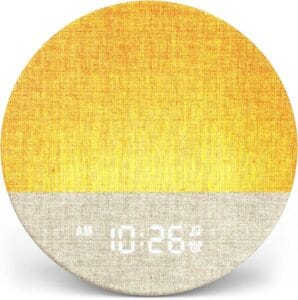
Dreamegg Sunrise Alarm Clock, Natural Wake up Light, White Noise Machine
The light comes up over several minutes instead of switching. That gradual version works better on an early riser, because there is no single moment to react to.
Sleep sounds built in. Useful in an apartment, or in a house where somebody leaves for work at 5:30 and the front door is audible from the crib.
Band four
For an older one who needs the routine, not the light
Around six or seven the color stops meaning much. What a child that age struggles with is the order of things, not whether it is morning.
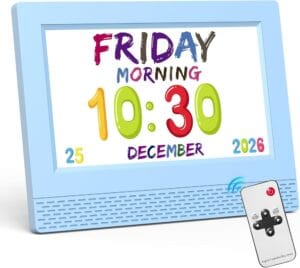
Kids Digital Alarm Clock with Voice Scene Reminders, 7 Eye-Caring Display
It says the next step out loud at set times. That takes your voice out of the morning, which is worth a lot if the nagging has become the routine. A visual timer does a related job for the getting-ready part.
Reads as a proper clock rather than a toy, which matters to a seven year old who has noticed the cat one is babyish.
When it stops working after a month
This is the bit nobody mentions in the reviews. It works beautifully for three weeks, and then one morning she is next to your bed again at five forty.
Usually the novelty has gone. Green stopped being interesting, so it stopped being a rule. The repair is to give the green light a job instead of making it permission. A small tray of quiet things she is allowed to do only after it turns, kept on her shelf and swapped every week or so.
Check the time itself too. Bedtime drifts later over a month without anyone deciding it, and a green light at six thirty asks much more of a child who now falls asleep at eight than it did when she was asleep by seven.
And if she is coming in because something woke her rather than because she is done, the clock was never the right tool. That is a different evening and a different fix.
What we would skip
Anything that needs an app to set the time. You are putting a phone between you and a bedroom light. The battery dies, the app updates, the pairing drops, and now the clock is broken in a way you cannot fix at bedtime. Buttons on the back are better here.
Clocks with under about fifty reviews. There are dozens of near-identical ones and the failure mode is always the same: it works for six weeks, then the color sticks. A thin review count tells you nothing about month three.
Buying one for a child under two. They cannot hold the rule yet, so it becomes a light to press. Spend the money on the room and the routine, and come back to this at two and a half.
The part that decides whether it works
Set the green time to the hour they already wake, then move it later by ten minutes every few days. Setting it to seven when they wake at five thirty teaches them the clock is a liar.
And expect the clocks to go back in fall to undo a chunk of your progress. That is normal, and the hour change has its own approach.
If your question is a bit different
Leave the first comment
Share your thoughts
Frequently asked questions
Most children can hold the rule from around two and a half, and it lands more reliably at three. Under two the light tends to become something to press rather than a signal. If your child cannot yet follow a simple two-step instruction, wait a few months.
No. It changes what happens after they wake, not when. A child who is genuinely finished sleeping at five will still be awake at five, but the clock gives them a rule for staying in the room. If the early waking itself is the problem, look at bedtime and light in the room first.
Usually three to seven days if you set the green time to when they already wake, then move it later in small steps. Setting it an hour beyond their real wake time on day one is the most common reason it fails, because the rule stops matching anything they experience.

I'm for the parent standing in the bookshop, overwhelmed. I read them all - the wise, the smug, the single good idea stretched to 240 pages - so your nightstand stack stays short. I'll point you to what's truly worth it, and kindly, what to put back.
More from MeiWhich tool earned its place - and which was a waste of money?
No right answers here - tell us how it went. Someone reading needs to hear it.
Join the conversation