
Best Visual Timers for Kids: The Ones We’d Buy

“Five more minutes” lands on some kids like a sentence in a language they never learned. You say it, they nod, the screen goes off, and the floor falls out, because five minutes was never a real thing to them. It had no shape. It didn’t shrink, or creep toward zero, or warn them it was nearly gone.
That is the whole reason a visual timer earns a spot on the desk. Not because it makes a child faster, but because it turns the minutes into something they can watch from across the room without you saying a single word.
We have kept a small pile of these going on the kitchen table for a while, the genuinely good ones next to the two that quietly died after a month. That is the same test we run on our list of Christmas gifts for kids: what is still in use by March. Here is what is worth your money, sorted by the kid you are buying it for.
A timer doesn’t make time go faster. It just stops time from being invisible.
What a visual timer does (and what it can’t)

The job is simple. A block of time disappears in front of your child: a red wedge shrinks, a colored disk empties, a bar slides down to nothing. For a kid who genuinely cannot feel ten minutes pass, that is the gap between a vague nag and a finish line they can see coming. The psychologist Russell Barkley calls this “time blindness,” the real, measurable trouble some kids (especially with ADHD) have sensing how long anything takes.
What it will not do is make your child want to start. It lowers the cost of beginning and softens the shock of stopping, and honestly that is plenty. It is not a behavior cure. Keep that somewhere in your head before a single star rating talks you into anything.
The picks, by the kid you’re buying for
Star ratings below are the current Amazon averages, not ours. We grouped them by the problem you are solving, because the best timer for a noise-sensitive seven-year-old is not the one you want glowing on a toddler’s nightstand.
Start with the one we reach for on an ordinary Tuesday, the timer that does the job so quietly you forget it was ever a decision.
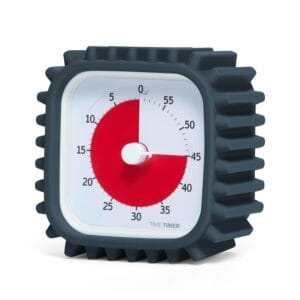
Time Timer MOD
The MOD is the one we keep reaching for. The red disk shrinks as the minutes go, there is nothing to read, and the silicone case has survived more desk-dives than I want to admit. It also costs a good bit more than everything else here, which is exactly why we put it through its own honest review. Short version, it is worth it as a daily driver and overkill if you only need a timer twice a week.
As an Amazon Associate, Decoded Kids earns from qualifying purchases. Price checked live on Amazon.
If the budget is tight, or the trouble spreads across two rooms at once, the sensible buy is not the fanciest one. It is the pair.
Two magnetic timers for less than the price of one MOD, with close to nineteen thousand ratings behind them. The big digits read easily across a room, and a second unit means the morning bathroom and the homework table each get their own. Not silent, so skip it if a beep sets your child off.
Some kids do not flinch at the task. They flinch at the beep. For a child who hears the whole room louder than everyone else, silence is not a nice-to-have, it is the entire feature.
If the ticking or the final beep is the thing that derails your child, this is the one. The disk empties quietly and there is no alarm to brace for, which matters more than you would think for a kid who hears the room louder than everyone else. Lighter build, so treat it as a desk timer, not a throw-it-in-the-bag one.
When the battle is bedtime rather than homework, you want the timer to double as the thing that stays glowing softly after the countdown is done.
The soft glow is what makes this one earn its keep at night. You set the wind-down on the same object that then sits there as a gentle nightlight, so bedtime stops being a thing you narrate minute by minute. The light is the real selling point, the timer itself is ordinary, and that is fine.
And for the older kid grinding through real study blocks, the small stuff starts to matter: more range, and a charge that lasts the week.
For an older kid doing longer study blocks, the count-up mode and the 99-minute range give you more room, and USB-C charging means you are not hunting for AA batteries on a Sunday night. It carries the lowest rating of the bunch, mostly over charging quirks, so it is the one to read the recent reviews on.
The five, side by side
Same job, five ways in. Ratings are current Amazon averages.
How to use one so it helps

Here is the part nobody prints on the box. The timer works when it belongs to your child, not when it becomes one more thing you point at. Set it stupidly short at first, five minutes, just so the win lands fast and the object earns some trust. Let your child press start. Then, the hard part, stop talking about it. The whole point is that they watch it instead of hearing you.
Pair it with one task, never a whole evening. “Until the red is gone we do spelling, then we stop” beats “do your homework” by a mile, because one of those has an edge your child can actually see.
Set it short, let them start it, then go quiet. The timer is for them to watch, not for you to point at.
So which one?

If you want the one we would buy again without thinking, it is the MOD, and the review lays out exactly when that price is and isn’t justified. Money tight, or two trouble-spots in the house? The classroom two-pack is the easy call. Noise-sensitive kid, the silent LIORQUE. Bedtime battles, the night-light. Older kid grinding through longer blocks, the rechargeable. None of them are magic, and any of them beats one more “five more minutes” that means nothing to a child who cannot see it.
A timer is one small piece of a much bigger picture, and it works best beside a calm, predictable routine rather than instead of one. If the trouble shows up most at the homework table, that knot is worth its own read.
Frequently asked questions
They help a lot of kids, as scaffolding rather than a cure. Many children with ADHD have what Russell Barkley calls time blindness, a genuine difficulty sensing how long things take, and watching a disk or bar shrink makes those minutes visible. It lowers the friction of starting and stopping. It will not, on its own, make a child want to do the task.
For a toddler or preschooler, the simplest glance-and-go disk wins, because there is nothing to read. A silent one suits a child who flinches at beeps, and a night-light version is lovely for bedtime. Save the digital count-up models for older kids who can use the extra range.
For a noise-sensitive child, very much so. The ticking or the final alarm is often the exact thing that tips a sensitive kid over, so a timer that empties in silence removes the part that was causing the trouble. For most other kids a quiet beep is fine and you can save the money.
Around three or four for a simple shrinking-disk timer they only have to look at. Reading digital minutes and using count-up modes tends to land better from about seven. The trick at any age is to keep the first sessions short so the timer feels like a win, not a deadline.
Leave the first comment
Share your thoughts

I'm for the parent standing in the bookshop, overwhelmed. I read them all - the wise, the smug, the single good idea stretched to 240 pages - so your nightstand stack stays short. I'll point you to what's truly worth it, and kindly, what to put back.
More from MeiWhich tool earned its place - and which was a waste of money?
No right answers here - tell us how it went. Someone reading needs to hear it.
Join the conversation