
The Homework Tools That Help Kids Focus

It’s the worksheet that does it. Twenty minutes of math that should take eight, a pencil that’s somehow turned into a drumstick, and your kid sliding halfway under the table swearing they’re “almost done” when they haven’t started a single sum. You’re not being soft and they’re not being lazy. Homework just asks for the three things a distractible brain hands out last: starting, sitting still, and keeping track of time. So you nag, they melt, and the math is still there at the bottom of the bag at 8pm.
Here’s what finally took some heat out of our kitchen table: a child who can’t focus on homework usually isn’t refusing the work. They genuinely can’t feel the minutes passing, can’t hold the run of steps in their head, and can’t quiet a body that badly wants to move. None of that bends to “just concentrate.” What helps is making the invisible parts visible, and a few plain, well-chosen tools do that far better than another reminder from the doorway.
Why can’t my child focus on homework?
Mostly it comes down to time-blindness and a working memory that’s already running hot. A lot of kids here can’t sense how long “ten minutes” is, so a worksheet feels endless, and an endless task is one nobody wants to begin. Meanwhile the brain is juggling the instructions, the next step, and the urge to fidget all in the same moment, and one of those nearly always drops. Understood bundles all of that under executive function, and homework leans on every piece of it at the worst hour of the day, when the tank is already empty.
It’s why the same kid who’ll build an elaborate fort for two hours falls apart over four spelling words. The interest isn’t the problem; the scaffolding is. (Ours reliably unraveled at 4:30, like a switch flipped. Took me an embarrassingly long time to stop reading it as defiance.) Groups like CHADD land in the same place: prop up the executive skills first, and the cooperation tends to follow.
The homework tools that earn their place
You don’t need a desk full of gadgets, and nothing here buys focus on its own. What these do is lift a job off the overloaded part of the brain, turning time and tasks into something your child can see and hold. Three or four is plenty. Star ratings below are the current Amazon averages.
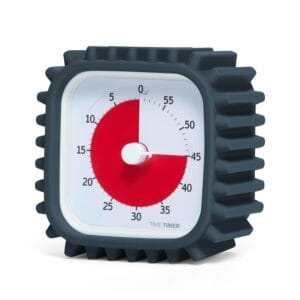
A kid who can’t feel ten minutes pass can watch the red wedge shrink, and suddenly the end of the task is in sight instead of imaginary. We start ours on a stupidly short setting (five minutes, just to begin) because starting is the part that actually hurts. As an Amazon Associate, Decoded Kids earns from qualifying purchases. Price checked live on Amazon.Time Timer MOD
Occupational therapists reach for these because steady pressure quietly tells a busy nervous system it’s safe to slow down. For plenty of kids it’s the difference between three restarts and one calm sit.
Half the battle isn’t doing the work, it’s holding the order of it. Sliding one finished step across and seeing the single next one gives a stuck brain a handhold instead of a wall.
Not as sturdy as the original and the dial’s a touch fiddly, but it does the one job that matters: it makes time visible. A fine way to test whether a timer even helps your kid before you spend more.
The four, side by side
Same goal, four ways in. Ratings are current Amazon averages.

Somewhere in the middle of every homework session the body wins for a minute, and that’s allowed. A child who’s been holding still and holding focus has spent more than we tend to credit, so a short, planned reset usually buys back the next ten minutes. A lap of the yard, a drink of water, two minutes upside-down on the sofa. It looks like avoidance; it’s closer to a pit stop.
How do I get my child to use them?
Let them run it. The kid who sets the timer, slides the tile, or pulls on the vest is doing the task with you instead of being managed by you, and that small bit of ownership is most of the battle. Keep it boring and identical each night (same corner, same order) because predictable is the opposite of overwhelming. And praise the start, loudly: “you sat down and began” is the hard part, far more than finishing. A calm visual routine earlier in the day makes the homework version land easier, too.
When homework help isn’t enough
Tools take the edge off most homework battles, but they aren’t a diagnosis. If it’s a fight every single night for months, if your child melts the moment a book opens, or if the gap between their effort and the result keeps widening, it’s worth a quiet word with the teacher and a look at whether something underneath is making the work genuinely hard. That can be the same current running through why some kids with ADHD struggle at school, and asking early is the same instinct that has you sitting beside them at the table in the first place.
Anyway, tonight, keep it small. One timer, one step in view, one “you started, that’s the worst bit done.” That’s usually enough to take the fight out of the table and get everyone to the bottom of the page.
Frequently asked questions
They can help a lot: as scaffolding, not magic. Visual timers, deep-pressure input and step-by-step boards work by making time and tasks visible and by settling a restless body, which is exactly what a distractible brain struggles to do alone. They work best alongside a calm, predictable routine, never as a reward or a punishment.
For most kids a visual timer like the Time Timer is the single highest-impact pick, because time-blindness is usually the core problem: seeing the minutes shrink makes an “endless” task feel finite. If your child can’t sit still at all, add deep-pressure input like a weighted vest; if starting is the wall, a visible task board helps most.
Shorter than you’d think, and in chunks. A common guide is about 10 minutes per grade level, but for a child who can’t sustain focus it’s better to work in short timed bursts with real breaks than to push for one long sitting. If homework regularly runs far past that, tell the teacher. The amount may be too much.
Drop the volume and the pressure first: one tool, one tiny step, lots of praise for starting. If it’s still a nightly battle for weeks, loop in the teacher and consider whether a learning difference or anxiety is underneath it. Tools help a focus problem; they can’t fix work that’s the wrong level or a child who’s quietly overwhelmed.
Leave the first comment
Share your thoughts

I'm for the parent about to spend money they're not sure about. I buy the gadget, live with it, and give you the honest verdict - including the 'don't'. I've burned through enough hype to save you the cash, and when something truly earns its place, I'll show you exactly why.
More from TylerWhich tool earned its place - and which was a waste of money?
No right answers here - tell us how it went. Someone reading needs to hear it.
Join the conversation