
The Reading Signs That Show Up Years Before Anyone Says Dyslexia
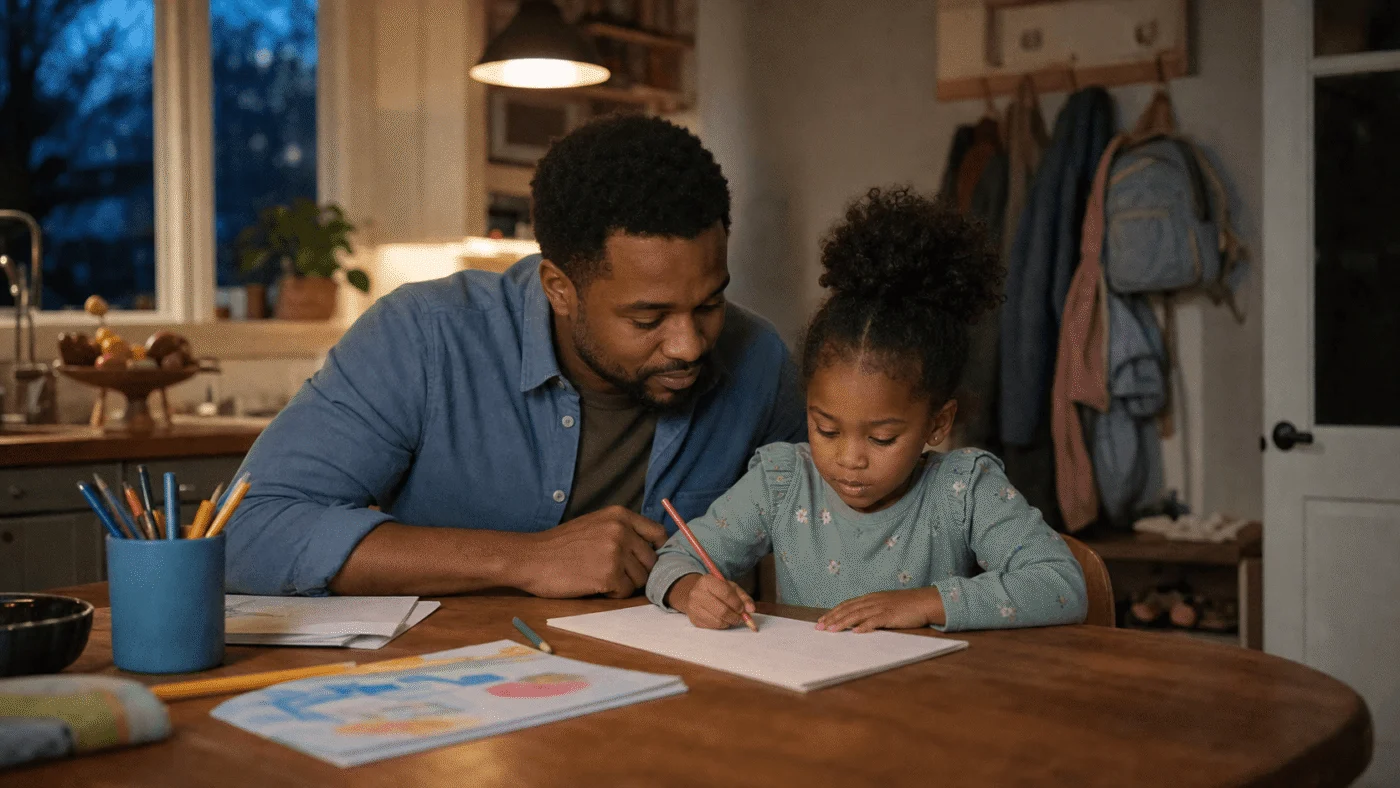
You watched them write their name again tonight, and the b was facing the wrong way again, and now it is quarter past eleven and you are on your third search of the evening.
Every list you found put the backwards letters at the top.
Here is the thing nobody tells you at eleven at night. That sign is the least useful one on the whole page.
The sign everyone leads with is the one that is not a sign
Reversed letters feel like proof because they are so visible. You can hold the paper. You can see the d where the b should be.
But almost every child does this while their hand and their memory are still learning what a letter is. It often fades as children become more familiar with print. Plenty of children who flip letters read perfectly well, and plenty of children who never flip a single one turn out to be dyslexic.
The reason the myth sticks is that it makes dyslexia sound like an eye thing, a mix-up between the page and the brain. That picture is wrong, and it sends parents to the wrong appointment. The book we reviewed on working out who assesses what spends a whole chapter on that particular wrong turn.
What the early signs really look like

Because reading is built on speech, the clues turn up before school does.
In the preschool years, the things worth noticing are all about sound. A child who cannot get the hang of nursery rhymes. A child who does not hear that cat, bat and rat belong together, even after you have said them slowly six times. Trouble learning and holding on to the names of letters. Words that stay mispronounced longer than you would expect, with baby talk that lingers.
Then there is the one that people skip past because it feels like blame. A family history of trouble with reading or spelling. If you, another parent, or an aunt found school miserable in exactly this way, that belongs on the list. It is an important clue.
Once school starts, the picture sharpens. A child who cannot sound out cat, map or nap. A child who does not connect the letter b with the sound it makes. And reading mistakes with no link at all to the letters on the page. They say pony when the word is horse, because they are guessing from the picture.
None of these is a verdict on its own. Children arrive at all of this at wildly different speeds. A slow start is very often just a slow start.
The gap that actually gives it away
If you take one thing from this page, take this one.
It is not any single sign. It is a mismatch.
The child who cannot sound out a three letter word is often the same child with a huge vocabulary. They follow a long story read out loud without missing a beat. They ask questions about it afterwards that you have to think about. Sharp reasoning. Real curiosity. Then you hand them a page and everything stalls.
That distance is the thing to watch. What they can do out loud, against what they can do on paper.
It is also why so many of these kids get called lazy. They get told they are not trying, for years, before anyone tests a thing. The effort was never missing. Nobody could see where it was going.
Some of them get very good at hiding the gap. That is its own kind of tired, and holding it together like that has a cost. It usually lands at home, not in the classroom.
Dyslexia is one reason a child stalls on the page. It is not the only one, and it is worth working out which part of reading is stuck before you name it.
When to actually get it looked at
Sooner than most people think, and you do not have to wait for a school to suggest it.
Because the early clues live in speech and sound, a child can be looked at well before they are expected to read fluently. If the preschool signs are stacking up, especially alongside family history, that is enough of a reason to ask. You are not asking anyone to label a four year old. You are asking someone to look properly.
Who to ask depends on where you are and what you are seeing. That is its own small maze. Your child’s school can start the process too. If you are in the U.S., our plain-English IEP and 504 guide explains how school support requests work and what each plan can cover. Attention trouble is often tangled up in this as well, and the reasons kids stall at school overlap more than most checklists admit.
One honest note. The people who define this changed their own wording recently. The International Dyslexia Association updated its definition in 2025. The current wording explicitly notes that early oral-language weaknesses can foreshadow later literacy challenges. Many articles still quote the older 2002 version. So if you read something that frames dyslexia mainly as a problem that shows up once reading starts, it is not wrong exactly. It is just a step behind where the field has moved.
Tonight, just watch the rhymes
You do not need to do anything with all this before morning.
Read something with a bouncy rhyme in it and notice whether they can finish the line. Notice whether they can tell you what rhymes with cake. That is not a test and it proves nothing on its own. It is just a gentler thing to pay attention to than a backwards b, and it is pointed at the part that matters. If it helps to see how ordinary slow reading starts are, the numbers on children’s reading say a lot.
Sources
The claims here come from the two organisations that set the standard on this, linked so you can read them yourself. Last verified 26 July 2026.
- Yale Center for Dyslexia & Creativity: Dyslexia FAQ (the sound-not-vision point, letter reversals, prevalence)
- Yale Center for Dyslexia & Creativity: Signs of Dyslexia (the preschool and early school signs, and the strengths that sit alongside them)
- International Dyslexia Association: Definition of Dyslexia (the revised definition adopted October 2025)
Frequently asked questions
Usually not. Most young children reverse letters while learning to write, whether or not they have dyslexia, and it often fades as they become more familiar with print. Most children with dyslexia do not reverse letters at all. It is a writing stage far more often than it is a warning sign.
At that age the clues are about sound rather than letters. Trouble learning nursery rhymes, not hearing that cat and bat rhyme, difficulty learning letter names, and words that stay mispronounced. A family history of reading or spelling trouble matters too and is an important signal.
The mismatch is useful information. Children with dyslexia may have strong speech, a wide vocabulary, and excellent understanding of stories read aloud, then stall on a simple written word. A struggle that shows up mainly on the page may point to a reading-specific difficulty rather than a lack of effort.
Earlier than most people expect. Because the first clues sit in spoken language, a child can be assessed before they are expected to read fluently. If preschool signs are stacking up, especially with family history, that is reason enough to ask rather than waiting to see how the next school year goes.
It can be either, and it is often both, which is why a proper assessment matters more than a checklist. Roughly speaking, dyslexia shows up as trouble matching sounds to letters, while attention difficulties show up across many tasks, not only reading. Only an evaluation can separate them reliably.

I'm for the parent doing it largely alone. I've done the single-dad decade - two homes, one income, the handovers, the very quiet Tuesdays - and I write from the far side of most of those days, with humour and hard-won calm. Not advice from above; a hand back from a few steps up the road.
More from DiegoWhat's the one thing that actually calmed the chaos in your house?
No right answers here - tell us how it actually went. Someone reading needs to hear it.
Join the conversation