
9 Things That Get Bedtime Back Before Term Starts

Somewhere in July, bedtime quietly moved. Light evenings, no school in the morning, one more chapter. By August you are an hour late and nobody minds.
Then term starts and that hour has to come back in a single night, which is the week everyone remembers as the hard one. It does not have to be. Bodies shift about fifteen minutes at a time, so two weeks of small moves does what one brutal night cannot.
Nine things below, in the order they matter: the room, the wind-down, and the rule that ends the negotiation.
Ratings are live Amazon ratings, never ours.
- 1
 White noise machineBest first change for a noisy house
 - 2
 Sound machine with 20 soundsBest for a child who wants to choose
 - 3
 Dimmable night lightBest for the dark being the problem
 - 4
 Weighted blanketBest for a body that will not settle
 - 5
 Kids weighted blanketBest lighter option for a smaller child
 - 6
 Star projectorBest for giving them something to look at
 - 7
 Kids alarm clockBest for handing the morning over
 - 8
 Ok-to-wake owl clockBest for an early riser who cannot tell time
 - 9
 Precious Little SleepBest if you want the reasoning, not a gadget
Part one
The room does half the work
Before you change anything about bedtime itself, change the room. It is the cheapest fix and the one that keeps working when you are too tired to be consistent.
Sound comes first. A steady hum covers the television downstairs, the sibling on the landing and the car doors outside, and it becomes a signal in itself after about a week.

Homedics SoundSleep White Noise Sound Machine
As an Amazon Associate, Decoded Kids earns from qualifying purchases. Price checked live on Amazon.
Keep the volume around the level of a shower running and put it across the room rather than by their head. Machines that switch off after an hour are less useful than they sound, because the street does not switch off with them.
Light is the second lever. Warm and dim is fine, bright and blue is not, and a lamp your child can control themselves takes one more argument off the table.
Part two
The wind-down for a body that will not stop

Some children lie down and stop. Others lie down and start, and the second kind is why this part exists.
Weight is the option most parents ask about. It helps some children settle and does very little for others, so treat it as a try rather than a fix. The rules are simple: no weighted blanket for a child under two, keep it to roughly a tenth of their body weight, and they have to be able to push it off themselves.

If your child runs warm, the cotton versions beat the plush ones by a distance. A child who kicks the blanket off at eleven has not rejected the idea, they are just too hot.
A projector is not a sleep aid, it is a place to put their eyes. That is worth something for a child whose head starts working the moment the light goes off, as long as it goes off too. We looked at what else earns its place in the sleep tools that stay on the nightstand.
Part three
The rule that ends the negotiation
Every extra request at bedtime is a small negotiation, and you will lose most of them at nine in the evening.
A clock takes your voice out of it. The rule stops being your decision and becomes a thing on the shelf, and children argue with a thing far less than they argue with you.
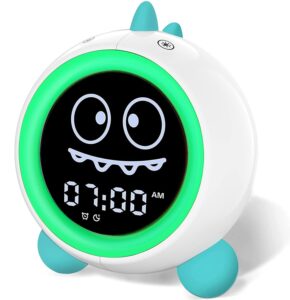
For a child who cannot read a clock face yet, color does the same job. Green means come and find me, and it works because it is the same every morning, including on weekends, which is the part most families give up on.
If you would rather understand the machinery than buy another object, one book covers most of it honestly, including where the research is thin.
The other half of this is the morning, and the two are the same problem seen from opposite ends. Our school morning kit covers the 7am hour, and if the clocks are about to change on top of all this, the fall-back reset uses the same fifteen minute method.
What we would skip
Melatonin bought off a shelf. It is a hormone, not a supplement, and dosing for children is genuinely unsettled. If bedtime is bad enough that you are considering it, that is a conversation with your child’s doctor and not a purchase.
Sleep trackers for children. They mostly measure movement, they are wrong often enough to worry you, and a parent watching a graph at midnight sleeps worse than one who is not.
The honest caveat: we have not tested every item here in our own homes. Ratings are live Amazon ratings. Picks are chosen on whether they make the same thing happen at the same time every night, and where we do not know something, we say so.
Two weeks, fifteen minutes at a time
None of this works in one night, and that is the actual advice.
Pick the new bedtime, count back two weeks, and move it fifteen minutes earlier every third night with the wake-up time moving too. Get outside in the morning light. Keep the last hour the same and boring. The objects on this list make that easier to hold, but the holding is the thing that works.
The rest of the school-term guides
Frequently asked questions
About two weeks is comfortable for most families. Move bedtime fifteen minutes earlier every second or third night and move the wake-up time with it, because the morning end is what actually resets the body clock. One week works if you are late, but expect a few rough evenings.
Not for children under two, and not for any child who cannot lift the blanket off themselves. Above that age the usual guidance is roughly ten per cent of body weight, never over the head, and it is worth checking with your doctor first if your child has any breathing or mobility condition.
It helps mainly by masking sudden noises that would otherwise wake a child between sleep cycles, which is most of its value in a busy house. Keep it at a moderate volume and across the room rather than beside the bed, and expect it to become a familiar cue within about a week.
Leave the first comment
Share your thoughts

I'm for the parent doing it largely alone. I've done the single-dad decade - two homes, one income, the handovers, the very quiet Tuesdays - and I write from the far side of most of those days, with humor and hard-won calm. Not advice from above; a hand back from a few steps up the road.
More from DiegoWhat's the one thing that calmed the chaos in your house?
No right answers here - tell us how it went. Someone reading needs to hear it.
Join the conversation