
Why Bedtime Suddenly Feels Scary for Your Child
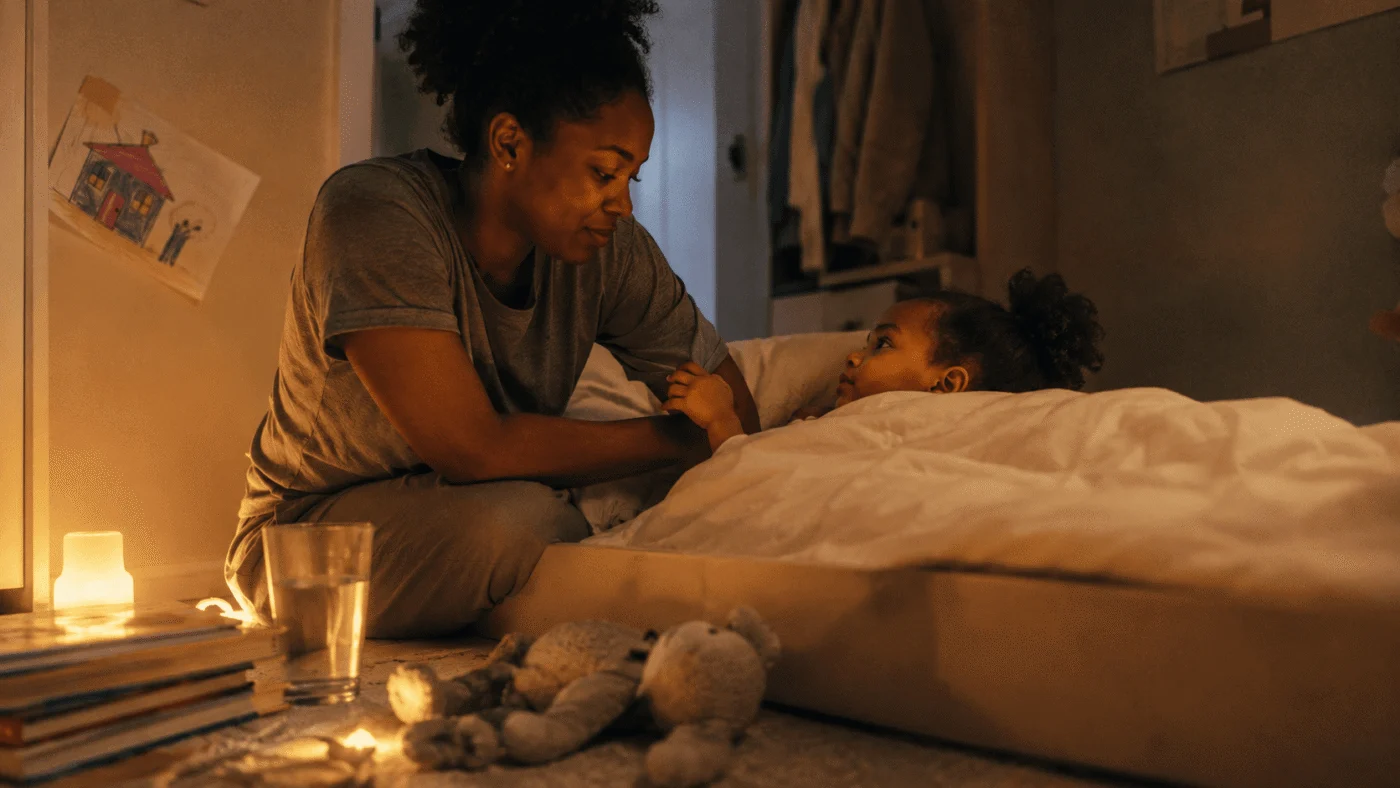
It’s the small voice that gets you. Lights off, story done, that second cup of water already gone. And then, right as your hand finds the door, don’t go. Maybe it’s the closet that looks wrong in the dark. Maybe it’s a noise the house has apparently never made until tonight. Either way your kid is wide awake and a little bit frightened, and now so are you, because you genuinely have to sleep at some point before morning.
The thing that finally took the dread out of 8pm for me: a child afraid of the dark at bedtime is about the most ordinary thing a kid can do. Roughly two in every three children go through a stretch of nighttime fear at some point: the dark, a shadow, the idea of being the only one awake in the house. So if it feels like your once-easy sleeper got swapped overnight, you’re not doing anything wrong, and this isn’t one of the usual reasons sleep falls apart either. The way back is mostly about your child borrowing your calm at night until they grow enough of their own.
Why is my child suddenly afraid of the dark?
Fear tends to arrive right as the imagination does. Somewhere around three or four, a child gets old enough to picture something that isn’t there, which is wonderful for stories and terrible for 9pm. The same brain that builds a dragon out of a bathrobe can’t quite switch that off when the light goes out.
Summer makes it sneakier, too. The evenings are bright now, so bedtime arrives while the sky still looks like playtime, and then the room has to go suddenly, completely dark. A low, warm night light for a child afraid of the dark softens that switch. That jolt (loud day, black room) is enough to unsettle a kid who was fine in winter. (Mine always got worse in June. Took me two years to connect it.)
What your child is asking for
Here’s what helped me stop arguing with the fear: your child isn’t trying to win a debate about whether monsters exist. They already half-know the closet is just a closet. What they’re asking, in the only language they’ve got at 8pm, is am I safe, and are you near. That’s a primal question, and “there’s nothing there, go to sleep” doesn’t answer it.
So you answer the real one instead. You take the fear seriously without feeding it. The Child Mind Institute and the team at Cincinnati Children’s both land in the same place: name the worry, stay warm, and don’t move your child into your bed as the fix, because that quietly tells them their own room really was unsafe.
The fade, not the fight
The method most child psychologists reach for has a boring name, “fading”, and it works because it’s gentle. Instead of one big scary night alone, you shrink your presence a little at a time. Night one you sit on the edge of the bed. A few nights later, the chair. Then the chair by the door. Then the doorway, then the hall, with a quick “I’m right here” each time they check. Fading is one of several approaches, and the differences between them are set out clearly in the best sleep training books.
It’s slow. Some nights you’ll slide backward and that’s allowed. This is scaffolding, not a staircase, and scaffolding holds weight while something gets built. The praise matters more than it sounds: a big deal made of “you stayed in your own bed all night” does more than any lecture about being brave.
A few small things that genuinely help the room feel safer:
- A warm, dim light, amber or red, never bright white, so it soothes without blocking the sleepy hormone that gets them down.
- A security object they choose themselves, because the one they pick beats the one you buy every time.
- A 30-minute wind-down in the same boring order each night, because predictable is the opposite of frightening.
- A quick “worry drop” at dinner, not bedtime: five minutes to say the scared thing out loud while the sun’s still up.
Three things that make the dark less heavy
You don’t need a closet of gear. A couple of well-chosen comforts do real work, mostly because they give your child something to hold onto once you’ve left the room. Star ratings below are the current Amazon/Google averages.
A soft amber glow on its lowest useful setting tells a small brain “the room is fine” without lighting it up like noon. Skip anything blue-white. That’s the wavelength that keeps them wired. As an Amazon Associate, Decoded Kids earns from qualifying purchases. Price checked live on Amazon.Dimmable Amber Night-Light

The gentle weight gives the same settled feeling as a hand on the back. For a lot of anxious kids it becomes the thing they reach for instead of your bedroom door.
A story about a worried little dinosaur does something a lecture can’t. It lets your kid talk about his fear instead of their own. Sneaky, and it works.
The three, side by side
Same job, three ways in. Ratings are current Amazon and Google averages.
When it’s more than a phase
Most bedtime fear fades with a calm, repeated approach over a few weeks. Keep an eye out, though, if the worry shows up in the daytime too: clinginess at drop-off, tummy aches before school, a kid who can’t be in a room alone at noon. That can be the same unease behind when everything suddenly feels too big, and it’s worth a chat with your pediatrician or a child psychologist. Asking for help early isn’t failing at this. It’s the same instinct that has you standing in a dark hallway right now, whispering that you’re still here.
A soft, always-on glow helps some children more than a lamp you switch off. We looked at one that doubles as a wake-up cue in our LittleHippo Mella review.
If the room itself is the battle (bright summer evenings, the wrong light), a few sleep tools genuinely earn their keep, and doing all this solo with more than one is its own small art.
Tonight, keep it small. One light, one boring routine, one quiet “I’ll check on you in five.” That’s usually enough to start.
Frequently asked questions
Yes, extremely. Around two in three children go through a phase of nighttime fear, most often between ages 3 and 8, as their imagination outpaces their sense of what’s real. It usually settles with a calm, consistent response over a few weeks.
As a one-off on a rough night, fine. As the nightly fix, it tends to backfire. It quietly confirms that their own room wasn’t safe. Going to them with reassurance, and slowly fading your presence, builds more lasting confidence.
A dim, warm (amber or red) night-light helps anxious kids feel safe and won’t disrupt sleep. Bright or blue-white light is the problem. It suppresses melatonin and keeps them wired.
If the fear is intense, lasts more than a few weeks despite a calm routine, or shows up during the day too (separation anxiety, stomach aches, panic), check in with your pediatrician or a child mental-health professional.
Leave the first comment
Share your thoughts

I'm for the parent watching a feeling they can't name and wondering if it's normal. I've spent years close to the child-mental-health research and the specialists behind it, and I carry the heavy parts into plain language. I won't diagnose your child - I'll help you see what you're looking at, and say honestly when it's time to ask someone in person.
More from SofiaWhen did you last feel out of your depth - and what helped, even a little?
No right answers here - tell us how it went. Someone reading needs to hear it.
Join the conversation