
She Asked From the Back Seat How Christmas Works Now
You’re stopped at a red light when the question comes from the back seat, flat and casual, like she’s asking what’s for lunch. “So how does Christmas work now?”
The answer exists, technically. It sits in a custody order and on a shared calendar. Neither one tells her what she’s asking: where she wakes up, who is there, whether she opens presents twice, and if Santa knows the new address.
A calendar answers when. She wants to know what.
How does Christmas work when there are two houses?

For a child, it works when each house has a Christmas of its own. A copy is the same day at half volume: fewer presents, the same movie, and a kid who spends the afternoon counting what’s missing. A real one has something that couldn’t happen anywhere else.
Pick one thing per house and keep it small, like a two-foot tree on her dresser or pancakes in whatever shape she orders. Hang a stocking with her name on the wall from December 1. More ideas: Christmas traditions that cost nothing.
Then make the room say she lives here: the bed made the night before she arrives, and one of her drawings where she can see it from the pillow. Which days go where is a calendar question, and our guide to co-parenting Christmas schedules covers the common patterns.
Skip the “lucky you, two Christmases” speech. It sounds like a trade, and she never asked for a prize. She asked how it works, so tell her: this house on the 24th, that house on the 25th.
What do you say when she asks why Daddy isn’t here?
Answer the question she asked, and only that one. The American Academy of Pediatrics (AAP) has a guide to talking to children about divorce. It says most kids worry the split was their fault, and “few find the nerve to ask directly.”
Two sentences is plenty. The first says where Daddy is and when she sees him. The second says it isn’t her doing. Swap in Mommy if that fits. For a four-year-old: “Daddy’s at his house today. That’s not because of anything you did, and you’ll see him after three sleeps.” The AAP’s list of typical reactions to divorce includes preschoolers blaming themselves, so the second sentence isn’t optional.
For a seven-year-old, the same question can carry a bigger wish. School-age kids may hope the family will be back together, and December makes that wish loud. Try: “You wish we were all in one house. We’re not going to be, and you can wish it anyway.” With a twelve-year-old, say less: “You can miss him and still have a good day.”
If she asks whether he’s alone, give the true version. “He’s at Grandpa’s” works when it’s true. When you don’t know, say that: “I don’t know what he’s doing, but he’ll want to hear about your day.” Our books that explain divorce to kids can carry the rest.
How do you handle the handover on Christmas Day?

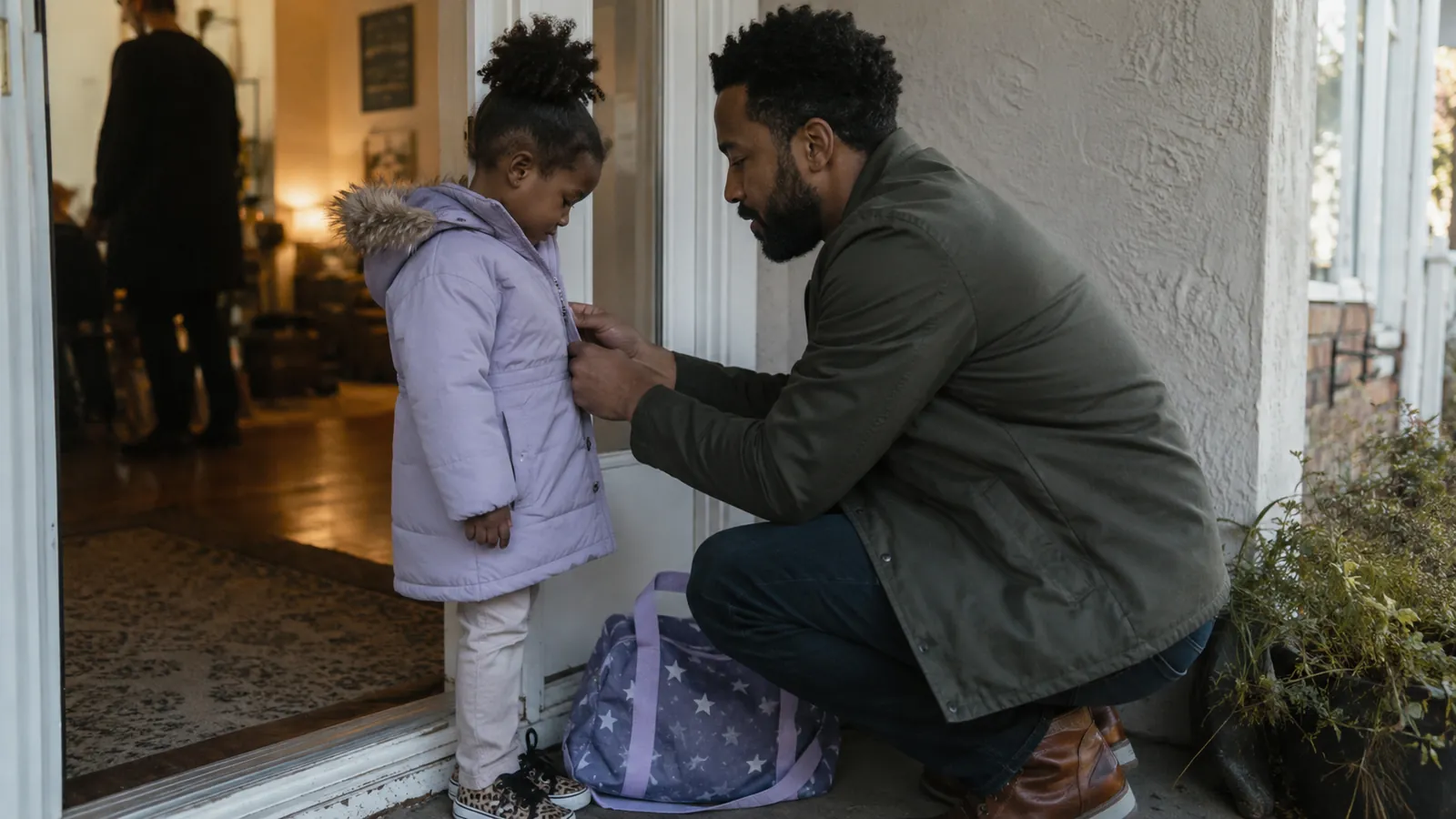
She reads two faces at the door, yours and theirs. What she’s checking is whether she’s allowed to enjoy the next few hours. The AAP says children “should be allowed to spend time with their other parent without feeling guilty,” so the door is where you say so out loud.
Keep it to three sentences and two minutes. To her: “Go have a great Christmas.” To the other parent, level and boring: “Bag’s by the door, bear’s in her hand.” Then say “See you Saturday at ten” to her, and walk away. Settle everything else by text the night before, so the doorstep has nothing left to argue about.
Send a present with her. In the Child Mind Institute’s guide to divorce and holidays, Alan Ravitz, MD, puts it this way: “Each of you should encourage and help them to buy a present or make a card for their other parent.” Wrap the gift at your house on the 22nd. A crayon card counts for a three-year-old. She hands it over herself, and for a minute she’s the one giving. Nobody is passing her along.
How does Santa work at two houses?
The kid logic is fair: one man, one night, two addresses. Yes, he comes to both. Settle it with the other parent in October, by text, in one sentence you’ll both say: “Santa visits whichever house you’re sleeping in on Christmas Eve.” If she’s away on the 24th, Santa leaves her stocking early with a note.
Use one roll of plain brown paper for Santa’s gifts at both houses, and write the tags in block letters. A second Santa handwriting is how the story comes apart at a school lunch table. If the other house won’t play along, do your half and leave theirs alone.
Keep Santa’s gifts the same size at both houses: a stocking and one small thing. The big presents come from Mom and from Dad, by name. That’s the rule in our guide to how many presents a child should get. A kid who gets a scooter from Santa at one place and socks at the other starts wondering what she did.
Let her put both addresses on her letter to Santa. When she asks plainly whether he’s real, that’s a different talk, covered in what to say when a child asks if Santa is real.
What happens after the first Christmas with divorced parents?
Whatever you did the first year becomes the rule. By year two, a child will say “that’s not how we do it” about a tradition you invented eleven months ago. That means she trusts the pattern.
The year the schedule flips is the one to watch. If she woke up at Mom’s last time, tell her in November that she wakes up at Dad’s this time, and let her carry one thing from last year’s morning, like her mug.
On New Year’s Day, ask two questions: what does she want again, and what would she change? Write the answers on next December’s calendar page. Ravitz says it’s easier on kids younger than 12 when the adults make the decisions, while teenagers are more capable of deciding for themselves.
Answer her questions in the same plain words every year. Most Christmas trouble in year two is ordinary adjustment, and what adjustment looks like in the first 90 days makes a useful yardstick.
Ask her to explain it to the bear
At bedtime this week, ask her to tell the bear how Christmas works this year. Don’t correct her. Whatever she leaves out is the question she hasn’t asked yet, so answer it tomorrow, in one sentence, at the same time of day.
Leave the first comment
Share your thoughts
Frequently asked questions
Many families follow the custody order and give the child two separate celebrations, on different days or in two blocks of the same day. It works for the child when she knows the plan early, has something special at each house, and sees a short, calm handover between them.
Keep adult conversations private and settle the plan by text beforehand. Say one warm sentence to your child at the door, one plain logistics sentence to the other parent, and leave. Never use her as the messenger, and never criticize the other parent where she can hear you.
Give two true sentences: where the other parent is, and when she will see them. Add that it isn’t her fault, since preschoolers in particular may blame themselves. Skip the details of why you split, unless your child already knows or a safety issue is involved. If you don’t know what the other parent is doing, say so.
Many follow their custody order or written agreement, then build a second celebration around the days the child is with them. Some alternate Christmas morning each year, some split Christmas Eve and Christmas Day, and some divide the holiday into two blocks of several days. Hearing the plan early matters most to the child.
It is usually the first time she sees the new arrangement on a day that matters, so the questions arrive: where will I wake up, will Santa find me, will you be sad? Answer briefly, keep bedtime the same at both houses, and expect the same questions again next year.

I'm for the parent doing it largely alone. I've done the single-dad decade - two homes, one income, the handovers, the very quiet Tuesdays - and I write from the far side of most of those days, with humor and hard-won calm. Not advice from above; a hand back from a few steps up the road.
More from DiegoWhat's getting you through right now? Be honest - we're all figuring it out.
No right answers here - tell us how it went. Someone reading needs to hear it.
Join the conversation