
The Toy That Hurt Somebody Last Year Was a Crayon

Two of the children who died in toy incidents in the United States in 2023 had choked on a crayon.
Not a magnet. Not a battery. Not a recalled thing off a website you had never heard of. A crayon. That one fact is the most useful thing on this page. It tells you the risk is almost never the toy that looks risky.
December is when most of this arrives, all at once, in a room full of wrapping paper. So the sorting matters more this month than any other.
What the numbers actually say
The US Consumer Product Safety Commission puts out a report on this every year. The 2023 one is worth reading, because there is nothing dramatic in it.
About 231,700 toy injuries of all ages were treated in American emergency rooms in 2023. Seventy two percent of those were children aged 14 or younger. Thirty six percent were children aged four or younger, and 45 percent of all the injuries were to the head and face.
The biggest single group was not a small part at all. Scooters made up 23 percent. Most toy injuries are a child falling off something fast, which makes a helmet the best value thing you will buy all year.
Deaths are much rarer and they look different. The Commission had reports of 10 toy deaths among children 14 or younger for 2023. Two were choking on a bouncy ball. Two were choking on a crayon. Two were drownings with a float. A set of twins died in a wooden toy chest. One death involved a scooter and a car, and one child died after swallowing water beads.
The report includes one line that changes how you read the rest of it.
Everyday things, normal rooms, very young children. That is the shape of it.
The tube test, and why age labels are not about cleverness
The official version of the rule uses a plastic tube, 2.25 inches long and 1.25 inches across. It stands in for the fully open throat of a child under three. If a thing fits right inside it, any way up, without being squashed, it counts as a small part. It should not be in a toy made for under-threes.
You do not need the official one. The inner tube of a toilet roll is close enough for kitchen-table use. Anything that drops through it goes on the high shelf.
Which brings us to the label on the box. Not for children under 3 says nothing about how bright your child is. It says the thing holds, or can break into, pieces that fit in that tube. Parents skip past it because their two year old is ahead for her age. The label was never measuring that.
The other half of the rule is the part almost nobody knows. Toys get tested for what breaks off under hard use, not just for what is loose in the box. A wheel. An eye. A battery cover. So the check is worth doing again a few weeks after a toy arrives, not only on the day.
Button batteries are the emergency
If you read one part of this twice, read this one. A swallowed coin-cell battery does not sit safely in a stomach. It can burn through the food pipe of a child in about two hours.
Between 2011 and 2021 the Commission knew of 27 deaths and about 54,300 emergency room visits linked to these batteries being swallowed or pushed into a nose or ear. That led to Reese’s Law, signed in August 2022. Under the rule that followed, battery lids have to resist small hands, and clear warnings have to appear on the product, the box and the battery.
What that means in your house. Any battery lid a child can open with fingers is a problem. One that needs a screwdriver is not. The worst ones are rarely toys. They are remote controls, kitchen scales, key fobs, fake candles, musical cards, thermometers and the little light in a pair of flashing trainers.
If you ever think a child has swallowed one, go straight to hospital. Do not wait and see. Say button battery at the desk.
Magnets, and why two is worse than one
Strong magnets are the other risk, and they work in a way that has nothing to do with choking.
One magnet passes through. Two or more, swallowed at different times, will find each other through the wall of the gut and clamp. The tissue caught between them dies. That leads to a hole, a blockage, infection and in the worst cases death. This is not a rare risk on paper either. The Commission put the number at about 26,600 magnet swallowings treated in emergency rooms between 2010 and 2021.
A safety rule took effect in October 2022. Any loose magnet small enough to fit that tube now has to be weak enough to do little harm. The rule covers things made after that date. That leaves a huge amount of older stock out there, in cupboards, at grandparents’ houses and on resale sites.
The rule with a toddler around is blunt. No loose magnet sets in the house at all. Check magnetic tiles and letters for cracked seams too, because the magnet lives inside the plastic and the plastic is what fails.
The ones people forget
Water beads. They arrive the size of a peppercorn and swell to the size of a marble. A child can swallow one while it is small and it grows inside her. They do not show up well on an x-ray. One of the 2023 deaths involved them. Not worth it under about six.
Balloons. Latex balloons, blown up or not, are one of the most dangerous things in any house with a small child. A burst piece takes the shape of the airway and cannot be coughed clear.
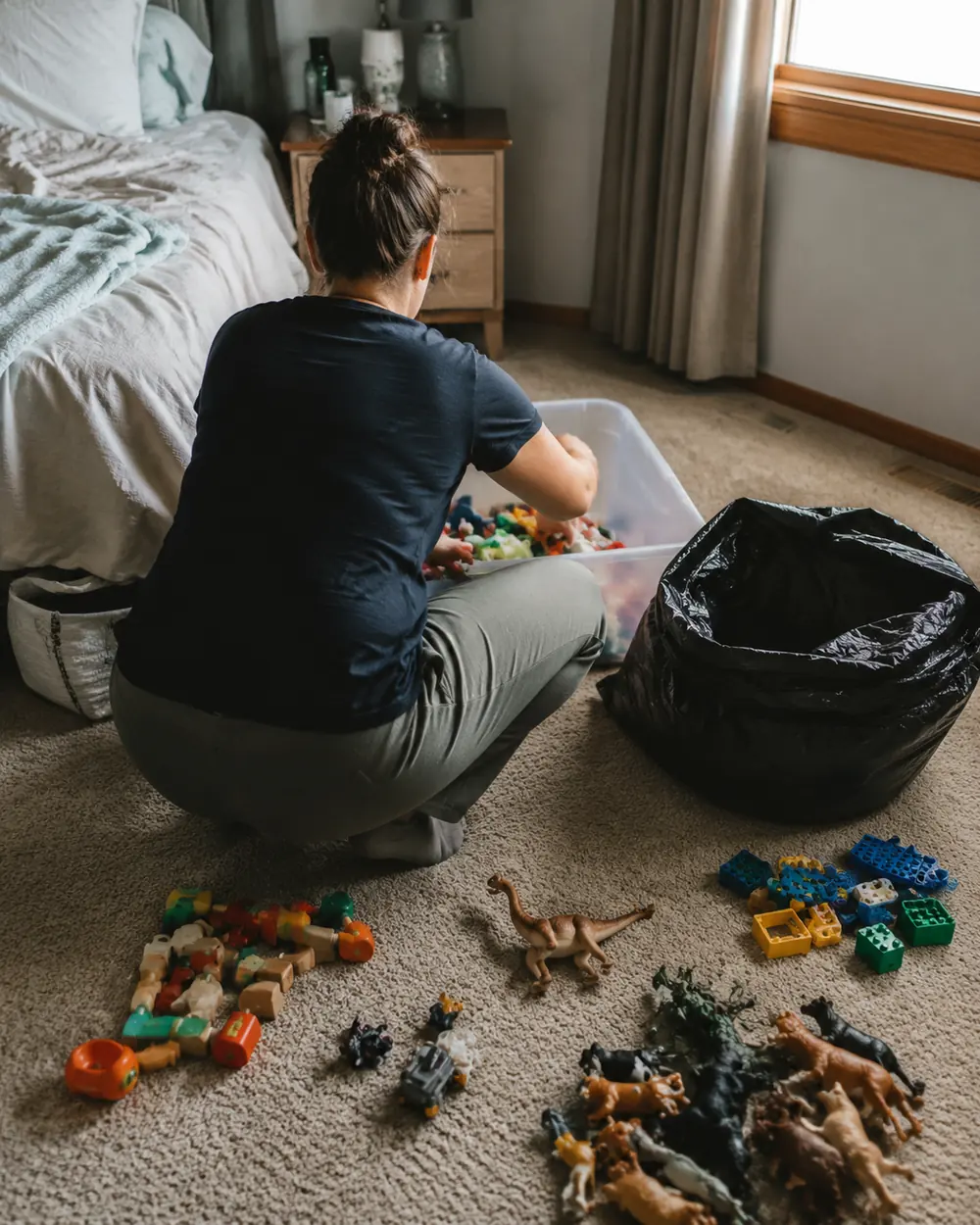
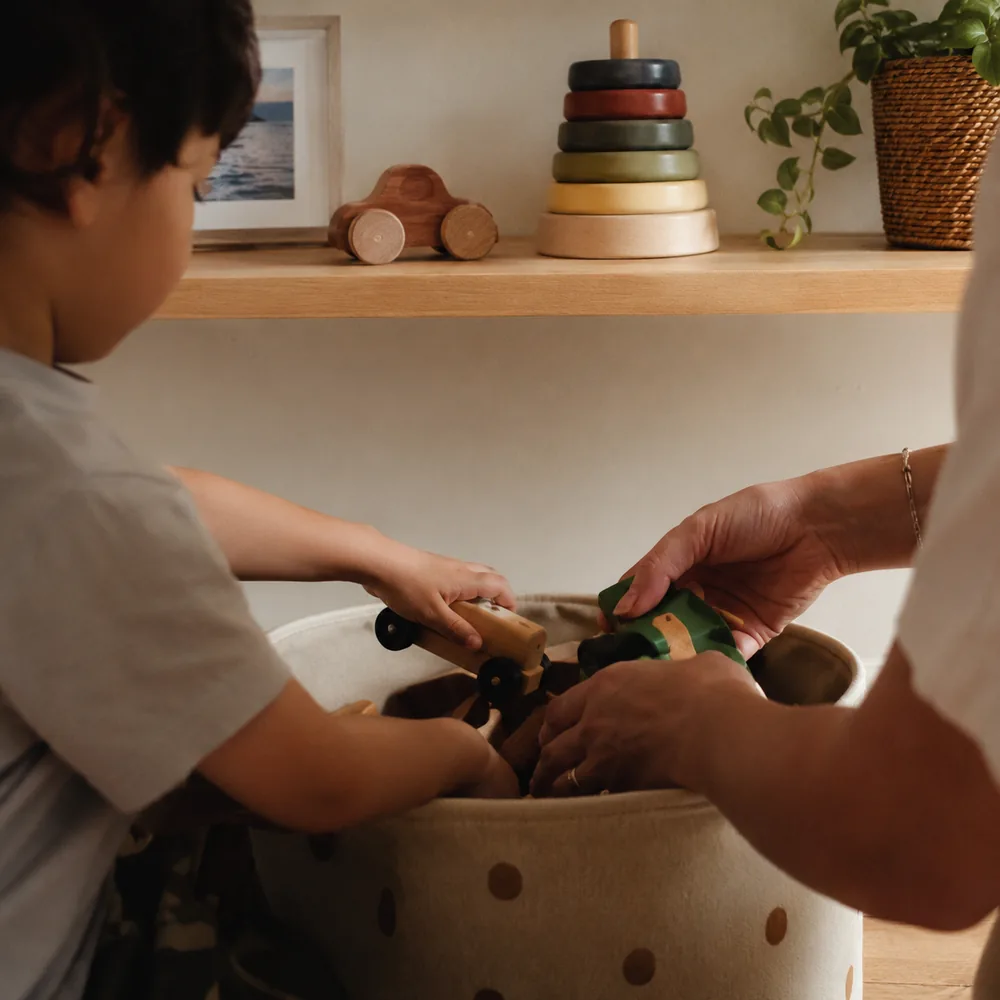
Toy chests. The twins in that report died in a wooden toy chest. If you have one, it wants either no lid at all, or a lid with slow-close hinges and air holes. The safest storage for a young child’s room is an open shelf, which also makes tidying up possible.
Cords and strings. Anything longer than about 30 centimetres on a pull-along toy can catch and pull tight, and so can anything in a loop. A child who cannot untangle herself is the one at risk.
The older sibling problem
Most small parts in a house with a toddler do not belong to the toddler. They belong to a seven year old. He is old enough for the building set and not old enough to remember that the baby eats things. There is more on making one room work for two very different ages if they share.
Nobody solves this by nagging. It gets solved by where things live. Small-piece stuff sits somewhere the little one cannot reach. It gets played with on a table or a tray rather than the floor, and it goes back up when he is done. A tray helps more than it sounds like it would, because it gives the play an edge a child can see. The same trick runs through most good sensory play at home.
Then hoover. The vacuum is a safety device in a house with a crawler and an older child. Running it after the pieces go away catches the ones that did not.
Hand-me-downs and the box from the loft

A lot of what a toddler plays with was not bought this year. It came from a cousin, a charity shop, a neighbour clearing out, or your own childhood box.
None of that is a reason to say no. It is a reason to look harder, because a used toy has already had its use-and-abuse test and nobody wrote down the result. Check for cracked plastic, loose eyes, a battery lid that has lost its screw, and any piece that now fits through the tube because it broke.
Age matters here in a way it does not with new things. The Consumer Product Safety Improvement Act of 2008 made the American toy safety standard mandatory, and it brought the lead limit down in steps, to 600 parts per million in February 2009, then 300, then 100 in August 2011. A painted wooden toy from the 1980s was never held to any of that. Loved, yes. Not for a child who still puts things in her mouth.
Older magnet sets and older battery lids sit in the same category, for the reasons above. And a second-hand toy will not have been registered, so a recall notice never reached the person who gave it to you. That one is worth two minutes of searching before it goes on the floor.
What to do on the day the toys arrive
Twenty minutes, once, and then you can stop thinking about it.
Sort into three piles as they come out of the paper. Fine for this child. Fine, but the small parts stay upstairs. And not yet. Check every battery lid with a fingernail. Read the label on anything with a magnet in it. Take the packaging out to the bin in one go.
The not-yet pile is the one that saves you, and it does not have to be a loss. Put those away and bring them out in March, when everything in the house has stopped being interesting anyway. There is a fuller argument in the piece on toy volume. If you are still choosing what to buy, the age band matters more than the box suggests, and the number of parcels matters too.
Then register anything that can be registered, because that is the only way you hear about a recall. Check the Commission’s recall list once a year. It takes two minutes and almost nobody does it.
The room, not the toy
Get down on the floor and look at the room from the height of the child who lives in it. You will see the things nobody sees standing up. A battery cover under the sofa. The corner of a magnet tile. A ribbon.
That is the whole method. It works better than any checklist because it is your actual house. If you also have a tree going up this month, the bottom three feet of it are the same problem with tinsel on, and that has its own piece.
Leave the first comment
Share your thoughts
Frequently asked questions
Small parts they can choke on, button batteries, strong magnets and water beads. Anything that fits inside a cardboard toilet roll tube is a choking risk for a child under three. Balloons and lidded toy chests belong on the same short list.
It is a safety rating, not a skill rating. Not for children under 3 means the toy holds, or can break into, pieces small enough to fit inside the official small parts tube. It says nothing at all about how advanced your child is.
A swallowed coin cell battery can burn through a child's food pipe in about two hours. Between 2011 and 2021 US regulators recorded 27 deaths and roughly 54,300 emergency room visits linked to them. If you think one has been swallowed, go straight to hospital.
Loose magnet sets are not. Two magnets swallowed at different times can clamp together through the wall of the gut and kill the tissue between them. A 2022 US standard limits the strength of small loose magnets, but older stock is still in circulation everywhere.
Usually, with two extra checks. Look for cracked plastic, loose parts and a battery lid missing its screw, since a used toy has already had its rough handling. Painted items made before 2009 predate the current US lead limits, so keep those from a child who mouths things.

For nearly two decades I was the school counsellor across from the angry kid, the silent one, the parents out of ideas. I write the way I listened - slow, steady, never from above. If tonight feels heavy, I hope this felt like having someone in the room.
More from TheoWhich tool actually earned its place - and which was a waste of money?
No right answers here - tell us how it actually went. Someone reading needs to hear it.
Join the conversation