Child Decoded, Reviewed: The Book for When No Single Diagnosis Explains Your Kid

By now you probably have a folder. School notes, a hearing screen that came back fine, an attention questionnaire someone filled in last spring. Every professional you saw was kind about it. Every one of them handed back a different piece of your kid, and the pieces do not snap together.
That is the exact parent this book was written for, and almost nobody writes for her.
Child Decoded came out in 2017. It is still the only book we have found that starts with your child’s symptoms and then tells you which kind of specialist owns them. That alone is worth the price. It also has one section we want you reading with your guard up, so we will do both.
So what is this book, actually?

Most parenting books pick one lens and go deep. The Explosive Child hands you a method for the kid who blows up. Smart but Scattered builds planning and follow-through skills. The Out-of-Sync Child stays inside sensory issues. All three assume you already know which door you are standing in front of.
Child Decoded assumes you do not. It starts with what you see at home, then points you toward about ten different fields: attention, speech, hearing, dyslexia, sensory issues, vision, autism, concussion, math and writing, behavior, social skills. Each chapter is written by people who work in that field. The vision chapter reads like an eye doctor wrote it, because one did.
Three editors put it together. Robin McEvoy is a child neuropsychologist in Denver with about thirty years in practice. Kim Gangwish works in mental health and applied physiology, and runs a wellness center in Colorado. Marijke Jones is the developmental editor. She is a former therapist, and the mother of a twice-exceptional son she ended up homeschooling. That last part shows. The book is patient with the parent doing the reading.
It runs about $21 in paperback and $7.99 on Kindle. It is self-published, which matters later.
The forty pages that carry the whole book

If you buy this book, you are really buying chapters two and three. Everything else is a bonus.
Chapter two is a set of checklists. You read down a list of things you have actually watched your child do, and tick what you recognize. The pattern of ticks points you to the chapters worth your evening. It is a triage tool. Reviewers single it out, and one of them, a school principal with forty years in the job, calls out the behavior checklists by name.
Chapter three answers the question that quietly costs families the most money. Who does what. It lays out what a neuropsychologist tests for, and how that differs from a speech therapist, an occupational therapist, an eye doctor, or an educational therapist. It also separates assessment from diagnosis. That sounds like a small thing until you have paid for the wrong one. If you have ever sat in a waiting room unsure whether you booked the right appointment, this chapter is the reason to own the book.
That framing helps most when a kid’s trouble keeps getting read as attitude. A lot of what looks like defiance is a child having a hard time rather than giving you one. The same goes for the child who will not tell you anything about school, or who falls apart in the first twenty minutes at home. The book gives you words for taking those patterns to a professional without sounding like you are guessing.
Where we would read with your guard up
Three things to know before you order it.
The last section is alternative medicine. Section four covers naturopathy, neurofeedback, chiropractic neurology, and craniosacral therapy. A free bonus chapter adds homeopathy. That section is not held to the same standard as the first three. Craniosacral therapy and homeopathy have both picked up more evidence against them since 2017.
One program in that section belongs to an editor. Section four includes LEAP, an acupressure method for learning. LEAP was developed by Kim Gangwish, one of the book’s three editors. The book’s own website says so plainly, so it is disclosed rather than hidden. Read that chapter knowing she has a stake in it.
The ratings tell two different stories. On Amazon the book sits at 4.8 stars from 31 ratings. On Goodreads, from almost the same number of readers, it averages 3.89. About a third of them gave it three stars or fewer. Amazon has no written critical reviews at all. Two samples this small settle nothing, and early Amazon ratings on a self-published book often run warm. We would trust the Goodreads spread more. It reads as useful but uneven.
One more thing. The book is nine years old. It came out before the 2022 update to the DSM-5 and before video appointments became normal. The who-does-what part has held up well. Specific diagnosis rules have aged less well, so check anything clinical against current guidance.
Does it help with the school side?
Some. Chapter seventeen is about speaking up inside the school system, and chapter eighteen covers managing care across several providers. Both are short. Neither will turn you into an expert on your rights, so if you are heading into a meeting about support at school, treat them as an orientation and get local advice too.
What they do give you is the vocabulary. Walking in able to name which evaluation you want, and why, puts you in a different conversation than walking in worried. That matters for the kid whose attention falls apart in class, and for the one for whom school itself has started to feel too big.
| Book | What it actually gives you | Best for | Where it stops |
|---|---|---|---|
| Child Decoded | A map across about ten specialties, plus symptom checklists | The kid whose issues overlap and whose results keep coming back unclear | It hands you a map. It will not coach you through daily life. |
| The Explosive Child | A method for solving problems together with a rigid child | Blow-ups and constant power struggles | One lens. Assumes behavior is the thing to work on. |
| Smart but Scattered | Planning and follow-through skills, step by step | Forgetful, messy, cannot get started | Skills only. No help finding a cause. |
| The Out-of-Sync Child | A deep look at one thing, sensory processing | A child whose world is too loud, too bright, too scratchy | Sensory only. Everything else is out of frame. |
Should you buy it?
Buy it if your child is complicated and the professionals keep disagreeing. Skip it if you already have a clear diagnosis and what you need is a plan for Tuesday evening.
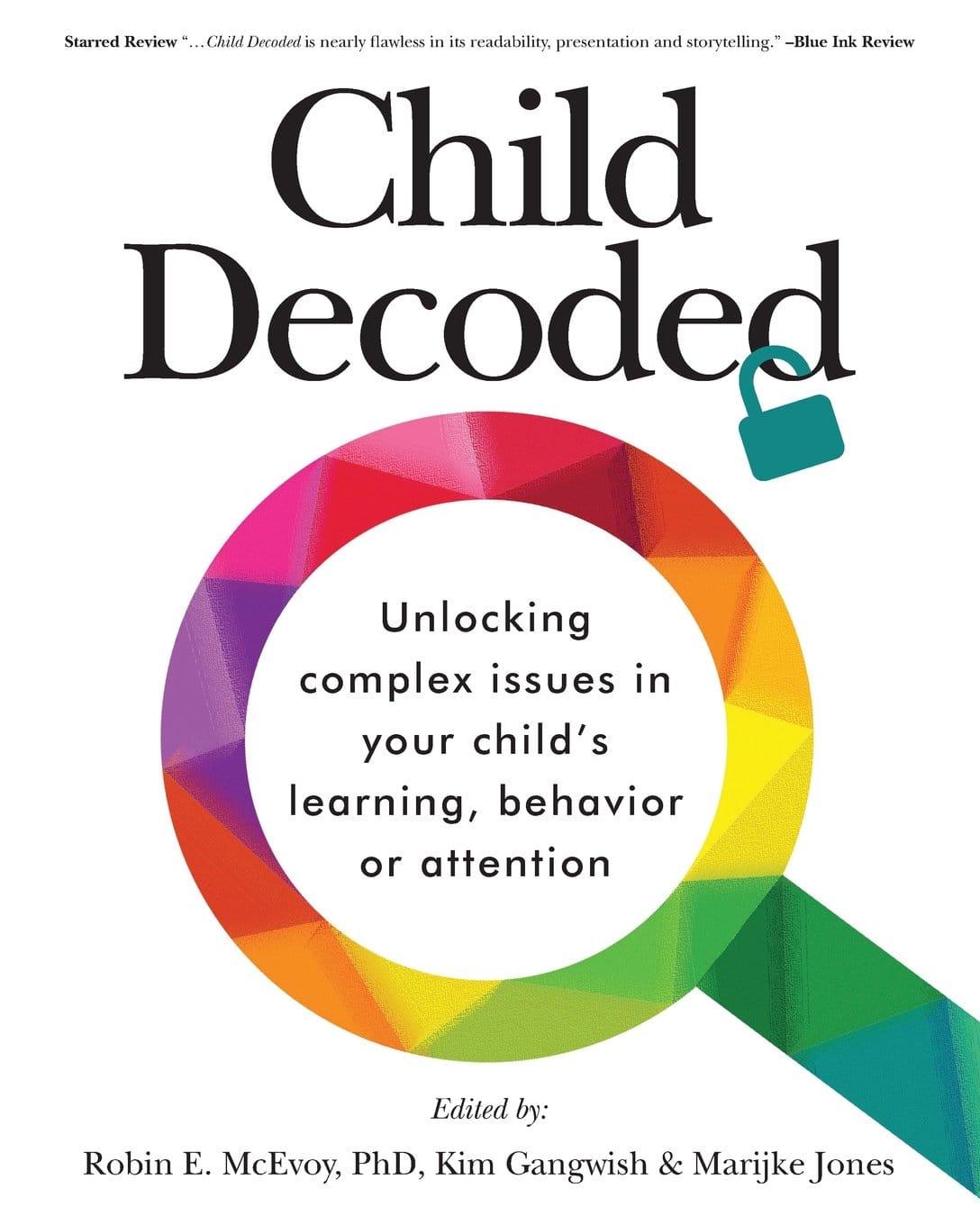
Child Decoded
~$21 paperback · $7.99 Kindle
Jones, McEvoy and Gangwish, 2017. 418 pages. 4.8 from 31 Amazon ratings, 3.89 from 28 on Goodreads. Endorsed by Temple Grandin, and by Lucy Jane Miller, co-author of The Out-of-Sync Child.
Get it if
- Your child has more than one thing going on and nobody has connected them
- You keep paying for tests without knowing which specialist you need
- You want the checklists and the who-does-what chapter more than a technique
Skip it if
- You already know the diagnosis and you need day-to-day strategies
- You want everything in it to be evidence-based, because the last section is not
- 418 pages of reference is the opposite of what you have energy for
Where to start if you do buy it
Read chapter three first, before chapter one. Chapter one is CJ’s story. It is the emotional one, the part reviewers mention crying through. It will still be there in an hour. Chapter three is the one that changes what you do on Monday.
Then work the checklists in chapter two. Take your three most-ticked chapters and leave the rest of the book closed. Nobody reads 418 pages of this straight through. Treating it as a reference you dip into is how it stays useful, instead of becoming one more thing you feel behind on.
Frequently asked questions
It is a 418-page reference book that starts from a child’s symptoms and points parents to the right specialty. It covers attention, speech, dyslexia, sensory issues, vision, autism, concussion, learning disabilities and behavior. Each chapter is written by people who work in that field, and a master checklist helps you decide which chapters apply to your child.
It is worth it if your child has overlapping issues and test results keep coming back unclear. The value sits in the checklists and the chapter explaining which professional assesses what. It came out in 2017, so check specific diagnosis rules against current guidance, and treat the final alternative-medicine section more skeptically than the rest.
It was edited by Marijke Jones, Robin E. McEvoy PhD and Kim Gangwish, with individual chapters written by practitioners in each field. McEvoy is a child neuropsychologist, Gangwish works in mental health and applied physiology, and Jones is an editor and former therapist who homeschooled her own twice-exceptional son.
Amazon shows 4.8 stars from 31 ratings with no written critical reviews. Goodreads averages 3.89 from 28 ratings, with about a third at three stars or below. Both samples are small, and self-published books often see warmer early Amazon ratings, so the Goodreads spread is probably the more realistic picture.
Start with chapter three, which explains which professional does which type of evaluation, and how assessment differs from diagnosis. Then work through the master checklists in chapter two, and read only the three or four chapters your results point to, rather than reading the book front to back.
Leave the first comment
Share your thoughts

I'm for the parent standing in the bookshop, overwhelmed. I read them all - the wise, the smug, the single good idea stretched to 240 pages - so your nightstand stack stays short. I'll point you to what's truly worth it, and kindly, what to put back.
More from MeiWhich book actually changed something at home - and which did you put back?
No right answers here - tell us how it actually went. Someone reading needs to hear it.
Join the conversation