
When Your Co-Parent Won’t Co-Operate: Stop Co-Parenting, Start Parallel Parenting

You put reddit on the end of the search, because you did not want another article. You wanted to know whether other people are actually living this, and whether it ever stops.
So we went and read those threads. Not one or two. The big ones. The rooms where people use the word narcissist about their ex, and the room where people are just trying to get through the week.
The two rooms do not say the same thing. That gap turned out to be the useful part.
The two rooms, and what each one is for
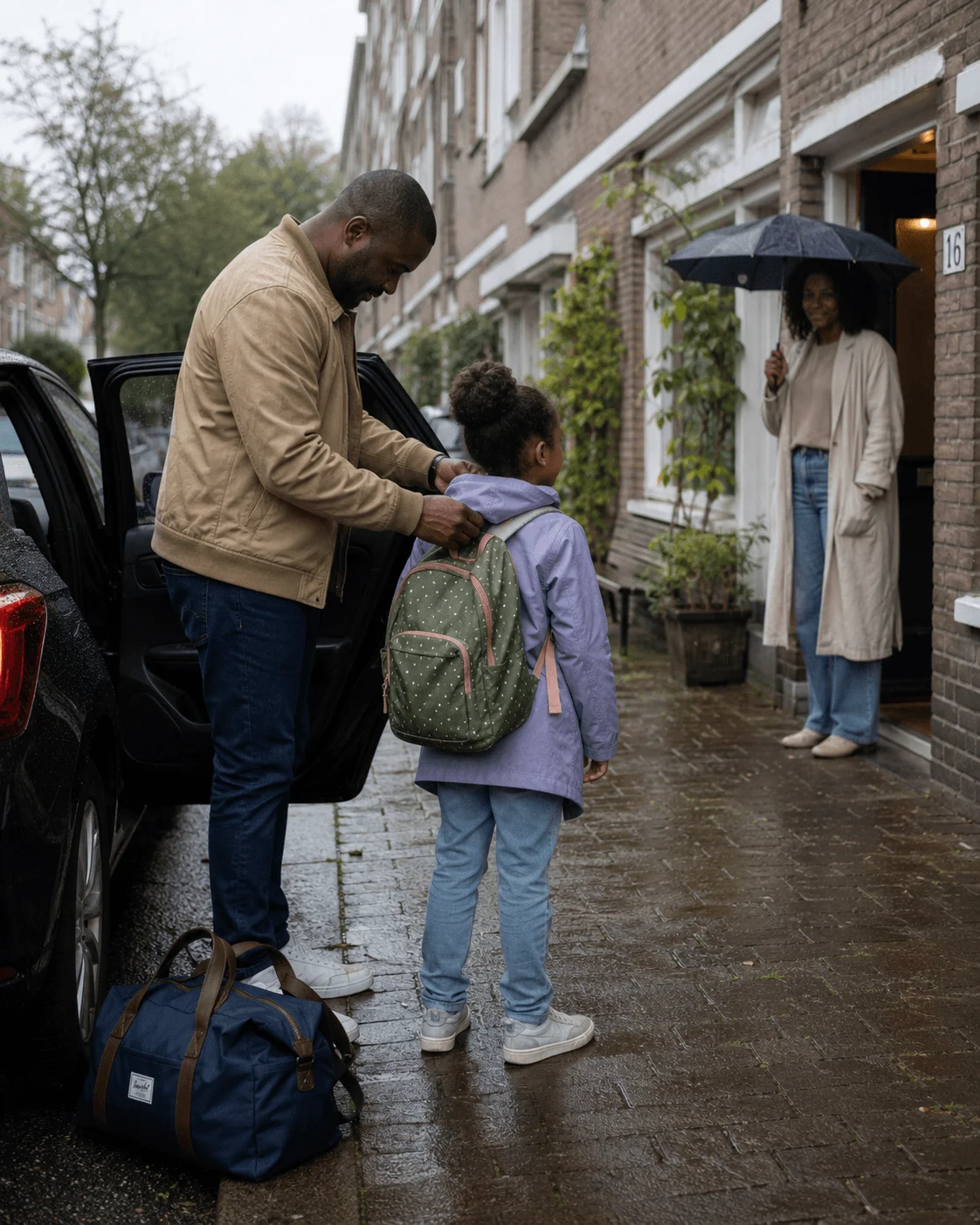
In the rooms built around the label, the talk is about spotting it and guessing what comes next. What traits to watch for. How it will show up in their parenting. What they will do when you finally leave. People share long, detailed histories and they are believed, which matters enormously if nobody in your life has believed you yet.
What you mostly come away with is vigilance.
In the room built around the logistics, something different happens. The word narcissist turns up in a thread title and then nearly vanishes from the replies. Nobody debates the diagnosis. The answers are mechanics: what to send, what to ignore, what to write down.
And the advice repeated more than any other is the one that feels most wrong. Stop giving the other parent advice about their parenting. Person after person describes the day they quit offering constructive criticism as the day it got easier. That is not the same as not caring. It is a decision about where your effort lands, and whether it has ever once worked.
You cannot diagnose your ex, and it changes nothing anyway
Worth saying plainly, because the search term almost demands it. Narcissistic personality disorder is diagnosed against nine criteria, and a clinician needs to find at least five. The guidance is that this kind of diagnosis works better when someone is watched over time, rather than in one sitting. It also overlaps with several other conditions that have to be ruled out first.
So nobody diagnoses it from the outside. Not you, not us, not a thread. The word is how people search for this, not a finding.
Here is the part that helps: it does not change your options. Whether the pattern has a clinical name or is just someone behaving badly, what you can do about it is identical. You can control your own house and your own reactions, and that is the whole list. So the useful question is not what to call them. It is how to communicate when you can barely stand to text each other. If you are still sharing an address while this plays out, that situation has its own rules.
What the research does support
Quite a lot, but not where you would expect.
Psychologist Joan Kelly reviewed a decade of research on this. Much of what looks like damage caused by divorce traces back to conflict that was already there before it. So divorce itself should not be treated as the main cause. A later meta-analysis looked at how children respond to conflict between parents, and tied those responses to adjustment problems in intact and separated families alike.
Read those together and the target moves. The thing to reduce is not the separation. It is how much conflict your child is standing in. That is why stepping back is a real move rather than giving up, and it is the strongest argument for parallel parenting there is.
Now the honest half. Parallel parenting itself is a practice model, not a tested treatment. Canada’s Department of Justice reviewed high-conflict separation and lists low contact between parents as part of these plans. It also says plainly that most of the programs in this field are small and barely tested. Gray rock is the same story. It is a named technique that started on a mental-health blog, and academic psychologists reviewing it say no studies show whether it works.
Sound reasoning, thin outcome data. We would rather you heard that from us than found it out later.
The part nobody warns you about
Across every thread, the obstacle is not the ex. It is grief.
People describe mourning the co-parent they thought they would have. Not the marriage, the co-parent. The version who would text back about the fever, who would sit on the same side at the school play. That grief is exactly what makes switching feel like failure, because going parallel means admitting the other version is not coming.
Which is why one thread stuck with us. Someone asked outright whether people regretted going parallel. The replies came back as relief. Not one person described going back.
Two warnings from the same reading. It usually gets worse before it settles. When you stop reacting, the pushback tends to spike first, and the psychologists reviewing gray rock flag that escalation too. Expect it, so you do not read it as proof you chose wrong. And the timelines people give are their own. One person described about three months before it went quiet. That is one person, not a rule.
Your child is running their own version of this adjustment underneath yours, and what that looks like month by month is worth knowing, if only so you stop reading every bad week as damage.
What it looks like on an ordinary Tuesday

Messages stay short and cover one thing. Dates, times, appointments, school. You write them the way you would write to a colleague you do not especially like, because that register is boring and boring is the point.
What happens at your house is yours. What happens at theirs is theirs. You stop auditing the other place unless your child is genuinely unsafe. Handovers stay flat and short, and you save the feelings for after the door closes.
One line that is not optional. If your child is not safe, this is a different problem and none of the above is the answer. Write down what you see, and take it to a lawyer or a professional who can act. A communication style does not fix a safety issue.
You are allowed to stop auditioning
Somewhere in this you probably started treating cooperation as a test of whether you are the reasonable one. You have been proving it to a person who was never going to score you fairly. You can put that down. Your child does not need the two of you to be friends, and they were never grading that either.
Frequently asked questions
Parallel parenting is an arrangement where separated parents disengage from each other while both stay involved with their child. Each parent runs their own household by their own routines, communication is limited to logistics like schedules and appointments, and neither tries to influence how the other parents. It is used when cooperation has repeatedly failed.
Co-operative co-parenting needs both parents to want it, so if one refuses, it is not available to you no matter how well you behave. Parallel parenting is the realistic alternative. Note that narcissistic personality disorder is a clinical diagnosis requiring assessment over time, so the label is best treated as how people search rather than as a finding about your ex.
Gray rock means giving flat, boring, minimal responses so there is nothing to react to. Academic psychologists reviewing it report that no scientific studies have evaluated whether it works, and they warn that the behavior often escalates before it settles. Many separated parents find it useful, but it is practice wisdom rather than proven treatment.
Research consistently links conflict between parents to poorer adjustment in children, in separated and intact families alike. Reducing your child’s exposure to that conflict is the goal, so a low-contact arrangement is generally considered better for them than sustained hostility. Children usually adapt well to two homes with different rules when both are predictable.
There is no reliable figure, and anyone quoting one is guessing. Parents describing their own experience often report things getting louder first, once they stop reacting, before settling over a period of months. Treat other people’s timelines as their story rather than a schedule yours should match.
Leave the first comment
Share your thoughts

I'm for the parent doing it largely alone. I've done the single-dad decade - two homes, one income, the handovers, the very quiet Tuesdays - and I write from the far side of most of those days, with humor and hard-won calm. Not advice from above; a hand back from a few steps up the road.
More from DiegoWhat's getting you through right now? Be honest - we're all figuring it out.
No right answers here - tell us how it went. Someone reading needs to hear it.
Join the conversation