
Your Son Is a Sheep and the Show Is in Nine Days

Your son announces it at the sink, still in his coat. He is a sheep. He says it the way other kids announce a puppy.
The email lands an hour later. Costumes are up to families. The show is in nine days, and nobody says what a sheep wears.
Sign-ups and costume notes usually arrive in November, the show follows in December, and the gap is shorter than it looks. A pageant costume has two jobs. It has to tell a grandparent in the back row who your kid is, and it has to survive a raised platform.
What does a shepherd, an angel or a sheep wear?
Many churches and schools stage the nativity as a Christmas pageant for kids, with a familiar cast: shepherds, angels, Mary and Joseph, kings, an innkeeper. Secular school winter shows hand out trees and snowflakes instead. In both kinds, one strong shape in one color beats five small details, since the audience sits far away.
- Shepherd: a bathrobe, a belt, and a striped dish towel held on with a headband. The crook is a wrapping-paper tube with a cardboard hook taped on.
- Angel: a white pillowcase or oversized white T-shirt, plus a tinsel garland twisted into a halo.
- Mary, Joseph or innkeeper: a long plain robe, a blue scarf for Mary, a darker cloth for Joseph, an apron for the innkeeper.
- Star or sheep: a yellow shirt with a foil star glued to a headband, or a cream sweatshirt your child already tolerates with felt ears glued on.
- Tree or snowflake: a green or white shirt with a paper leaf or snowflake taped flat on the front.
Sheep are the easy ones.
Should you make it, buy it or borrow it?
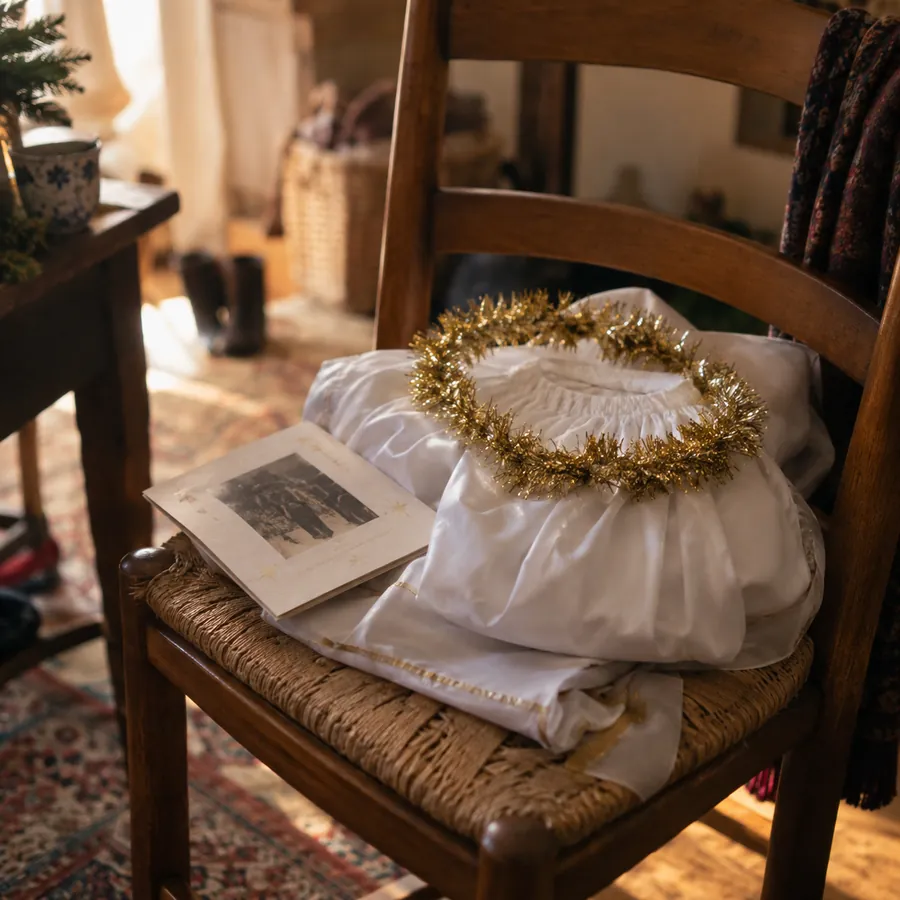
Ask before you buy anything. Many churches and schools keep a shared costume box.
For a shepherd or Joseph, belt the bathrobe and drape a dish towel over your child’s head so the ends hang past the ears. A wide stretchy headband on top holds it there. Roll the sleeves once so they clear the hands.
Everything else starts with one rectangle of fabric. Fold a bedsheet in half, cut a neck hole along the fold, and cut a gap for each arm on the sides. Glue or stitch the seam shut, and you have a tunic for an angel, a king or Mary. Cut the neck hole smaller than you think, since a wide one slides off a small shoulder.
For a small angel, a white pillowcase is the shortcut. Cut a neck hole in the closed end and an arm hole in each side. Let your child make the halo, one of the crafts a small child can do mostly alone.
If you do shop, check the tag. The U.S. Consumer Product Safety Commission (CPSC) tells shoppers to look for the label “Flame Resistant” on costumes, masks, beards and wigs. A homemade costume has no such label, so keep it away from flame.
A plain white or blue dress from your child’s closet often beats a bought angel or Mary. Buy the size that fits today. A costume that runs long is the one that trips a child on the steps.
What can trip a child on a real stage?
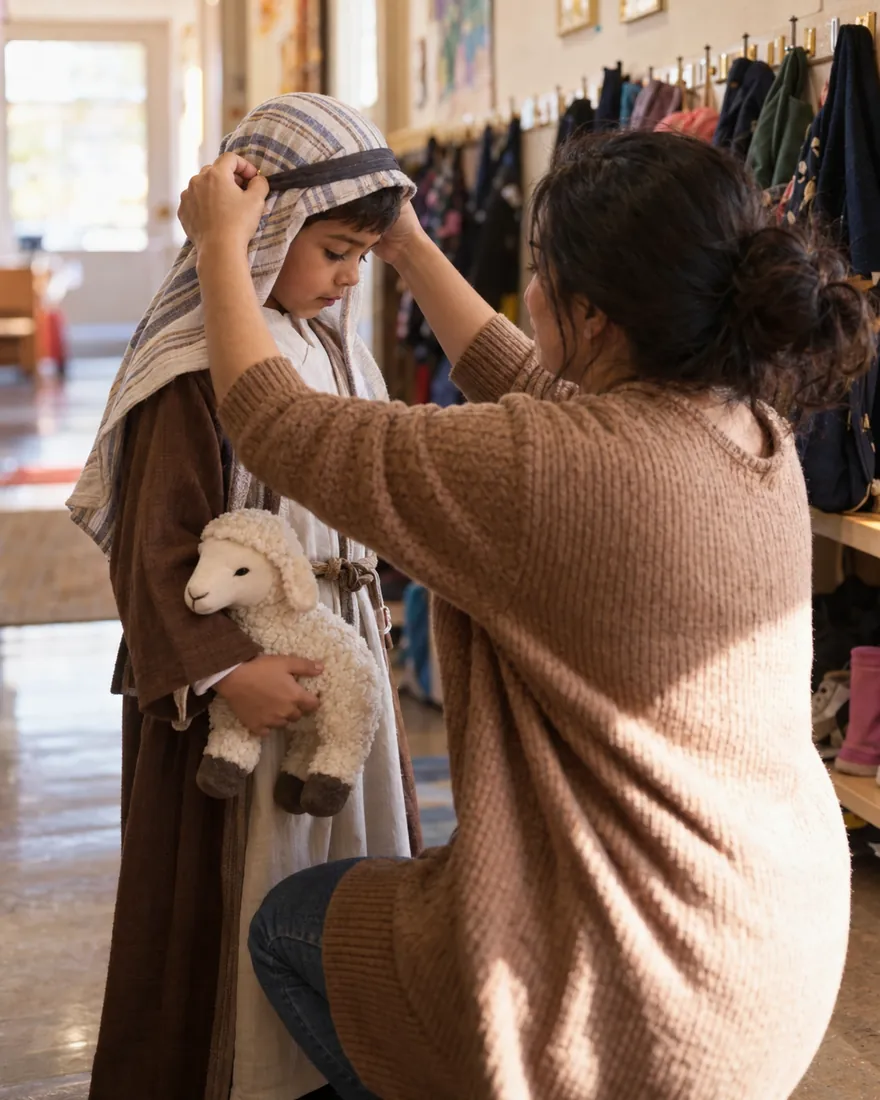
The stage is higher than it looks from the pew. Start with the hem. CPSC’s Halloween guidance says to “avoid overly long or baggy costumes to prevent trips and falls.” It says 25% of Halloween-related injuries came from falls, including “tripping on costumes.”
Try this at home. Put your child in the costume and the shoes they will wear, then have them climb your stairs twice. If they reach for the robe with both hands, the hem is too long. It should hover an inch above the floor.
Headwear is the second trip. A headcloth that slides forward blocks the eyes, and a child who cannot see the stage edge will find it. CPSC says eye holes in masks “should permit full visibility,” and the same goes for a towel. Have your child nod hard three times. If the cloth moves, put the headband under it or stitch the towel to the band.
Send flat shoes with grip, because socks skid on wood. For a drafty church hall, add a thin layer under the robe instead of a puffy one. Our winter layering guide covers each layer.
What about tinsel, halos and candles?
Some churches put real candles near the stage, as in the photo at the top. The same CPSC guidance says costumes “with loose, flowing fabrics can also be a fire hazard when close to open flames,” and it favors polyester or nylon over sheer cotton or rayon. Still, “any fabric can burn if it comes in contact with an open flame.”
The National Fire Protection Association (NFPA) has a tip sheet for candles in places of worship that lists December as the peak time of year for home candle fires. It also says three of every five home candle fires happen when a candle sits too close to something that can burn.
Ask the person running the show two questions before dress rehearsal. Will any real flames be on or near the stage? Can the ones near children be battery candles?
Check halos too. A halo bent from wire has sharp ends, so fold them over and wrap them in tape, or use a tinsel garland twisted into a ring with the tips tucked in.
What if your child refuses to put it on?
He wore it for two minutes at 4:10 and had it off by 4:12. “It’s itchy,” he says, and points at the neck. Ask which part. A child can often point to one. Then fix that part and leave the rest: a soft shirt under a scratchy robe, the tag cut out, a headband instead of a headcloth.
The wear-it-at-home routine in our sensory-friendly costume guide works for pageants too.
Sometimes the costume is fine and the stage is the problem. If he puts the robe on happily and goes quiet when you mention Thursday, that is stage fright in children, and the guide covers the days before a show. If the trouble is the role itself (“I don’t want to be the sheep”), ask the director early.
Put it all on one chair the night before
Lay the costume, the headband, the halo and the shoes on one chair, and add one quiet thing for the wait in the pew. Our list of quiet activities for kids in church has plenty. Then walk away.
Leave the first comment
Share your thoughts
Frequently asked questions
Start with soft everyday clothes underneath, such as a long-sleeved shirt and leggings or pants your child already tolerates. The costume goes over them. Add flat shoes with grip, and ask the director whether shoes will show, since a long robe often hides them.
Ask your church or school first, because a shared costume box may already hold a robe in your child’s size. After that, party stores, online costume sellers and thrift shops all carry robes, veils and halos. On store-bought pieces, look for the “Flame Resistant” label from CPSC’s shopping advice.
Almost never. One rectangle of fabric with a neck hole cut on the fold and gaps for the arms makes a tunic, closed at the sides with fabric glue or a few stitches. A pillowcase works the same way for a small angel. Keep the neck hole small so it stays on the shoulders.
Pick something warm that fits over layers, such as a bathrobe shepherd, a sheep in a fleece hoodie or a star in a yellow sweatshirt. A parade means walking outside for a long stretch, so skip long hems. CPSC suggests reflective tape as trim on costumes to help kids be seen in lower light.
Yes. A plain white dress with a tinsel halo makes an angel, and a blue or white dress with a blue scarf over the head makes Mary. Check that the hem clears the floor and the sleeves do not trail. Keep any tinsel and gauzy fabric away from lit candles.

I'm for the parent standing in the bookshop, overwhelmed. I read them all - the wise, the smug, the single good idea stretched to 240 pages - so your nightstand stack stays short. I'll point you to what's truly worth it, and kindly, what to put back.
More from MeiWhat's the one thing that calmed the chaos in your house?
No right answers here - tell us how it went. Someone reading needs to hear it.
Join the conversation