
No-Drama Discipline: How to Hold the Limit Without the Shouting Match

The moment you hear yourself counting “three…” through gritted teeth, you already know how this ends. They dig in, you escalate, and ten minutes later you are both upset and nobody has learned a thing except that the kitchen can get very loud. If you have ever finished a hard parenting moment feeling like the villain, there is a book that quietly rewires the whole thing. It is called No-Drama Discipline, from the same two authors as The Whole-Brain Child, and its promise is almost annoyingly simple: you can hold a firm limit without the shouting match.
Why does discipline turn into a shouting match?
Because most of us were raised to think discipline means punishment, when the word actually means to teach. Daniel Siegel and Tina Payne Bryson start right there. When your child digs in, their emotional brain has usually flooded, and a flooded brain cannot take in a lesson. It can only fight or flee. So the louder you get, the less goes in. You are not raising the stakes, you are just raising the volume on a brain that already stopped listening a minute ago. The shouting feels like control. Mostly it is just noise.
What is no-drama discipline?
It leans on one move you might recognize from their first book: connect, then redirect. First you connect. You get down low, you name the feeling, you let your child know you are on their side even while the answer stays no. Only then do you redirect, so the limit still holds, but now it lands on a brain calm enough to hear it. The authors are firm that this is not the soft option. You can be deeply kind and completely unmovable in the same breath. Warmth is not the opposite of a boundary. It is the thing that makes the boundary stick.
The part that changes the moment
The most useful thing in the book is a tiny pause they build around three questions: why, what, and how. Why is my child doing this (nearly always a need or a missing skill, not pure defiance), what do I want to teach right now, and how can I say it so it gets through. That three-second gap is where the drama either ignites or fizzles. They also hand you something to do with the heat of it, getting curious instead of furious, chasing the need sitting underneath the behavior. None of it means letting things slide. It means the limit and the warmth show up together, and that pairing is what shifts a child over the long run.

Is No-Drama Discipline worth reading?
If The Whole-Brain Child explains the why, this is the one that hands you the words. It is the more practical of the pair, full of real scripts, before-and-after examples, and even a fold-out fridge sheet of redirect strategies for the moments your own brain has gone offline. Parents say it is the book that finally made firm and kind feel like one thing instead of a trade-off. It is a touch lighter on the neuroscience than its older sibling, so if you want the full picture, read the two together. For about the price of a couple of coffees, it earns its shelf space quickly.
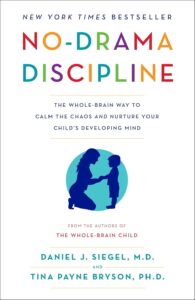
No-Drama Discipline
The hands-on companion to The Whole-Brain Child: real scripts, worked examples, and a fold-out redirect cheat sheet for when your own brain has clocked out. Lighter on neuroscience, heavier on what to say. The book that makes firm and kind feel like the same move.
As an Amazon Associate, Decoded Kids earns from qualifying purchases. Price checked live on Amazon.
It takes a while to feel natural, and you will still lose your temper sometimes, which is allowed. If the defiance in your house tends to come out as fists or teeth, there is a calmer way through when your child hits or bites, and on the days it curdles into “I hate you”, that one has a gentler script too. Both lean on the same connect-first idea this book is built around.
You will not get it right in the heat of every moment, and the book is the first to say so. But the next time you feel the count climbing in your throat, you might pause on that one quiet question, what am I trying to teach here, and answer it with your voice down instead of up. That is the whole no-drama thing, really.
Frequently asked questions
That discipline means teaching, not punishing. Because a flooded, upset brain cannot learn, the approach is to connect with your child’s feeling first, then redirect to the limit or lesson once they are calm enough to take it in. You stay firm and warm at the same time.
It overlaps with gentle parenting on warmth and connection, but it is not permissive. The authors are clear that limits should hold firmly. The difference from old-school discipline is how you deliver the limit, not whether there is one.
It is written for parents of children roughly 1 to 12, with most examples in the toddler-to-primary range. The connect-and-redirect principle still works with teenagers, the scripts just grow up with them.
Either works. The Whole-Brain Child explains the why behind your child’s behavior, while No-Drama Discipline gives you the practical words for the moment. Many parents read Whole-Brain Child first for the foundation, then No-Drama Discipline for the day-to-day scripts.
Leave the first comment
Share your thoughts

I'm for the parent standing in the bookshop, overwhelmed. I read them all - the wise, the smug, the single good idea stretched to 240 pages - so your nightstand stack stays short. I'll point you to what's truly worth it, and kindly, what to put back.
More from MeiWhich book changed something at home - and which did you put back?
No right answers here - tell us how it went. Someone reading needs to hear it.
Join the conversation