
Why Your Words Make the Meltdown Worse (and What Calms Them Instead)
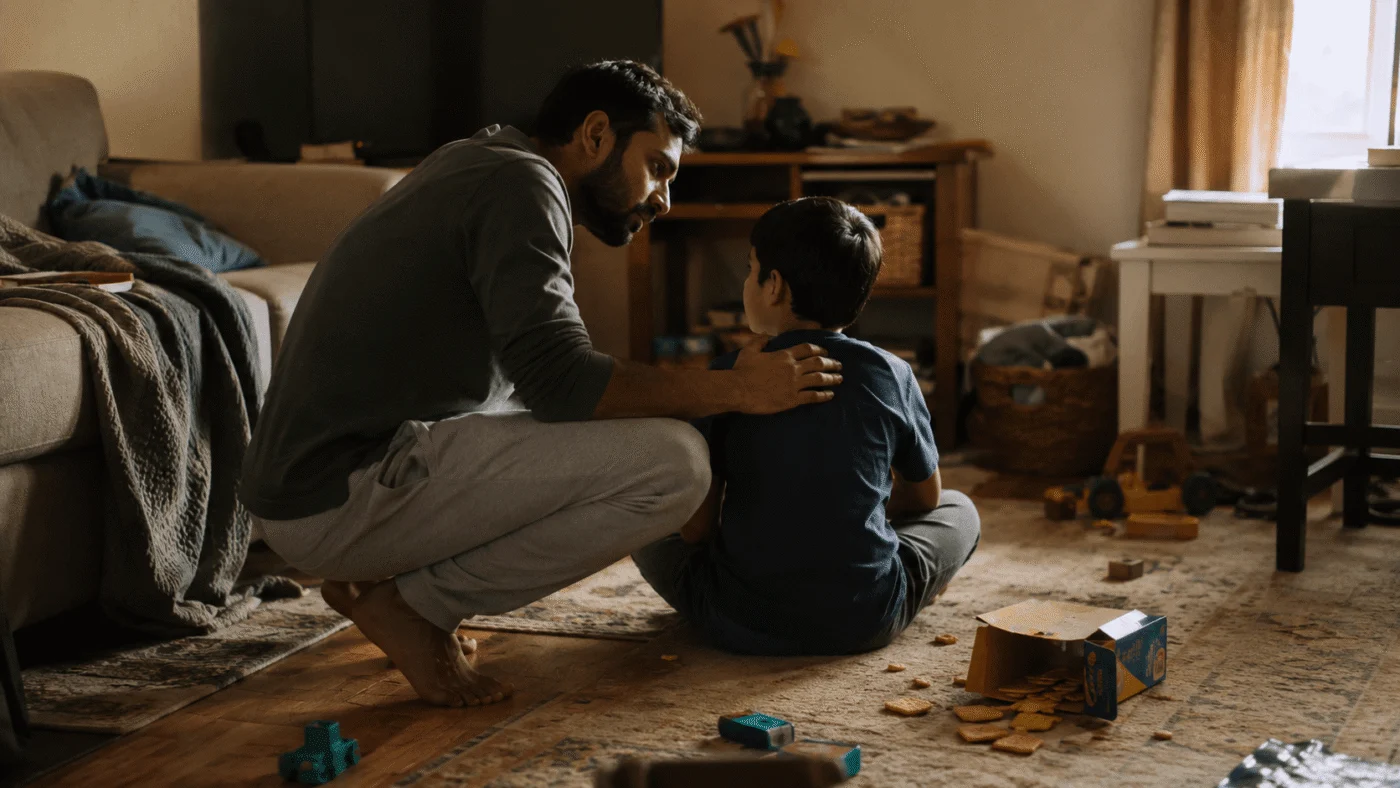
You crouch down, you explain it for the third time in your most reasonable voice, and somehow the screaming only climbs. That is the part that quietly breaks you. You are doing everything the gentle-parenting posts told you to, you are staying calm-ish, you are using your words, and your child is further away than when you started. Here is what almost nobody warns you about: in the thick of a meltdown, your words are not landing as comfort. They are landing as more.
Why do my words make the meltdown worse?
A meltdown is not a negotiation your child is trying to win. It is a brain that has, for a few minutes, lost the part that does logic. Dan Siegel calls it flipping your lid: the thinking, reasoning upstairs brain drops offline and the older, faster survival brain grabs the wheel. While the lid is flipped, language is the wrong tool. Explaining, counting to three, asking “why would you do that” all arrive as fresh input to a system already running past full. You mean it as a rope. It registers as more water.
This is also why your calmest, most loving explanation can make things spike instead of settle. It is not that your child is ignoring you or playing you (they genuinely cannot reach the part of the brain that would weigh your point). The same circuitry hums underneath a lot of behavior that looks like flat-out defiance, which I get into more in when your child’s anxiety looks like anger. The meltdown is a nervous system shouting that it is overwhelmed, not a decision to give you a hard time.

What calms a child down?
One nervous system borrows calm from another. That is the quiet secret, and it has a name: co-regulation. Long before children can steady themselves, they steady by catching it from a regulated adult nearby. Researchers like Stephen Porges and Bruce Perry keep landing on the same loop: your calm is contagious, and so is your panic. So the job in the hot moment is not to fix it or talk them out of it. It is to be the steady thing in the room your child can sync back to.
In practice it looks smaller and quieter than you would think:
- Get low. Drop to their level or below it, soften your shoulders, unclench your jaw.
- Say less. A few words on a loop, “I’m here, you’re safe,” beats a whole paragraph.
- Slow your own breath. They are reading your body long before they hear a word.
- Offer, don’t insist. A hand, a blanket, closeness if they want it, room if they don’t.
- Let it crest. The wave has to break. Your job is keeping them safe while it does, not cutting it short.
None of this is permissive, and none of it is doing nothing. Staying regulated while a small person comes apart in your kitchen is some of the hardest work there is.
But won’t this teach them they can act this way?
This is the fear that keeps so many of us talking straight through a meltdown, that staying gentle means letting them away with it. It helps to split the moment from the lesson. Nothing useful is being learned while the lid is flipped, by anyone. The teaching and the repair both land later, once the thinking brain is back online. Perry’s sequence is blunt and genuinely useful: regulate, then relate, then reason. Jump straight to reason while they are still flooded and you are talking to an empty room.
Connection first does not mean no limits. You can hold a boundary calmly (you can stop a hand mid-swing, you can keep everyone safe) without a lecture stapled to it. If the meltdowns are tipping into hitting or biting, there is a calmer route through that in when your child hits or bites you. The limit lives in what you do, not in how much you say.
What do I do once the storm passes?
Afterward is where the real growth happens, and it is gentler than you would guess. Once your child is back in their body, you reconnect first (a cuddle, a drink of water, a small ordinary moment) before any words about what happened. Then you can name it: “that was a big one, you got so frustrated when the tower fell.” Siegel calls this name it to tame it, and putting a word to the feeling genuinely helps the brain file it away. You are not debriefing a crime. You are helping build the map they will one day use to steer themselves. Some kids find it far easier to point at a feeling than to say it out loud, which is where a simple feelings tool earns its keep.
On the days you lose the thread and talk too much and it all goes sideways anyway, that counts too. The repair you do afterward is its own quiet lesson. You are allowed to be a work in progress right in front of them.
A few things that help a child come back down
None of these calm a child on their own, and you do not need a single one to co-regulate. What they can do is hand an overwhelmed body something to hold and a big feeling somewhere to go. Star ratings are current Amazon averages.
A meltdown is a body problem before it is a feelings problem, and plenty of kids settle faster with something solid to squeeze. The gentle weight gives restless hands a job and the nervous system a small, steady signal that the danger has passed. Ours lives on the bed and gets grabbed without being asked. As an Amazon Associate, Decoded Kids earns from qualifying purchases. Price checked live on Amazon.Weighted Comfort Plush

Once the worst of the storm has passed, a few minutes under a weighted blanket can help a wired body actually let go. Occupational therapists lean on the same deep-pressure idea. One safety note: skip these for babies and toddlers who can’t move the blanket off on their own.
Greene’s core idea, that kids do well if they can, quietly reframes the whole thing: a child who melts down is short a skill, not short on willpower. If most days seem to end in an explosion, this is the book that helps you find the gap underneath instead of just managing the noise.
The naming part of all this gets easier when a feeling has a face. A younger child who can’t yet say “I felt frustrated” can grab the right little blob instead, which is a surprisingly real first step toward steering the feeling on their own one day.
The four, side by side
Same goal, four ways to help a body settle. Ratings are current Amazon averages.
Frequently asked questions
Because a meltdown takes the thinking part of the brain offline. While your child is flooded, even kind and reasonable words arrive as extra input the brain can’t process, so explaining or reasoning often makes the distress spike. Fewer words and a calm, steady presence land far better until the wave has passed.
Co-regulate. Get down to their level, soften your face and shoulders, slow your own breathing, and use one short reassuring phrase on repeat, like “I’m here, you’re safe.” Offer closeness without forcing it, keep everyone safe, and let the feeling crest. Your steady nervous system gives theirs something to sync to.
No. Co-regulation isn’t the same as dropping the limit. You can hold a boundary calmly, including stopping unsafe behavior, without a lecture attached. The teaching and problem-solving work once your child can think again. Connection in the moment, the lesson once they’re regulated.
Self-regulation develops slowly across childhood and well into the teen years, because the brain’s control center is still maturing. Young children borrow calm from adults first and internalize it over time. Expecting a four-year-old to self-soothe like an adult sets everyone up to fail; your calm stays part of the equation for years.
Leave the first comment
Share your thoughts

I'm for the parent watching a feeling they can't name and wondering if it's normal. I've spent years close to the child-mental-health research and the specialists behind it, and I carry the heavy parts into plain language. I won't diagnose your child - I'll help you see what you're looking at, and say honestly when it's time to ask someone in person.
More from SofiaWhen did you last feel out of your depth - and what helped, even a little?
No right answers here - tell us how it went. Someone reading needs to hear it.
Join the conversation