
10 Reasons Your Child Won’t Listen Until You Yell

You know the exact moment. You ask for something small, shoes on, come to the table, teeth brushed, and nothing happens. So you ask again. Still nothing. Your voice tightens a notch and you can hear it doing it. You are not trying to be the shouty one, you are just late and tired and holding three other things, and your kid wanders past with one sock on asking why for the fourth time. Then you finally raise your voice, and suddenly they move.
That is the bit that stings later, once the house is quiet. It starts to feel like your child only hears you when you get loud, and you lie there replaying it. I asked nicely four times. Why did the calm version not count?
Here is the gentler truth. Your child is almost certainly not holding out for the yell on purpose. Somewhere along the line the house learned a pattern, and a pattern can be taught a new shape. That does not make you a bad parent. It makes you a parent with one habit loop to unpick.
As an Amazon Associate, Decoded Kids earns from qualifying purchases. Price checked live on Amazon.
Why your calm voice stopped landing
Stopping something fun, switching tasks, and doing the thing you would rather not, all lean on a part of the brain that is still very much under construction in childhood. Researchers at the Harvard Center on the Developing Child call this bundle of skills executive function, and it keeps wiring up well into the teenage years. So when your four-year-old sails straight past come here, it is not always defiance. Sometimes the message has to fight its way through a half-built block tower and a very loud inner world.
Then ordinary life piles on. The morning scramble, the missing shoe, a clock that refuses to slow down. And underneath it the house teaches its own quiet rule: a calm voice means there is still time, a loud voice means now it counts.
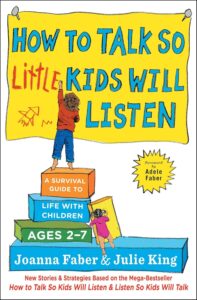
How to Talk so Little Kids Will Listen
10 reasons your child only listens after you yell
1. They have learned you will ask again. If “shoes on” arrives five times before anything happens, the early asks quietly teach their own lesson. Not urgent yet.
2. Their brain is mid-mission. A child deep in blocks is busy finishing a castle that matters a lot to them. “Come here” lands like a voice from another planet.
3. The instruction is too vague. “Behave.” “Get ready.” “Hurry up.” Those make sense to us and dissolve into fog for a child. “Get ready” can mean five different jobs. Try “Shoes on, then stand by the door.”
4. They are running on empty. Sometimes it is not defiance, they are just spent. Too much noise, too much rushing, a snack skipped two hours ago, and the wrong-colored cup becomes a genuine crisis.
5. Yelling is the loudest signal in the room. A raised voice changes everything fast. The air shifts, your face changes, and the child finally reads serious. The trouble is, once that is the cue, they start waiting for it.
6. They do not feel seen. Nobody has time for a heart-to-heart over socks. But a single line lands: “You want to keep playing, I know. Stopping is hard. Shoes on now.”
7. They are testing where the line is. Kids probe limits to learn how the world holds together. Do I really have to? What happens if I wait? Do you mean it on the first ask or the fifth?
8. You handed them five jobs at once. “Go up, brush your teeth, pajamas on, tidy the toys, and bring your cup down.” Reasonable to an adult, an avalanche to a six-year-old. One step at a time works better.
9. Everything has turned into a negotiation. Some homes slide into tiny courtrooms. “Bedtime.” “But I am not tired.” You explain, they appeal, and in comes the water, the extra hug, the one more story. Feelings are always welcome. Not every instruction needs a hearing.
10. Listening is a stack of skills, not one. Your child has to hear you, stop, ride out the not-wanting-to-stop, hold the words in mind, and then actually do it. That whole chain takes practice, structure, and steady follow-through.
Notice how few of those ten are really about a “naughty” child. Most are about timing, clarity, and a tired little brain meeting a tired big one in a hallway. That is good news, because timing and clarity are things you can change without becoming someone you are not.

How to get your child to listen without yelling
The goal is not to morph into a serene parent who never raises their voice. That parent does not exist, and chasing them just adds guilt to the pile. The goal is smaller and far more doable: make your calm voice mean something again. The American Academy of Pediatrics keeps circling the same plain advice for discipline that works, be calm, be clear, and mean it the first time. Here is what that looks like at 7.50am with one shoe missing.
- Close the gap first. Walk over, drop to their eye level, say their name, and wait for eyes before you speak. A direction shouted across two rooms barely registers as aimed at them.
- Give one thing, not five. “Shoes on, then the door.” Hold the next instruction back until that one lands.
- Follow through early, before your voice climbs. If the rule is no screen until the bag is packed, walk them to the bag on the first calm ask, not the fourth louder one.
- Name the feeling on the way past. “You want to keep building. Stopping is hard. Shoes on now.” Twelve words, and they feel met without a summit meeting over socks.
And when you do lose it, because you will, some mornings are just feral, repair it out loud afterwards. “I got too loud, and I am sorry for shouting. I still need you to listen when I ask.” That one sentence does two big things at once. It shows your child that owning a mistake is normal, and it keeps the boundary standing instead of dissolving into guilt.
Start ridiculously small. One clear instruction. One calm follow-through. One honest repair when you get it wrong. You are not undoing years of habit by Friday, and you do not need to. You are just teaching the room a new rule, gently and on a loop, until the first quiet ask is enough again.
Frequently asked questions
Usually because the calm request has not become the real boundary yet. If you repeat yourself several times before anything happens, your child learns that the early, quieter asks are optional and the loud one is the true signal to move. Making your first calm ask the one you follow through on changes that pattern over time.
Get close before you speak, say their name, and give one clear instruction instead of a list. Then follow through calmly and early, before your voice rises. Naming their feeling in the same breath, like “stopping is hard,” helps them cooperate without it turning into a battle.
Very. Stopping an activity and switching tasks relies on executive-function skills that are still developing through childhood and into the teens. A child who does not respond instantly is often not defying you. Their brain genuinely needs a beat, a clearer cue, and sometimes a gentle hand to get started.
There is no age where a child reliably listens the first time, every time, and expecting that sets everyone up to fail. Even school-age kids need clear, consistent, age-appropriate instructions and follow-through. The realistic goal is steady cooperation most of the time, not instant obedience.
Leave the first comment
Share your thoughts

I'm for the parent mid-meltdown - theirs or the kid's. I write from the actual floor of it: the crying that won't stop, the dinner thrown, the bedtime that unravels. Blunt because I respect you too much to pretend it's easy. Just what tends to work.
More from NourWhat's the one thing that calmed the chaos in your house?
No right answers here - tell us how it went. Someone reading needs to hear it.
Join the conversation