.dkp-wrap{padding:22px 16px 60px;}
.dkp-panel{max-width:900px;margin:0 auto;background:#ED512C;border-radius:22px;box-shadow:0 50px 140px -20px rgba(0,0,0,.7);padding:clamp(26px,5vw,46px) clamp(20px,5vw,48px) 50px;color:#141414;font-family:Marcellus,Georgia,serif;}
.dkp-htop{display:flex;align-items:center;justify-content:space-between;margin-bottom:26px;}
.dkp-pill{display:inline-block;border:1.5px solid rgba(10,10,10,.5);border-radius:999px;padding:6px 16px;font-family:Marcellus,serif;font-size:12px;letter-spacing:.06em;text-transform:uppercase;color:#0A0A0A;text-decoration:none;}
.dkp-pill:hover{background:#0A0A0A;color:#ED512C;}
.dkp-close{display:inline-flex;width:42px;height:42px;border:1.5px solid rgba(10,10,10,.4);border-radius:999px;align-items:center;justify-content:center;font-size:16px;color:#0A0A0A;text-decoration:none;transition:background .3s,color .3s;}
.dkp-close:hover{background:#0A0A0A;color:#ED512C;}
.dkp-title{font-family:Fraunces,’Cormorant Garamond’,serif;font-weight:600;font-size:clamp(31px,5.4vw,50px);line-height:1.04;letter-spacing:-.015em;color:#0A0A0A;margin:0 0 14px;}
.dkp-byline{font-family:Marcellus,serif;font-size:12px;letter-spacing:.05em;color:rgba(10,10,10,.6);margin:0 0 26px;text-transform:uppercase;}
.dkp-herofig{margin:0 0 30px;}
.dkp-herofig img{display:block;width:100%;height:auto;border-radius:16px;box-shadow:0 30px 70px -34px rgba(0,0,0,.55);}
.dkp-herofig figcaption{margin-top:.7em;font-family:’Cormorant Garamond’,serif;font-style:italic;font-size:1rem;color:rgba(10,10,10,.58);text-align:center;}
.dkp-body{font-size:1.16rem;line-height:1.82;color:#1b1b18;}
.dkp-body p{margin:0 0 1.25em;}
.dkp-body h2{font-family:Fraunces,’Cormorant Garamond’,serif;font-weight:600;font-size:clamp(24px,4vw,33px);line-height:1.13;color:#0A0A0A;margin:1.95em 0 .5em;clear:both;}
.dkp-body a{color:#15397F;text-decoration:underline;text-underline-offset:3px;text-decoration-thickness:1px;}
.dkp-body a:hover{color:#0A2257;}
.dkp-body ul{margin:1.3em 0;padding:0;list-style:none;}
.dkp-body ul li{position:relative;padding:0 0 0 1.6em;margin:0 0 .8em;}
.dkp-body ul li::before{content:”;position:absolute;left:.2em;top:.6em;width:7px;height:7px;border-radius:50%;background:#0A0A0A;}
.dkp-body strong{color:#0A0A0A;}
.dkp-quote{margin:2.1em 0;text-align:center;padding-top:.4em;font-family:’Cormorant Garamond’,serif;font-style:italic;font-size:clamp(22px,3.4vw,30px);line-height:1.32;color:#0A0A0A;position:relative;clear:both;}
.dkp-quote span{display:block;width:46px;height:2px;background:rgba(10,10,10,.5);margin:.7em auto 0;}
.dkp-quote cite{display:block;margin-top:.6em;font-family:Marcellus,serif;font-style:normal;font-size:13px;letter-spacing:.05em;text-transform:uppercase;color:rgba(10,10,10,.6);}
.dkp-key{margin:1.9em 0;padding:1em 1.3em;background:rgba(10,10,10,.08);border-left:3px solid rgba(10,10,10,.6);border-radius:14px;font-family:’Cormorant Garamond’,serif;font-style:italic;font-size:1.3rem;line-height:1.42;color:#0A0A0A;clear:both;}
.dkp-callout{margin:1.9em 0;padding:1.1em 1.35em;background:rgba(10,10,10,.08);border-radius:16px;font-size:1.04rem;line-height:1.68;color:#1b1b18;clear:both;}
.dkp-callout strong{color:#0A0A0A;}
.dkp-fig{margin:1.9em 0;}
.dkp-fig img{display:block;width:100%;height:auto;border-radius:16px;box-shadow:0 30px 70px -34px rgba(0,0,0,.5);}
.dkp-fig figcaption{margin-top:.7em;font-family:’Cormorant Garamond’,serif;font-style:italic;font-size:1rem;color:rgba(10,10,10,.58);text-align:center;}
.dkp-fig–right{float:right;width:46%;margin:.3em 0 1.3em 1.9em;}
.dkp-fig–left{float:left;width:46%;margin:.3em 1.9em 1.3em 0;}
.dkp-cmpwrap{background:#141418;border-radius:18px;padding:22px clamp(16px,3vw,26px);margin:24px 0;clear:both;}
.dkp-panel .pk-faq{margin:34px 0 4px;clear:both;}
@media(max-width:600px){.dkp-panel{padding:22px 18px 32px;border-radius:18px;}.dkp-body{font-size:1.08rem;}.dkp-fig–right,.dkp-fig–left{float:none;width:100%;margin:1.9em 0;}}

Back-to-School Sensory Kit for Kids With ADHD: What to Pack, What to Skip
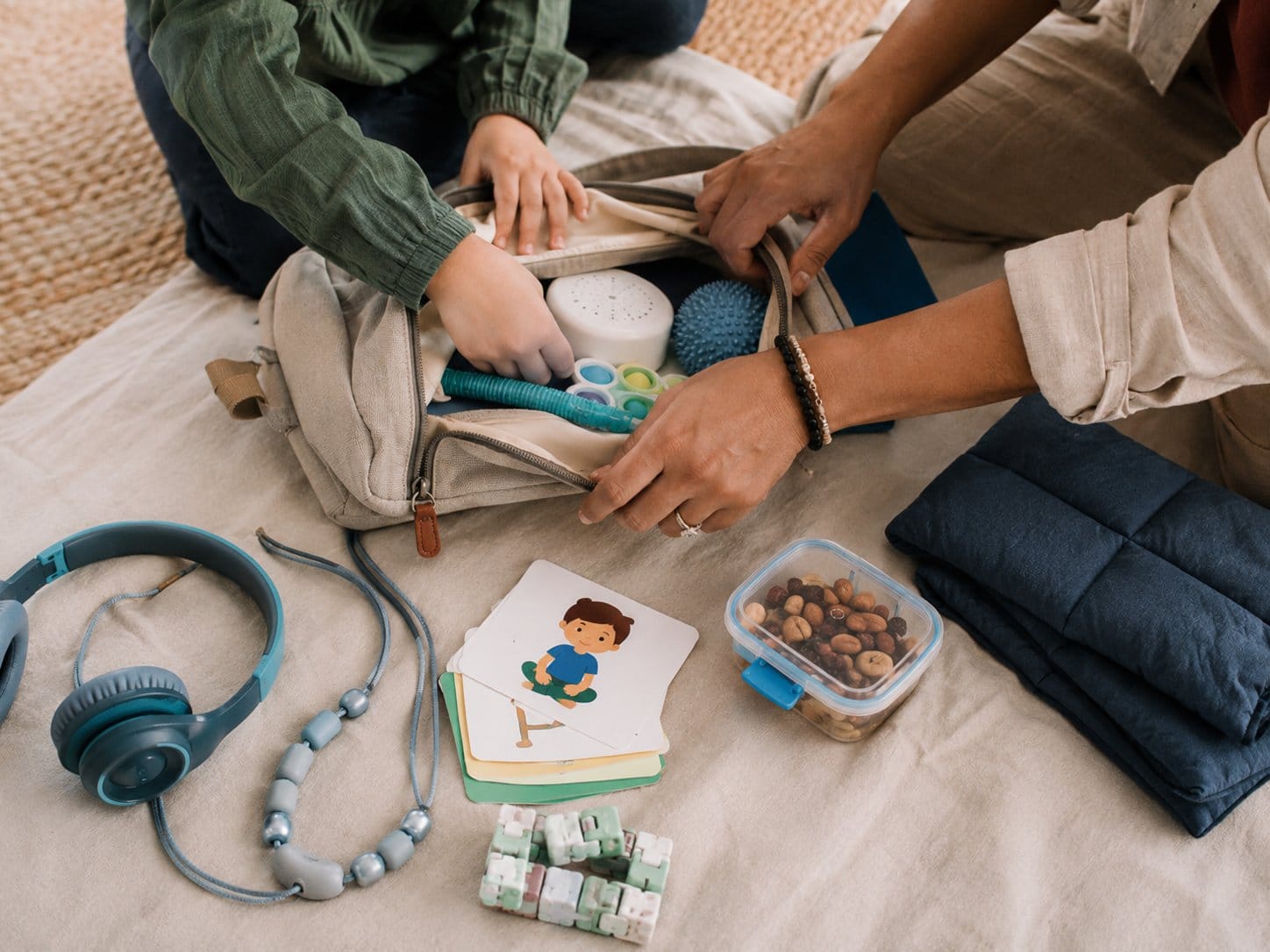
School sensory kit with headphones, visual schedule, lunchbox and quiet fidget tool
Pack one tool for the job, not a whole toy shop.

The backpack is already heavy. So no, your child does not need a giant therapy bin following them into third grade.

A good back-to-school sensory kit for kids with ADHD is small, quiet, teacher-friendly, and built around the one or two moments that actually go sideways. Loud lunchroom. Scratchy seat. Waiting in line. The worksheet that starts fine and then somehow turns into a full-body problem.

The kit is not there to entertain your child. It is there to give their nervous system a low-drama way back to class.

For most ADHD kids, the best school sensory kit has four jobs: lower noise, keep hands busy, make time visible, and give one calm reset option. Start with two or three tools, test them at home, and ask the teacher what is allowed before anything goes in the backpack.

What should actually go in a school sensory kit?

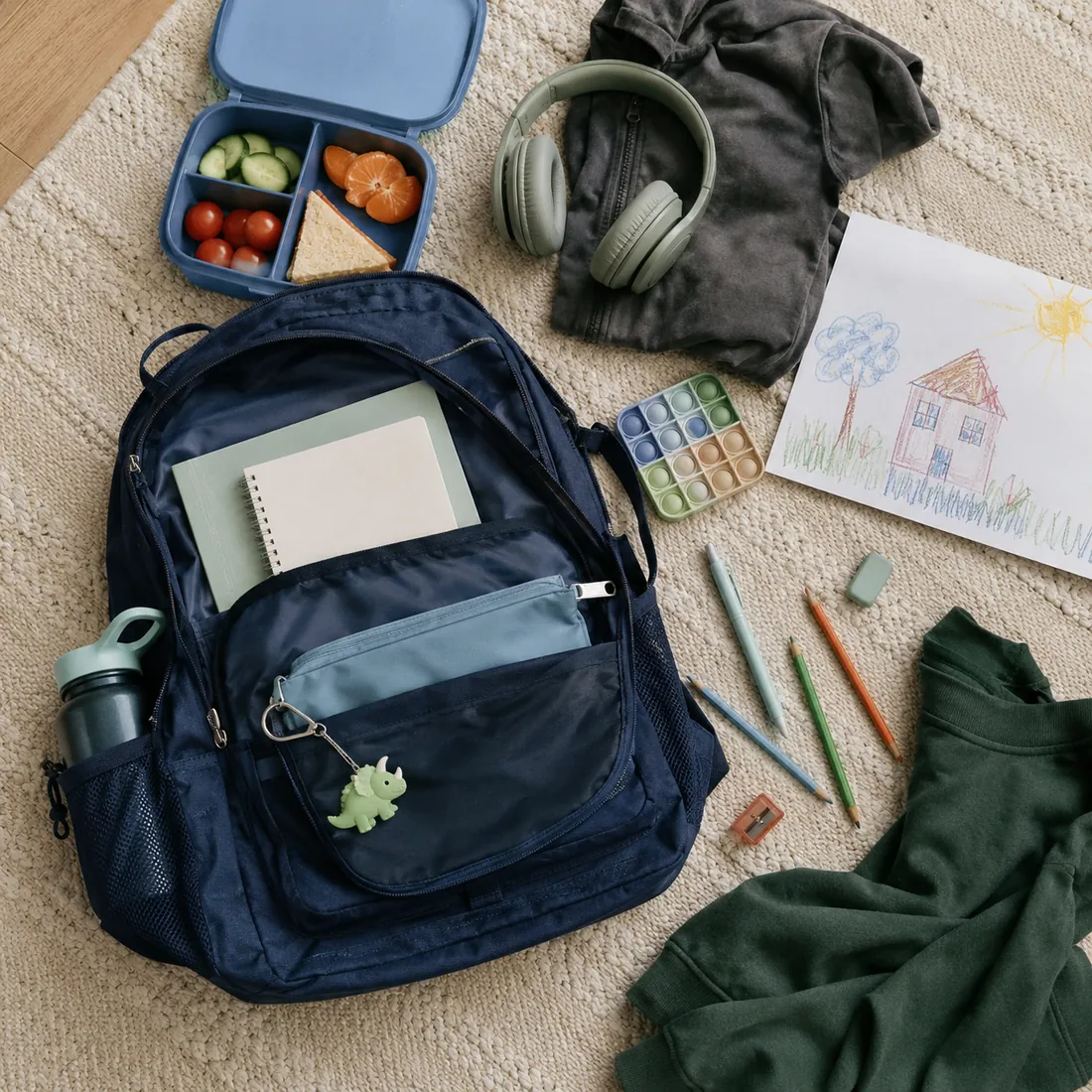
Parent and child packing a small sensory bag with headphones and visual cards
The best kit is boring enough to use every day.

Start with the problem, not the product. If your child melts down after cafeteria noise, you do not need five fidgets. You need hearing support. If they chew sleeves during spelling, you need a school-approved oral option, not another pop toy.

The Child Mind Institute says sensory kits can include things like snacks, gum, a quiet tactile object, and a weighted lap pad, depending on the child. Their shortest useful line is the one I would tape to the inside of the backpack: “Sensory kits can help kids stay calm during the day.”

The tool has to match the job. A noisy fidget in a quiet classroom creates a new problem with a cute label.Decoded Kids editor note

For a first version, I would pack from this order:

  • Noise: ear defenders or soft earplugs, if the school allows them.
  • Hands: one silent fidget that can stay under the desk.
  • Time: a visual timer for home practice, homework, or teacher-approved transitions.
  • Body: a small calm object, textured stone, or lap item for quiet pressure.
  • Plan: a card that says when the tool is used and when it goes away.

That last one is the unglamorous bit. Without rules, the sensory kit becomes a toy pouch. With rules, it becomes something your child can use without everyone watching.
Our pick★ 4.5

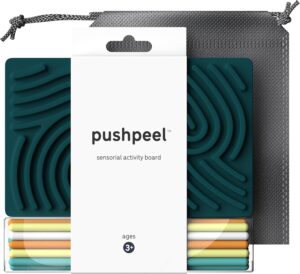
Pushpeel Sensory Activity Board

Best forQuiet desk fidget
UseBackpack or calm corner
NoiseSilent
Age3+
Check price on Amazon

As an Amazon Associate, Decoded Kids earns from qualifying purchases. Price checked live on Amazon.

How do you keep it from getting taken away?

School fidgets get confiscated when they perform. Lights, clicks, popping sounds, swapping with friends, a whole puppet show under the desk. I get why kids love them. I also get why teachers sigh.

The safest school pick is dull on purpose. One hand. No noise. No rolling across the floor. No tiny pieces. If your child needs movement to listen, read our guide to quiet fidget toys for kids with ADHD at school before you buy a multipack that becomes playground currency by Tuesday.

For some kids, a textured stone or a small ring works better than a toy-looking object. It gives the hand something to do without announcing itself to the table.

Best forPocket calm
UseReading or desk work
NoiseSilent
Pack size6 pieces
Check price on Amazon

If your child loses small things, a ring-style fidget may survive better. It is wearable, harder to drop, and less likely to become a class trading situation. Still test it at home first. Some kids twist calmly. Some kids turn anything into a tiny circus. Right.

Best forWearable fidgeting
UseBus, line, desk
NoiseQuiet
Pack size12 pieces
Check price on Amazon
\n

What about noise, lunchrooms, buses, and assemblies?
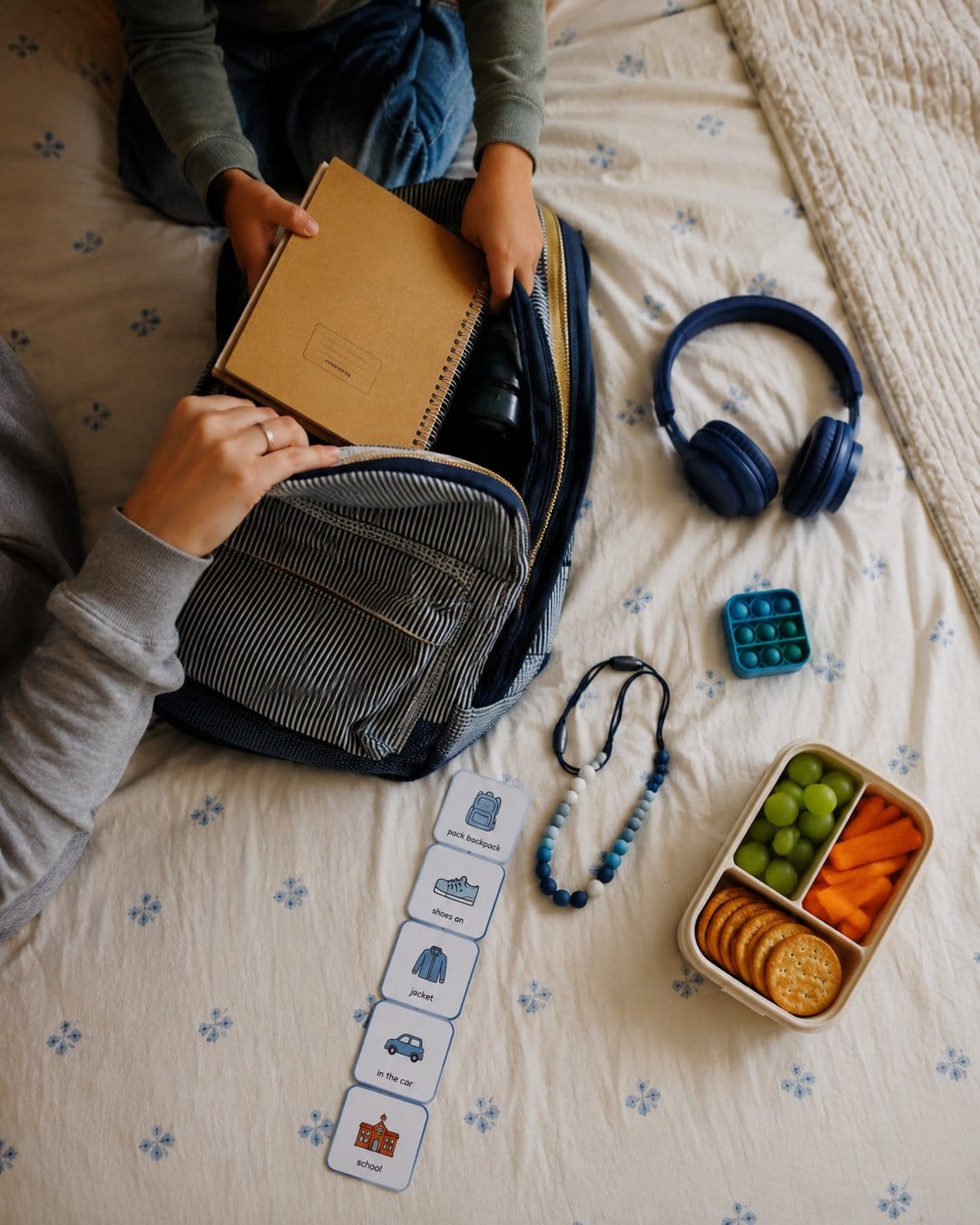
Child packing a backpack with headphones and a visual schedule on the bed
Practice the kit before the first loud day asks for it.

This is where sensory tools can be the difference between a hard day and a day that stays recoverable. A cafeteria can be a wall of scraping chairs, shouting, trays, bells, and fluorescent buzz. Some ADHD kids cope by getting louder. Some shut down. Some hold it together and save the crash for your car.

Noise-reduction ear muffs are not for every minute of school. They are for predictable loud spots: bus, lunch, pep rally, fire drill practice, gym echoes. The school may want rules around when they are used, which is fair. Ask early, write it down, and put the tool in the plan instead of hoping everyone remembers.

Best forLoud school moments
UseBus, lunchroom, assemblies
Rating29dB SNR
FitKids and adults
Check price on Amazon

One thing I would skip for most classrooms: music headphones. They can help at home, but in school they bring device rules, volume worries, charging problems, and the tiny chaos of Bluetooth. Ear defenders are boring. That is why they work.

Should a visual timer go in the kit?

Usually, the timer belongs at home first. Use it for the morning routine, homework starts, shoes-on time, or the last ten minutes before leaving. The CDC’s ADHD guidance tells parents to create routines, keep schoolbags in the same place, and break longer tasks into shorter steps. A visual timer turns those ideas into something your child can see.

At school, a timer only works if the teacher wants it in the room. Some classrooms already have timers. Some kids stare at them so hard they stop working. So I like the Time Timer as a home anchor first, then a school tool only if everyone agrees.

Best forTime blindness
UseMorning routine, homework, transitions
Length60 minutes
SoundSilent option
Check price on Amazon

Pair it with one sentence: “When the color is gone, we switch.” Then stop narrating. The whole point is removing your voice from the fight.

Read nextFor the mornings that fall apart before shoes are even on: ADHD Morning Routine Chart for Kids

What should you skip?

Skip anything that makes your child the main event. Glitter slime. Loud poppers. Light-up toys. Ten-item mystery bags. Anything with small parts if your child chews or swaps. Anything the teacher has already banned. Annoying, but useful.

What not to do: do not send the full sensory drawer to school on Monday. Send one tool for one job, then wait. If it helps, add one more. If it becomes a distraction, bring it home without making the tool feel naughty.

Also skip using the kit as a threat. “Use this or you lose recess” turns support into punishment. Better: “This is your lunchroom tool. Try it before it gets too loud.” Small, calm, boring. That is the whole vibe.

How do you get the teacher on board?

Send a short note, not a novel. Teachers are already carrying a lot.

Try this:

“We’re testing a small sensory kit for noise and focus. It has ear defenders and one quiet hand tool. Could we agree when she can use them, and where they should stay when she is done?”

That wording matters. You are not asking the teacher to manage a toy bag. You are offering a small support plan. If your child has a 504 plan or IEP, ask whether the allowed tools should be written into it, especially for noise, chewing, or movement breaks.

Pinterest’s 2026 parenting report also shows why this topic is hot right now: searches for daily routine charts rose 575%, and sensory play ideas rose sharply too. Parents are planning more offline, hands-on supports. A sensory kit fits that shift, as long as it stays practical and not Pinterest-cute for its own sake.

Pack it like a tiny reset, not a cure

The kit will not fix ADHD. It will not make a loud school quiet. It will not make every worksheet feel possible.

But it can remove one repeated fight from the day. It can give your child a way to say, “I need less noise,” without having to fall apart first. That is worth making room for in the backpack.

Read nextIf you want the broader home version of this kit: Best Sensory Tools for Kids That Actually Get Used
FAQTools & Apps

Frequently asked questions

A good school sensory kit usually has one quiet fidget, one noise option, one visual support, and one calm reset item. Keep it small enough for a backpack pocket. The best kit is built around your child’s hardest school moment, not around every tool online.

Some schools allow quiet fidgets, and some only allow them with a teacher plan, 504 plan, or IEP note. Ask before sending one in. Choose silent, one-hand tools that do not light up, roll away, make noise, or invite other kids to play with them.

They can help when noise is the trigger, especially in lunchrooms, buses, assemblies, gyms, or fire drill practice. They should be used with clear rules so your child can still hear instructions when needed. Talk with the teacher before making them part of the school day.

Start with a visual timer at home first, especially for mornings, homework, and transitions. At school, it depends on the classroom. Some teachers already use timers, while some children become distracted by their own. Ask whether it supports the routine or adds another thing to manage.

Skip tools that are loud, sticky, messy, light-up, scented, or too toy-like for class. Also skip large multipacks if your child trades or loses items easily. A school sensory tool should help your child return to learning without pulling the whole room toward it.

WHILE YOU’RE HERE…

Emotional Regulation Activities for Kids With ADHD: Small Things That Help Big Feelings Pass

Chore Chart for Kids With ADHD: A No-Nag Setup That Actually Gets Used

Parental Control Apps That Don’t Make You the Enemy: What We’d Actually Install

Referee, Judge, or Bystander: What Actually Works When Your Kids Fight

Children’s Reading Statistics 2026: What Every Parent Needs to Know

Parallel Parenting: How to Co-Parent Without Co-Operating

When You Have a Child From an Affair and a Wife You Never Wanted to Hurt

Outdoor Activities for Kids With ADHD: Screen-Free Summer Ideas That Actually Work

Yogasleep Hushh Review: The $25 Sound Machine That Goes Where Your Baby Goes

The Two Weeks Before School That Actually Matter

JOIN THE CONVERSATION

Leave the first comment

Share your thoughts

{“@context”:”https://schema.org”,”@type”:”BlogPosting”,”headline”:”Back-to-School Sensory Kit for Kids With ADHD: What to Pack, What to Skip”,”description”:”A practical back-to-school sensory kit guide for kids with ADHD, including what to pack, what to skip, school-safe tools, and teacher-friendly rules.”,”image”:[“https://parents-and-kids.com/wp-content/uploads/2026/07/school-essentials-flatlay-blue-headphones-visual-schedule-fjallraven-bento-fidget.jpg”,”https://parents-and-kids.com/wp-content/uploads/2026/07/parent-child-sensory-bag-packing-flatlay-blue-headphones-visual-cards-chewy-weighted.jpg”,”https://parents-and-kids.com/wp-content/uploads/2026/07/son-backpack-packing-bed-flatlay-headphones-visual-schedule-lunchbox-sensory.jpg”],”author”:{“@type”:”Person”,”name”:”Tyler Brooks”},”publisher”:{“@type”:”Organization”,”name”:”Decoded Kids”,”url”:”https://parents-and-kids.com/”},”datePublished”:”2026-07-06T16:20:23+00:00″,”dateModified”:”2026-07-06T16:20:23+00:00″,”mainEntityOfPage”:{“@type”:”WebPage”,”@id”:”https://parents-and-kids.com/back-to-school-sensory-kit-kids-adhd/”}}
{“@context”:”https://schema.org”,”@type”:”FAQPage”,”mainEntity”:[{“@type”:”Question”,”name”:”What should be in a sensory kit for a child with ADHD at school?”,”acceptedAnswer”:{“@type”:”Answer”,”text”:”A good school sensory kit usually has one quiet fidget, one noise option, one visual support, and one calm reset item. Keep it small enough for a backpack pocket. The best kit is built around your child’s hardest school moment, not around every tool online.”}},{“@type”:”Question”,”name”:”Are fidget toys allowed in school for ADHD?”,”acceptedAnswer”:{“@type”:”Answer”,”text”:”Some schools allow quiet fidgets, and some only allow them with a teacher plan, 504 plan, or IEP note. Ask before sending one in. Choose silent, one-hand tools that do not light up, roll away, make noise, or invite other kids to play with them.”}},{“@type”:”Question”,”name”:”Do noise-reduction headphones help kids with ADHD at school?”,”acceptedAnswer”:{“@type”:”Answer”,”text”:”They can help when noise is the trigger, especially in lunchrooms, buses, assemblies, gyms, or fire drill practice. They should be used with clear rules so your child can still hear instructions when needed. Talk with the teacher before making them part of the school day.”}},{“@type”:”Question”,”name”:”Should I send a visual timer to school?”,”acceptedAnswer”:{“@type”:”Answer”,”text”:”Start with a visual timer at home first, especially for mornings, homework, and transitions. At school, it depends on the classroom. Some teachers already use timers, while some children become distracted by their own. Ask whether it supports the routine or adds another thing to manage.”}},{“@type”:”Question”,”name”:”What sensory tools should I skip for school?”,”acceptedAnswer”:{“@type”:”Answer”,”text”:”Skip tools that are loud, sticky, messy, light-up, scented, or too toy-like for class. Also skip large multipacks if your child trades or loses items easily. A school sensory tool should help your child return to learning without pulling the whole room toward it.”}}]}
{“@context”:”https://schema.org”,”@type”:”BreadcrumbList”,”itemListElement”:[{“@type”:”ListItem”,”position”:1,”name”:”Home”,”item”:”https://parents-and-kids.com/”},{“@type”:”ListItem”,”position”:2,”name”:”Tools & Apps”,”item”:”https://parents-and-kids.com/category/tools-apps/”},{“@type”:”ListItem”,”position”:3,”name”:”Back-to-School Sensory Kit for Kids With ADHD: What to Pack, What to Skip”,”item”:”https://parents-and-kids.com/back-to-school-sensory-kit-kids-adhd/”}]}

Mei Lin Foster
Tools & Apps
Hi, I'm Mei Lin
Mei Lin Foster
Reads every book cover to covermother of threewill tell you to skip one

I'm for the parent standing in the bookshop, overwhelmed. I read them all - the wise, the smug, the single good idea stretched to 240 pages - so your nightstand stack stays short. I'll point you to what's truly worth it, and kindly, what to put back.

More from Mei
Your turn

Which tool actually earned its place - and which was a waste of money?

No right answers here - tell us how it actually went. Someone reading needs to hear it.

Join the conversation