.dkp-wrap{padding:22px 16px 60px;}
.dkp-panel{max-width:900px;margin:0 auto;background:#7B9DE8;border-radius:22px;box-shadow:0 50px 140px -20px rgba(0,0,0,.7);padding:clamp(26px,5vw,46px) clamp(20px,5vw,48px) 50px;color:#141414;font-family:Marcellus,Georgia,serif;}
.dkp-htop{display:flex;align-items:center;justify-content:space-between;margin-bottom:26px;}
.dkp-pill{display:inline-block;border:1.5px solid rgba(10,10,10,.5);border-radius:999px;padding:6px 16px;font-family:Marcellus,serif;font-size:12px;letter-spacing:.06em;text-transform:uppercase;color:#0A0A0A;text-decoration:none;}
.dkp-pill:hover{background:#0A0A0A;color:#7B9DE8;}
.dkp-close{display:inline-flex;width:42px;height:42px;border:1.5px solid rgba(10,10,10,.4);border-radius:999px;align-items:center;justify-content:center;font-size:16px;color:#0A0A0A;text-decoration:none;transition:background .3s,color .3s;}
.dkp-close:hover{background:#0A0A0A;color:#7B9DE8;}
.dkp-title{font-family:Fraunces,’Cormorant Garamond’,serif;font-weight:600;font-size:clamp(31px,5.4vw,50px);line-height:1.04;letter-spacing:-.015em;color:#0A0A0A;margin:0 0 14px;}
.dkp-byline{font-family:Marcellus,serif;font-size:12px;letter-spacing:.05em;color:rgba(10,10,10,.6);margin:0 0 26px;text-transform:uppercase;}
.dkp-herofig{margin:0 0 30px;}
.dkp-herofig img{display:block;width:100%;height:auto;border-radius:16px;box-shadow:0 30px 70px -34px rgba(0,0,0,.55);}
.dkp-herofig figcaption{margin-top:.7em;font-family:’Cormorant Garamond’,serif;font-style:italic;font-size:1rem;color:rgba(10,10,10,.58);text-align:center;}
.dkp-body{font-size:1.16rem;line-height:1.82;color:#1b1b18;}
.dkp-body p{margin:0 0 1.25em;}
.dkp-body h2{font-family:Fraunces,’Cormorant Garamond’,serif;font-weight:600;font-size:clamp(24px,4vw,33px);line-height:1.13;color:#0A0A0A;margin:1.95em 0 .5em;clear:both;}
.dkp-body a{color:#15397F;text-decoration:underline;text-underline-offset:3px;text-decoration-thickness:1px;}
.dkp-body a:hover{color:#0A2257;}
.dkp-body ul{margin:1.3em 0;padding:0;list-style:none;}
.dkp-body ul li{position:relative;padding:0 0 0 1.6em;margin:0 0 .8em;}
.dkp-body ul li::before{content:”;position:absolute;left:.2em;top:.6em;width:7px;height:7px;border-radius:50%;background:#0A0A0A;}
.dkp-body strong{color:#0A0A0A;}
.dkp-quote{margin:2.1em 0;text-align:center;padding-top:.4em;font-family:’Cormorant Garamond’,serif;font-style:italic;font-size:clamp(22px,3.4vw,30px);line-height:1.32;color:#0A0A0A;position:relative;clear:both;}
.dkp-quote span{display:block;width:46px;height:2px;background:rgba(10,10,10,.5);margin:.7em auto 0;}
.dkp-quote cite{display:block;margin-top:.6em;font-family:Marcellus,serif;font-style:normal;font-size:13px;letter-spacing:.05em;text-transform:uppercase;color:rgba(10,10,10,.6);}
.dkp-key{margin:1.9em 0;padding:1em 1.3em;background:rgba(10,10,10,.08);border-left:3px solid rgba(10,10,10,.6);border-radius:14px;font-family:’Cormorant Garamond’,serif;font-style:italic;font-size:1.3rem;line-height:1.42;color:#0A0A0A;clear:both;}
.dkp-callout{margin:1.9em 0;padding:1.1em 1.35em;background:rgba(10,10,10,.08);border-radius:16px;font-size:1.04rem;line-height:1.68;color:#1b1b18;clear:both;}
.dkp-callout strong{color:#0A0A0A;}
.dkp-fig{margin:1.9em 0;}
.dkp-fig img{display:block;width:100%;height:auto;border-radius:16px;box-shadow:0 30px 70px -34px rgba(0,0,0,.5);}
.dkp-fig figcaption{margin-top:.7em;font-family:’Cormorant Garamond’,serif;font-style:italic;font-size:1rem;color:rgba(10,10,10,.58);text-align:center;}
.dkp-fig–right{float:right;width:46%;margin:.3em 0 1.3em 1.9em;}
.dkp-fig–left{float:left;width:46%;margin:.3em 1.9em 1.3em 0;}
.dkp-cmpwrap{background:#141418;border-radius:18px;padding:22px clamp(16px,3vw,26px);margin:24px 0;clear:both;}
.dkp-panel .pk-faq{margin:34px 0 4px;clear:both;}
@media(max-width:600px){.dkp-panel{padding:22px 18px 32px;border-radius:18px;}.dkp-body{font-size:1.08rem;}.dkp-fig–right,.dkp-fig–left{float:none;width:100%;margin:1.9em 0;}}

Quiet Fidget Toys for Kids With ADHD at School: What Helps Without Getting Taken Away

Mother and daughter packing a school bag at the breakfast table with a quiet fidget nearby
The right school fidget disappears into the day. That is the point.

The teacher email is polite, which somehow makes it worse.

Your child is allowed to bring something to help with focus, but the squishy got shared across the table, the popper turned into a rhythm section, and now the whole thing feels like one more ADHD parenting mistake you were meant to predict.

Quiet fidget toys for kids with ADHD at school can help, but only when they pass the classroom test: silent, small, one-hand use, low novelty, and agreed with the teacher. The best ones give restless hands a job while the eyes and ears stay with the lesson.

For school, choose a fidget that is more tool than toy. If your child has to look at it, show it to a friend, chase it under a desk, or explain how it works, it is probably too interesting for class. Save the fun fidgets for home and send the boring useful one.

Why the teacher test matters

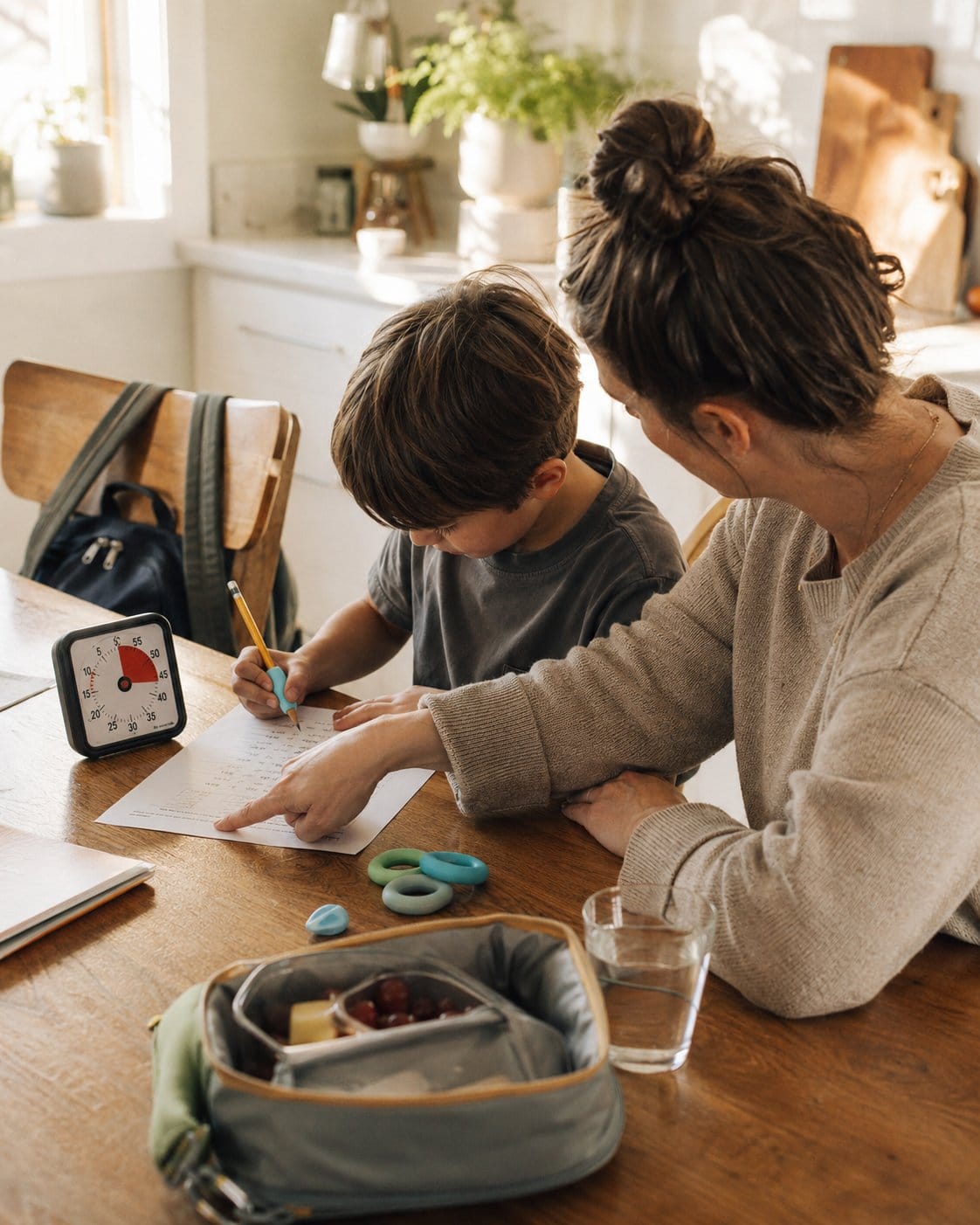
Child doing homework at a kitchen table with quiet fidget rings and a visual timer nearby
A good fidget keeps hands busy without asking the whole room to watch.

School asks ADHD kids to do the hardest things all at once: sit, listen, wait, filter noise, copy instructions, and keep their body from leaking energy into the chair legs.

The CDC classroom guidance for ADHD says adults should observe and talk with the student about what helps or distracts them, including fidget tools, because the same tool can help one child and derail another. CHADD describes classroom accommodations as changes to the structure or environment that help students learn the same material.

That is the spine of this whole list. A fidget is not a reward, a bribe, or a cute backpack accessory. It is a tiny accommodation that has to earn its place.

Develop a plan that fits the child.CDC, ADHD in the Classroom

The quiet fidgets most likely to survive school

Start with one tool, not a pencil case full of tiny temptations. Send it for a week, ask the teacher what happened, and believe the classroom data even if your kid insists it was “totally fine.” Kids are charming lawyers when a toy is on trial.

  • Best for silent pressure: textured stones or small hand rollers.
  • Best for finger picking: soft rings that roll or press.
  • Best for desk work: a flat silicone board or bendable wax sticks.
  • Best for breaks only: stretchy, squishy, bright, or social fidgets.
  • Best rule: eyes on teacher, fidget below desk, one hand only.

If focus fights mostly happen after school, the tool might be less important than the landing routine. Our homework refusal guide breaks down that after-school crash without blaming your child for running out of fuel.

Read nextWhen the focus problem shows up after school instead of during class: ADHD Child Refuses to Do Homework: What to Do Before the Fight Starts

A fidget for kids who need steady hand work

Some kids need a strong little job for their fingers. Pull, press, repeat. Nothing to launch, no pieces to trade, no glittery drama.
TOP SCHOOL PICK★ 4.5

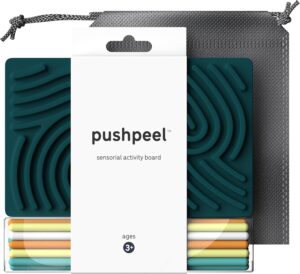
Pushpeel Sensory Activity Board

NoiseSilent
Best forOne-hand tactile input
Age3+
School fitGood when kept below desk

This one earns the top spot because it is quiet, contained, and hard to turn into a group performance. It gives a child something repetitive to do with their hands without adding slime, lights, sound, or runaway pieces to the classroom ecology.

Check price on Amazon

As an Amazon Associate, Decoded Kids earns from qualifying purchases. Price checked live on Amazon.

A fidget for kids who rub, pick, or chew pencils
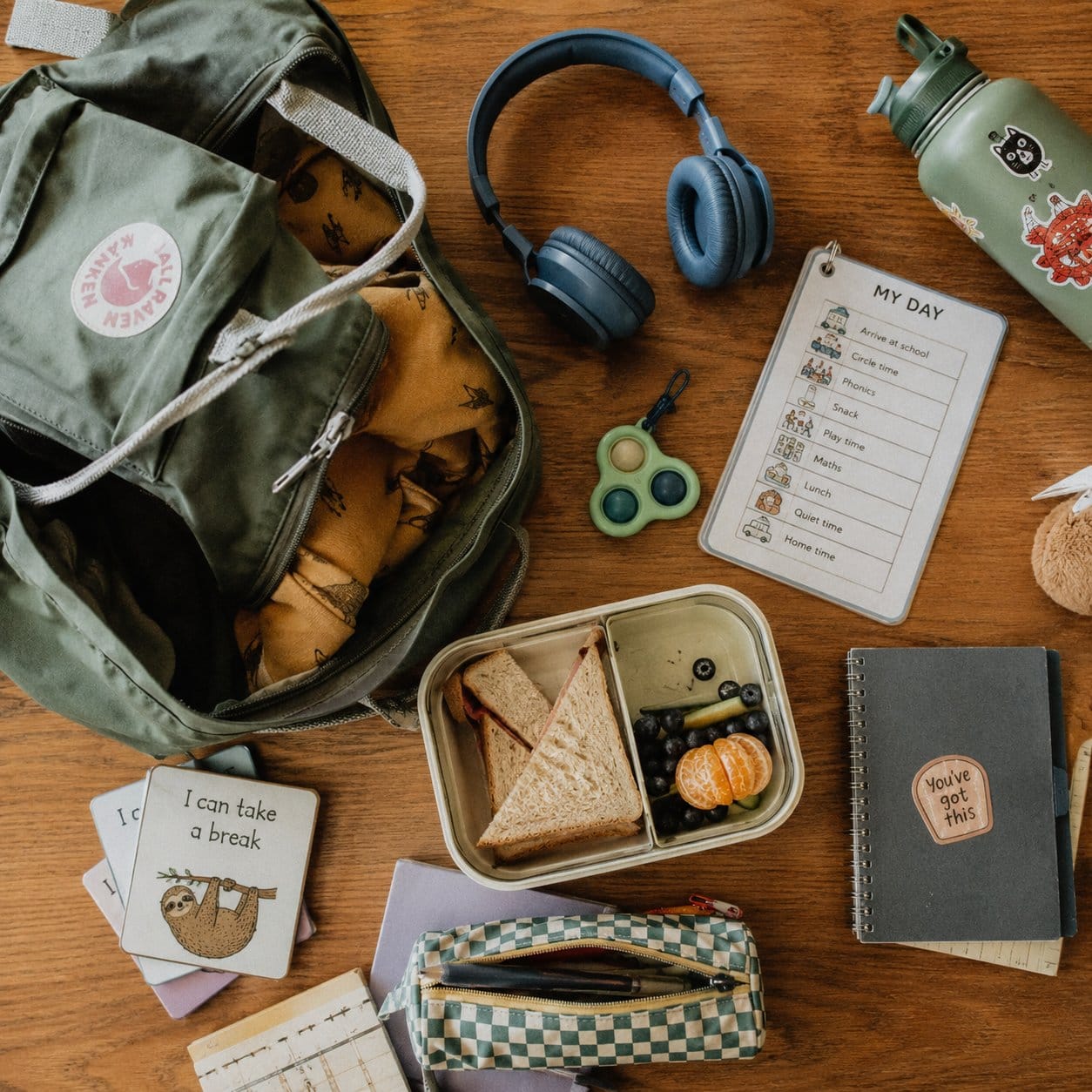
School sensory kit flatlay with headphones, visual schedule, lunchbox and small fidget tool
Pack one tool for the job, not a whole toy shop.

If your child picks at nails, sleeves, erasers, or scabs while listening, a small textured object can redirect that need without turning the desk into a circus. You are not trying to stop all movement. You are trying to make the movement less costly.

NoiseSilent
Best forNail picking or anxious hands
Pack6 stones
School fitVery easy to keep private

These are the closest thing to a worry stone for a school desk. They are not exciting, which is the compliment here. A child can rub one in a hoodie pocket or under the table while still looking up.

Check price on Amazon

NoiseSilent
Best forFinger rolling and pressure
Pack12 rings
School fitGood if your child does not trade them

Rings are useful when the problem is finger picking more than whole-body restlessness. The catch is social: a pack of twelve can become playground currency. Send one or two, not the whole stash.

Check price on Amazon

The fidgets I would keep for breaks

Some fidgets are wonderful and still wrong for direct instruction. Bright, bendy, stretchy, clever tools can be brilliant for the car, the counselor’s office, a calm corner, or a five-minute sensory break. In math class, they may steal the spotlight.

A 2022 classroom study on fidget spinners in children with ADHD, published in the Journal of Attention Disorders and available on PubMed Central, found the story was mixed: some movement changed, but the spinner itself could become highly rewarding and distracting. That is your warning label for anything too fun.

NoiseQuiet
Best forBendy tactile play
UseBreaks more than lessons
School fitAsk teacher first

This is satisfying in the hand, and that is exactly why I would not start with it for class instruction. It is better as a regulated break tool, especially for older kids who can put it away when the job changes.

Check price on Amazon

NoiseSilent
Best forFine motor play
Age3+
School fitBetter for breaks or OT-style work

Wikki Stix are quiet and low-mess, which makes them parent-beloved. During a lesson, though, they can turn into art time fast. I like them for waiting rooms, travel, and teacher-approved fine motor breaks.

Check price on Amazon

What not to send: anything that clicks, lights up, bounces, rolls, smells strong, leaks, stretches across the desk, or makes other kids say, “Can I try?” That is not a fidget anymore. That is a tiny classroom event.

How to ask the teacher without making it weird

Send a short note, not a dissertation. You want the teacher to hear partnership, not “I bought a thing and now you must manage it.”

Try: “We are testing one quiet hand tool for listening. If it distracts him or anyone else, please tell me and we will switch or keep it for breaks.” That line gives the teacher an exit, which makes them more likely to try.

If your child already has a 504 plan or IEP, ask whether a quiet fidget, movement break, or sensory item belongs in the accommodation language. If they do not, you can still test one informally, but a written plan helps when rules change between teachers.

For kids who need a bigger home setup around time and routines, the visual schedule printable guide pairs well with this. A fidget helps the hands. A visual schedule helps the next step stay visible.

Make the rule boring enough to work

Practice at home for five minutes before it ever enters a classroom. Reading time, worksheet time, audiobook time. Watch your child’s eyes. If the fidget gets more attention than the task, it is a break toy.

The rule I like is: “Quiet hands, listening eyes.” Imperfect, a little cheesy, but clear. If your child can use the tool while still answering a question about the story, you may have a school fidget. If not, no moral failure. Just data.

Read nextFor the kid whose main school struggle is time blindness, not busy hands: Best Visual Timers for Kids: The Ones We’d Actually Buy

Send the plain one first

The fidget your child loves most is often not the one school needs. Send the plain one first. Let the exciting one live in the backpack for after pickup, or at home next to homework, or in the car where nobody else has to learn beside it.

That is the quiet magic here. Not a miracle product. A smaller problem. Busy hands, quieter body, more room for the lesson to get in.

FAQADHD & Focus

Frequently asked questions

The best school fidgets are quiet, small, tactile, and boring enough not to become the lesson. Good options include textured stones, silicone boards, soft rings, bendable sticks, or one pocket-size fidget your child can use without looking down for long.

For some kids, yes, but not every fidget helps every child. Movement and tactile input can support attention, while loud or highly visual toys can pull attention away. Treat a fidget like an accommodation to test, not a magic fix.

Yes, if it breaks classroom rules or distracts other students. If your child truly needs one, ask the teacher about a written plan, 504 accommodation, or agreed classroom rule. The fidget should have a clear job and a clear stop point.

Avoid anything noisy, bright, messy, throwable, collectible, or exciting enough that other kids ask to play with it. Spinners, poppers, slime, stretchy strings, and squishies can work at home, but many classrooms find them too distracting during instruction.

Practice at home first. Say, “This is for listening hands, not playing hands.” Try it during reading or homework for five minutes. If your child watches the fidget more than the task, pick something plainer or use it only for breaks.

WHILE YOU’RE HERE…

Emotional Regulation Activities for Kids With ADHD: Small Things That Help Big Feelings Pass

Chore Chart for Kids With ADHD: A No-Nag Setup That Actually Gets Used

Parental Control Apps That Don’t Make You the Enemy: What We’d Actually Install

Referee, Judge, or Bystander: What Actually Works When Your Kids Fight

Children’s Reading Statistics 2026: What Every Parent Needs to Know

Parallel Parenting: How to Co-Parent Without Co-Operating

When You Have a Child From an Affair and a Wife You Never Wanted to Hurt

Outdoor Activities for Kids With ADHD: Screen-Free Summer Ideas That Actually Work

Yogasleep Hushh Review: The $25 Sound Machine That Goes Where Your Baby Goes

The Two Weeks Before School That Actually Matter

JOIN THE CONVERSATION

Leave the first comment

Share your thoughts

{“@context”:”https://schema.org”,”@type”:”BlogPosting”,”headline”:”Quiet Fidget Toys for Kids With ADHD at School: What Helps Without Getting Taken Away”,”description”:”A school-safe guide to quiet fidget toys for kids with ADHD at school, with teacher-friendly rules, product picks, and ADHD classroom support sources.”,”datePublished”:”2026-07-06″,”dateModified”:”2026-07-06″,”author”:{“@type”:”Person”,”name”:”Marcus Webb”},”publisher”:{“@type”:”Organization”,”name”:”Decoded Kids”,”url”:”https://parents-and-kids.com/”},”mainEntityOfPage”:”https://parents-and-kids.com/quiet-fidget-toys-kids-adhd-school/”,”image”:[“https://parents-and-kids.com/wp-content/uploads/2026/07/mom-daughter-breakfast-table-fidget-water-bottle-morning-white.jpg”,”https://parents-and-kids.com/wp-content/uploads/2026/07/mom-son-homework-visual-timer-fidget-rings-kitchen-white.jpg”,”https://parents-and-kids.com/wp-content/uploads/2026/07/school-essentials-flatlay-blue-headphones-visual-schedule-fjallraven-bento-fidget.jpg”]}
{“@context”:”https://schema.org”,”@type”:”FAQPage”,”mainEntity”:[{“@type”:”Question”,”name”:”What are the best quiet fidget toys for kids with ADHD at school?”,”acceptedAnswer”:{“@type”:”Answer”,”text”:”The best school fidgets are quiet, small, tactile, and boring enough not to become the lesson. Good options include textured stones, silicone boards, soft rings, bendable sticks, or one pocket-size fidget your child can use without looking down for long.”}},{“@type”:”Question”,”name”:”Do fidget toys actually help kids with ADHD focus?”,”acceptedAnswer”:{“@type”:”Answer”,”text”:”For some kids, yes, but not every fidget helps every child. Movement and tactile input can support attention, while loud or highly visual toys can pull attention away. Treat a fidget like an accommodation to test, not a magic fix.”}},{“@type”:”Question”,”name”:”Can a teacher take away my child’s fidget toy?”,”acceptedAnswer”:{“@type”:”Answer”,”text”:”Yes, if it breaks classroom rules or distracts other students. If your child truly needs one, ask the teacher about a written plan, 504 accommodation, or agreed classroom rule. The fidget should have a clear job and a clear stop point.”}},{“@type”:”Question”,”name”:”What fidget toys should kids avoid at school?”,”acceptedAnswer”:{“@type”:”Answer”,”text”:”Avoid anything noisy, bright, messy, throwable, collectible, or exciting enough that other kids ask to play with it. Spinners, poppers, slime, stretchy strings, and squishies can work at home, but many classrooms find them too distracting during instruction.”}},{“@type”:”Question”,”name”:”How do I introduce a fidget without making it a toy?”,”acceptedAnswer”:{“@type”:”Answer”,”text”:”Practice at home first. Say, “This is for listening hands, not playing hands.” Try it during reading or homework for five minutes. If your child watches the fidget more than the task, pick something plainer or use it only for breaks.”}}]}
{“@context”:”https://schema.org”,”@type”:”BreadcrumbList”,”itemListElement”:[{“@type”:”ListItem”,”position”:1,”name”:”Home”,”item”:”https://parents-and-kids.com/”},{“@type”:”ListItem”,”position”:2,”name”:”ADHD & Focus”,”item”:”https://parents-and-kids.com/category/adhd-focus/”},{“@type”:”ListItem”,”position”:3,”name”:”Quiet Fidget Toys for Kids With ADHD at School: What Helps Without Getting Taken Away”,”item”:”https://parents-and-kids.com/quiet-fidget-toys-kids-adhd-school/”}]}

Sofia Moreau
ADHD & Focus
Hi, I'm Sofia
Sofia Moreau
Years inside child-MH researchlearns from real specialistsdoesn't diagnose

I'm for the parent watching a feeling they can't name and wondering if it's normal. I've spent years close to the child-mental-health research and the specialists behind it, and I carry the heavy parts into plain language. I won't diagnose your child - I'll help you see what you're looking at, and say honestly when it's time to ask someone in person.

More from Sofia
Your turn

What finally made your child's focus click - even a little?

No right answers here - tell us how it actually went. Someone reading needs to hear it.

Join the conversation