
Nothing New on the Board, and He Ate Three of Them

You are at somebody else’s house. The table is full. There is a roast, three sides, a dish your aunt is proud of. Your child has eaten a bread roll and one piece of cheese, and is now asking if there is anything else.
Nothing on that table was made for a six year old. Not the way it is served, anyway.
That is the whole idea. It is not a recipe and it is not a craft project, even though the pictures make it look like one.
Why the board works when the plate does not

There is a study on exactly this. Liane Roe and her colleagues at Penn State served snacks to 61 children aged three to five at their childcare centre. Some snack times, the children were given one vegetable. Other times, they were given all three: cucumber, sweet pepper and tomato.
When there were three, the children ate about 31 grams more. That is roughly a sixth of what a child that age is meant to eat in a whole day, from one snack, with no new food and no persuading.
Nothing was added. The same vegetables were there. They were just next to each other, so choosing became a small pleasure instead of a demand.
This is the same principle underneath the division of responsibility, which is worth reading if mealtimes are hard all year and not just in December. You decide what goes out. They decide what they take.
What actually goes on it
Think in five jobs rather than in ingredients.
Something filling: crackers, bread cut into strips, plain pasta, rice cakes. Something with protein: cheese cubes, cold meat rolled up, boiled egg halves, chickpeas, a spoon of hummus. Something fresh: cucumber, pepper, cherry tomatoes, apple slices, grapes cut lengthways. Something sweet: two squares of chocolate, a few berries, a small biscuit. And something to dip in, because dipping is what makes a child touch a vegetable at all.
Five jobs, two or three items each. Fifteen small piles look enormous to a child and take about eight minutes to put out.
Cut everything smaller than you think. A cracker snapped in half reads as two things. A cheese cube quartered reads as four. The board is doing a trick with quantity, and it only works if the pieces are small enough for the trick to be worth it.
Leave one section empty on purpose. Children fill it themselves, usually with something from the fruit bowl, and a child who put something on the board eats what they put there.
The one rule that matters: put out very small amounts. A board that looks abundant with one cracker per pile is more appealing than a board with a heap of anything. You can refill. You cannot un-serve.
The container is doing more work than the food

You can use a chopping board and it will be fine. But if the foods touch, some children are finished before they start, and if it all has to come out again for the drive home, you will wish it had a lid.
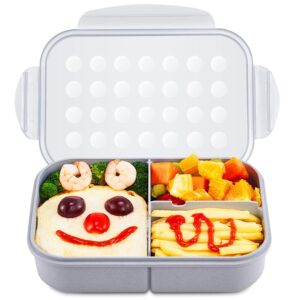
A box with real compartments solves both. The one below has four sections plus small picks and paper cups, which is the whole board in one object. The picks matter more than they should. A cube of cheese on a stick gets eaten. The same cube on the board gets ignored.
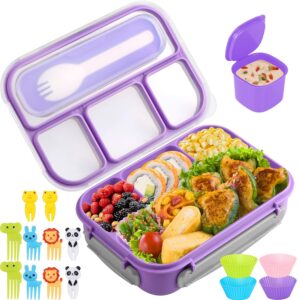
Bento Box for Kids 1300ML with 4 Compartment & Food Picks Cake Cups
As an Amazon Associate, Decoded Kids earns from qualifying purchases. Price checked live on Amazon.
If you are taking the board to somebody else’s house, take a lidded one and build it at home while nobody is watching you. Ten minutes at your own counter is calmer than ten minutes in a kitchen full of relatives asking whether he will eat that.
Three moments it earns its keep
The long afternoon before a big meal. Dinner is at four and it is one o’clock. A board on the coffee table stops the raiding of the kitchen and stops the crash that arrives at half past three. This is also the window where something for them to do makes the difference between a good day and a loud one.
At somebody else’s table. Put the board down near your child and let them eat from it while everyone else eats the roast. Nobody at that table needs to comment on it. If somebody does, the answer is that he is eating, which is the point.
The night the cooking runs late. A board is dinner. It has been dinner in our house more than once. Nobody has ever complained.
Where it stops working
It stops working if it becomes a performance. The versions online have skewers arranged into a tree, and cheese cut with a snowflake cutter, and grapes in a spiral. Those take an hour and get eaten in nine minutes by people who did not notice the spiral.
It stops working if you use it to introduce three new foods at once. One new thing on a board of known things is a fair offer. Four is an ambush, and children know the difference.
And it stops working if you hover. Put it down, say nothing, walk away. The whole advantage of a board is that it removes you from the middle of the meal. Standing over it puts you straight back there.
Most of the time, though, it does the thing you wanted. A child eats a reasonable amount without anybody raising their voice, on a day when everything else is already loud, and nobody has to be persuaded of anything.
Leave the first comment
Share your thoughts
Kids charcuterie board, answered
From about eighteen months, as long as everything is cut to a safe size. Grapes and cherry tomatoes should be quartered lengthways for under fives, and whole nuts left off entirely.
Work in five jobs rather than ingredients: something filling, something with protein, something fresh, something sweet and something to dip in. Two or three items per job is plenty.
One new thing next to known things is a fair offer. Several at once turns the board into a test, and children treat it as one.
No, a chopping board works. A box with real compartments helps if your child dislikes foods touching, or if you are carrying it to somebody else's house.
Build it up to two hours ahead and keep it covered in the fridge. Add crackers and anything that goes soft at the last minute.

I'm for the parent mid-meltdown - theirs or the kid's. I write from the actual floor of it: the crying that won't stop, the dinner thrown, the bedtime that unravels. Blunt because I respect you too much to pretend it's easy. Just what tends to actually work.
More from NourWhat's the one thing that actually calmed the chaos in your house?
No right answers here - tell us how it actually went. Someone reading needs to hear it.
Join the conversation