
The Traditions Cost Nothing and Those Are the Ones They Remember

Ask an adult what they remember about Christmas when they were eight, and you will almost never get a list of presents.
You get the drive to look at lights in pajamas. The aunt who always arrived two hours late. A film nobody actually liked but everybody watched anyway. The presents were opened, loved for two weeks, then absorbed into the pile in the corner. The brain filed them under nothing much.
This is not a sentimental idea that people say in December. It is one of the better documented findings in family research, and it has been sitting in the literature since 2002.
That is Barbara Fiese and her colleagues, then at Syracuse University, closing a review of thirty two studies in the Journal of Family Psychology. The paper draws a line worth carrying into December. A routine is something you do. A ritual is something that means something. Dinner is a routine. Dinner where everyone says one thing about their day is a ritual, and it is the second kind that keeps showing up in the results.
What makes something a tradition

Three things, and not one of them is money.
- It repeats. Same week, same night, ideally in the same slightly silly order.
- It has a marker. A song, a mug, a route, a phrase somebody always says. The marker is what the memory hangs on.
- It belongs to you. Not to the internet, not to your mother in law. Yours.
That is the whole recipe. A tradition is a small thing done on purpose, twice. The first year it is a nice evening. The second year your child says we always do this, and they are right, because now you do.
The ones that survive
These are the ones parents describe years later, and every one of them is free or close to it.
The drive or walk to look at lights. Coats over pajamas, one flask, no destination. It takes forty minutes and it is the single most named tradition when you ask adults what they remember.
The one evening with the good mugs. Pick a date in early December. Hot chocolate, the lamps off, the tree on. Twenty minutes. That is it.
The book that only comes out in December. One story, put away in January, unwrapped again next year. A book a child has heard eleven times is not boring to them. It is theirs. If you need a title to start with, we sorted the good ones in books to give kids at Christmas.
One job each. Someone always does the lights. Someone always makes the same terrible cookies. Being needed is stickier than being entertained, and children hold onto the job long after they outgrow the task.
Why the cheap ones outlast the expensive ones

An expensive tradition has to be justified, booked and survived. A trip that costs two hundred pounds is not repeated in the year money is tight, and a tradition that skips a year usually does not come back. The walk survives redundancy, illness, a new baby and a house move, because the only thing it needs is coats.
There is a second reason, and it is about attention. A big day out puts everyone in the role of audience. A small ritual at home puts a child in the middle of it, holding the flashlight, carrying the tray, choosing the song. Children remember what they did far better than what they watched.
None of this means presents are the enemy. It means the presents are not doing the job you think they are doing, which is worth knowing before you spend December trying to make the pile bigger. If the pile is already the problem, we wrote about that in too many toys.
Starting one this year without announcing it
Do not gather the family and declare a new tradition. It puts everyone on the spot and it almost never survives contact with a tired eight year old.
Do it instead. Pick one evening, do the thing, say nothing. Next year, do it again on roughly the same date, and this time say the sentence that does the work: this is what we do. That sentence is the entire mechanism. Children take it as fact.
Two practical notes. Keep it early enough in December that the week does not eat it, because the twenty third is already full and Christmas Eve has its own problems. And keep it short. A tradition your family can complete while tired is a tradition that gets repeated, which is the only thing that matters. If you want a ready made daily version, the advent calendar without the chocolate is the same idea spread over twenty four small days.
The one thing worth owning
Most of what makes December feel like December is not bought. There is one honest exception, and it is the object that comes back out every year, gets set up by the same child, and is put away in the same battered box.
A train that goes round the base of the tree is the classic version of this. It is not a toy that gets played with all year. It is a thing that appears, gets fought over slightly, runs for three weeks and then vanishes, which is exactly what makes it a marker rather than more clutter.
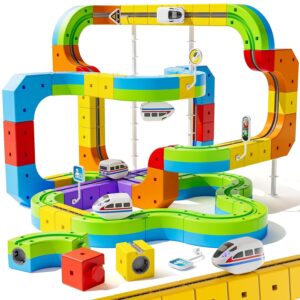
Electric Train Set
As an Amazon Associate, Decoded Kids earns from qualifying purchases. Price checked live on Amazon.
When a tradition stops working
They do stop, and it is not a failure. A nine year old goes quiet about the thing they loved at five. The usual reasons are that they have outgrown the part they were given, or that the tradition now happens to them rather than with them.
The fix is usually promotion rather than replacement. Give them the job you used to do. Let them choose the route, run the music, hold the matches under supervision. The ritual survives the age change if the child gets a bigger role in it.
The other thing that shifts is the calendar. The traditions that belonged to Christmas Day often move into the flat week between Christmas and New Year, which is where an older child suddenly has time for them.
And if a tradition really has died, let it go without a speech. Families are supposed to carry a few dead traditions around. The ones that lasted were never chosen carefully. They were the ones that happened to survive, twice.
Leave the first comment
Share your thoughts
Frequently asked questions
The walk or drive to look at lights, one hot chocolate evening with the lamps off, a book that only comes out in December, and giving every person one job they always do. All four repeat easily, need almost nothing, and survive the years when money is tight.
Repeated family rituals show up consistently in research on child adjustment and family identity, while individual gifts rarely do. The reason is repetition. A present happens once. A ritual happens every year, and the brain stores the pattern rather than the object.
Do it once without announcing it, then do it again next year on roughly the same date and say the words this is what we do. Keep it short and early in December so a busy week cannot eat it. Two repetitions is genuinely enough to make it stick.
Usually they have outgrown their role in it rather than the tradition itself. Hand them the job you normally do, or let them choose the route or the music. If it still does not work, drop it without ceremony. Most families carry a few retired traditions.

I'm for the parent standing in the bookshop, overwhelmed. I read them all - the wise, the smug, the single good idea stretched to 240 pages - so your nightstand stack stays short. I'll point you to what's truly worth it, and kindly, what to put back.
More from MeiWhat's the one thing that calmed the chaos in your house?
No right answers here - tell us how it went. Someone reading needs to hear it.
Join the conversation