
Seven Candles, One Black, and a Six-Year-Old Who Wants to Know Why
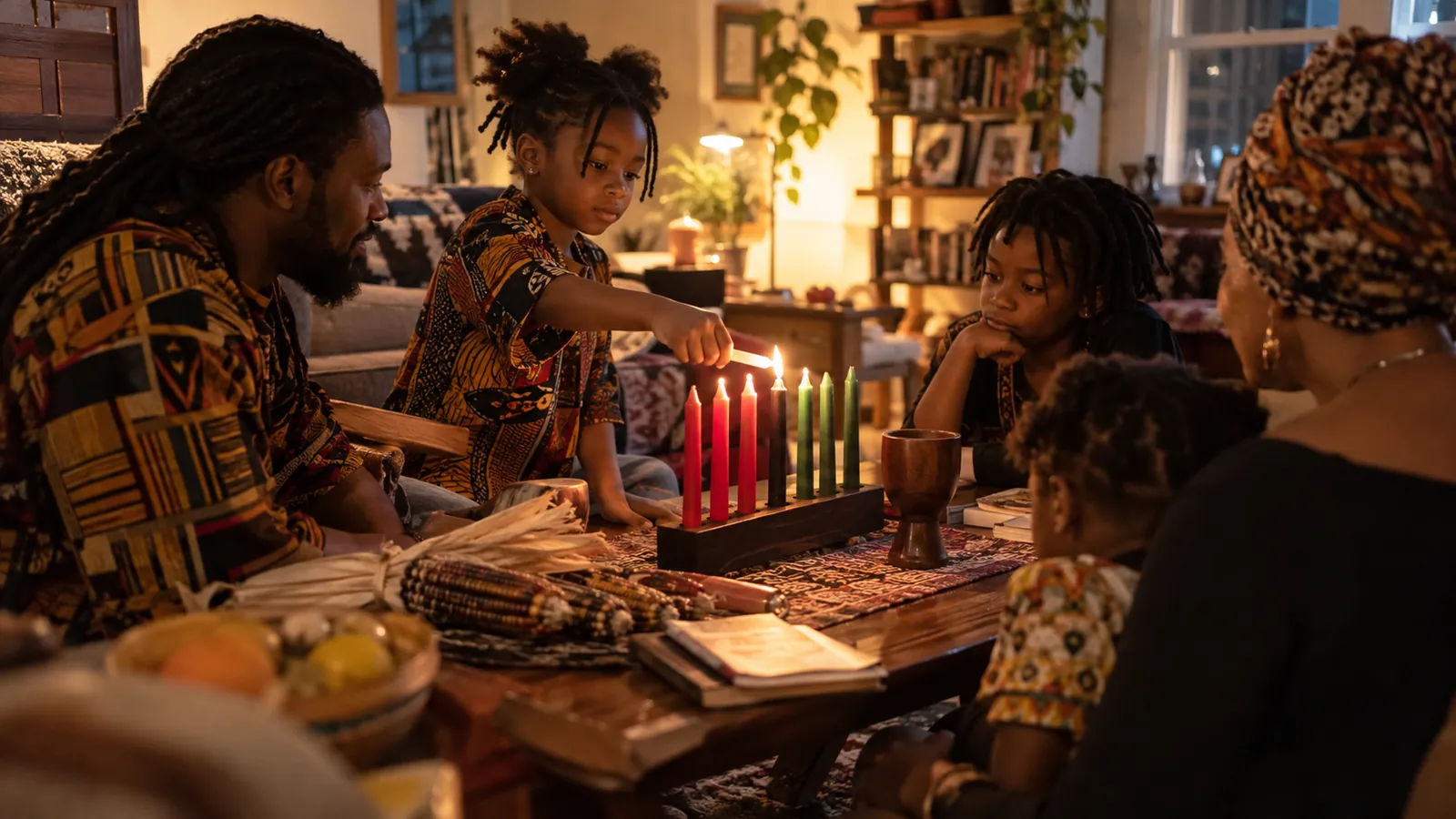
Your six-year-old has a library book open on the couch. She points at a picture of seven candles in a wooden holder and asks, “Why is the middle one black?”
Kwanzaa is a December holiday with candles, and past that your details get soft. She wants a real answer before bedtime.
The black candle stands for the people, and it gets lit first. That one answer opens up the holiday, and the rest is a few facts you can learn in one sitting.
How do you explain Kwanzaa to a child?
Start with the name. It comes from the Swahili phrase “matunda ya kwanza,” which means “first fruits.” CSUN’s history of the holiday says it grew out of harvest celebrations across Africa. The first one was held in 1966 at a home in Baldwin Hills, the same history says.
The extra a is the part kids remember. The Official Kwanzaa Website says that in the early days of the Organization Us, the group that founded the holiday, seven children each wanted to stand for a letter. Kwanza has six, so the group added an a to make seven.
It is a cultural holiday that families of many faiths keep. Who can join in? The official site calls it “an African holiday created for African peoples” and says other people can and do celebrate it too. It adds that attending a celebration is one thing and conducting the ritual is another. A good first step is a community event, where your child can watch and ask.
What are the seven principles, in words a child can say?
The seven principles are called the Nguzo Saba, and each day belongs to one. The official wording is grown-up, so these are kid-sized versions.
- December 26, Umoja (unity): “We stay together.”
- December 27, Kujichagulia (self-determination): “I get to say who I am, and I speak up for myself when it matters.”
- December 28, Ujima (collective work and responsibility): “When one of us has a problem, we solve it together.”
- December 29, Ujamaa (cooperative economics): “We build shops and businesses of our own and share what they earn.”
- December 30, Nia (purpose): “Everyone’s job builds our community, and we know why.”
- December 31, Kuumba (creativity): “We leave things more beautiful than we found them.”
- January 1, Imani (faith): “We believe in our people, our parents and our teachers.”
Kwanzaa’s greeting is “Habari gani?” (what’s the news?). The answer is that day’s principle. A child who knows the list can answer at breakfast and tell you at dinner what it looked like at school.
What goes on the Kwanzaa table?
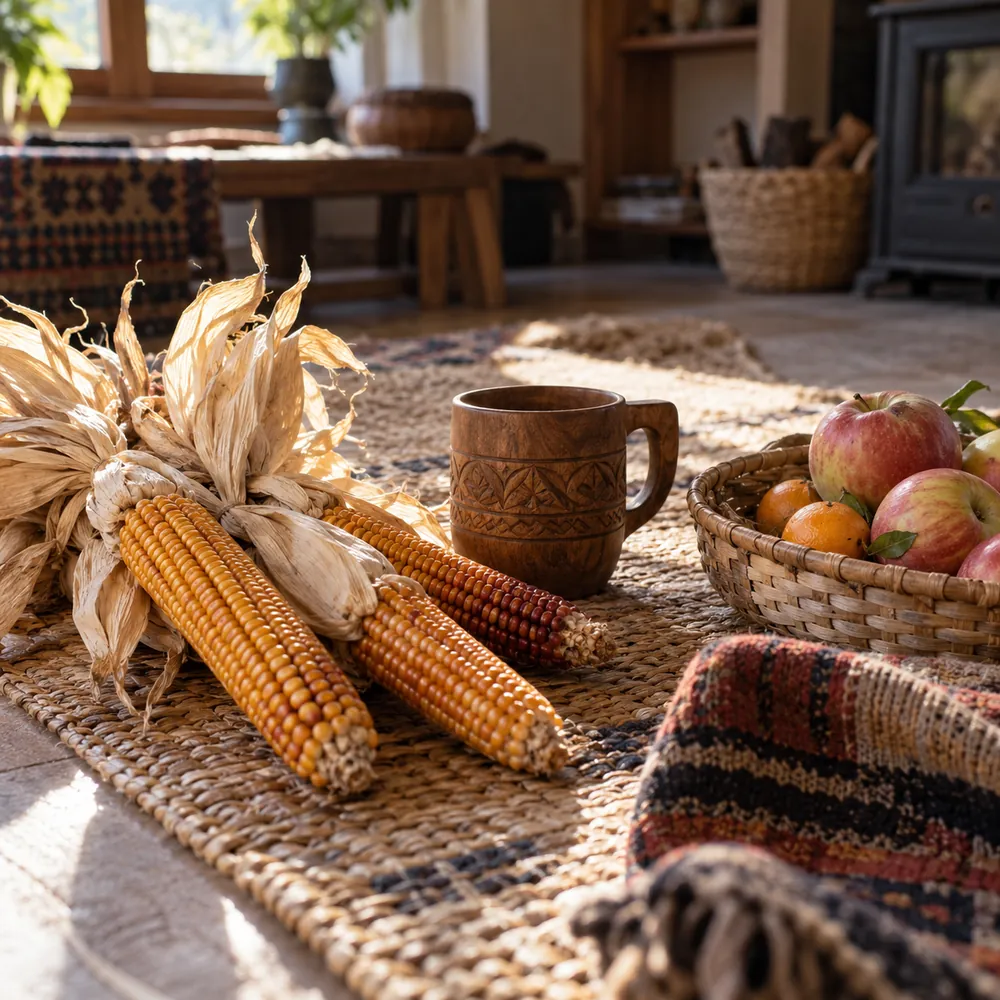
Kwanzaa has seven basic symbols. The official site says a family picks a central spot in the home, spreads a cloth on a table, and lays down the mkeka, the mat. Everything else sits on it or beside it. The kinara goes on the mat, and the seven candles go in the kinara.
Each piece has a meaning a child can repeat. The mat stands for tradition and history, the foundation you build on. The kinara stands for roots. Mazao, a basket of fruit and vegetables, stands for the harvest and the rewards of shared work. Muhindi, the corn, stands for children and the future, so tell your child the corn means her.
Zawadi, the gifts, stand for the labor and love of parents and the commitments children make and keep. The kikombe cha umoja, the unity cup, stands for the unity that makes the rest possible.
How does the candle lighting work?
The kinara holds one black candle, three red and three green. Black stands for the people, red for their struggle, and green for the future and the hope that comes from it, the official site says. Black sits in the middle, red on the left and green on the right.
Only the black candle is lit on the first night. After that, the remaining candles are lit “from left to right on the following days,” the official site says. Other accounts have red and green candles lit in alternating order, so ask whoever you follow which pattern they use. Either way, one more candle joins the others each night.
Each night an older child can light that night’s candle, with an adult right beside the match, while the family talks about its principle. A child who knows the Hanukkah menorah may expect nine candles, so count the kinara’s seven together on the first night. Our guide to Hanukkah activities covers that other candle holiday.
December 31, the sixth night, is the big one. CSUN says it typically brings a feast called karamu, with libations poured to honor the ancestors. January 1 is quieter. The official site calls it the Day of Meditation, a time to look back and recommit. A child can do that with a resolution small enough to keep.
What can a child make or do at Kwanzaa?
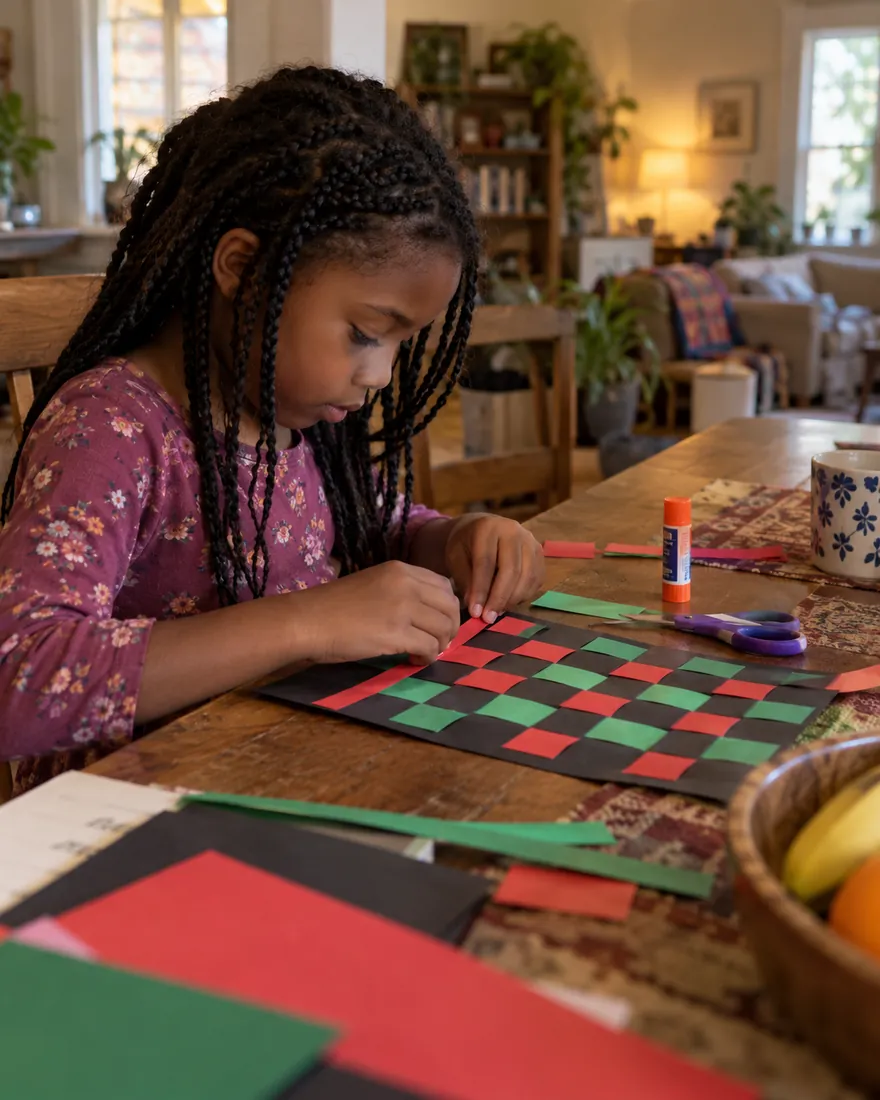
The official site’s page for children lists jobs, from lighting the candles to helping with the food. Five jobs fit an ordinary week.
Weave a paper mkeka. Cut slits across a black sheet, weave red and green strips through, and glue the ends. A 5- to 8-year-old can weave it, and a preschooler can glue strips down flat.
Let her fill the mazao basket, picking and arranging the fruit and vegetables herself. At dinner, our gratitude questions that go past the usual list keep the answers from repeating.
Make a zawadi. The official site says gifts go mainly to children and must always include a book and a heritage symbol. A gift the child makes fits its idea of commitments made and kept, and homemade gifts kids can make has ideas. For the book, PBS KIDS lists My First Kwanzaa by Karen Katz, or browse books to give instead of a toy.
Give a toddler the color job. A two-year-old can color seven paper candles red, black and green and stick them on a paper kinara, then point to the one that gets lit tonight. She does not need to say Kujichagulia, and you hold every match.
Last, hand her one food job on the sixth night, like washing greens or setting out cups. The official site says children should be given a small but meaningful project.
Start with the black candle
Tonight, answer the question she asked. The middle candle is black because the people come first, and that is also why it is the first one lit on the first night. Tell her about the extra a if she wants more, and skip the rest until she asks. The other six can wait.
Leave the first comment
Share your thoughts
Frequently asked questions
Kwanzaa lasts seven days, from December 26 to January 1, and began in 1966. Its seven principles are called the Nguzo Saba. The kinara holds three red candles, one black and three green. The word means “first fruits” in Swahili, and an extra a was added so it has seven letters.
A toddler can color seven paper candles and stick them on a paper kinara. A preschooler can glue paper strips into a simple mat, wash fruit for the basket, or set out the corn. Adults handle every real flame, and paper crafts stay away from candles.
Yes. The Official Kwanzaa Website encourages children to join in traditional and contemporary song and dance. The picture book Seven Days of Kwanzaa is written to the tune of “The Twelve Days of Christmas,” and libraries and children’s museums post storytime videos on YouTube. Watch any video first, since quality varies.
My First Kwanzaa by Karen Katz suits little ones. Li’l Rabbit’s Kwanzaa by Donna L. Washington is rated for ages 3 to 6 by Colorín Colorado. Seven Spools of Thread by Angela Shelf Medearis teaches the seven principles through a story about brothers and shows how to make a belt.
Yes, with care. The Official Kwanzaa Website says other people can and do celebrate Kwanzaa, and that the people whose holiday it is should conduct their own celebrations. A community event, library program or friend’s invitation is a good start, because your child can watch, ask questions and learn the seven principles.
For nearly two decades I was the youth mentor across from the angry kid, the silent one, the parents out of ideas. I write the way I listened - slow, steady, never from above. If tonight feels heavy, I hope this felt like having someone in the room.
More from TheoWhat's the one thing that calmed the chaos in your house?
No right answers here - tell us how it went. Someone reading needs to hear it.
Join the conversation