
Books & Guides

How to Pick a Parenting Book Without Wasting $20

7 min read · parent-tested

How to Pick a Parenting Book Without Wasting $20

BY HANNAH REEVE · PUBLISHED 23.06.2026 · REVIEWED FOR ACCURACY · 7 MIN READ
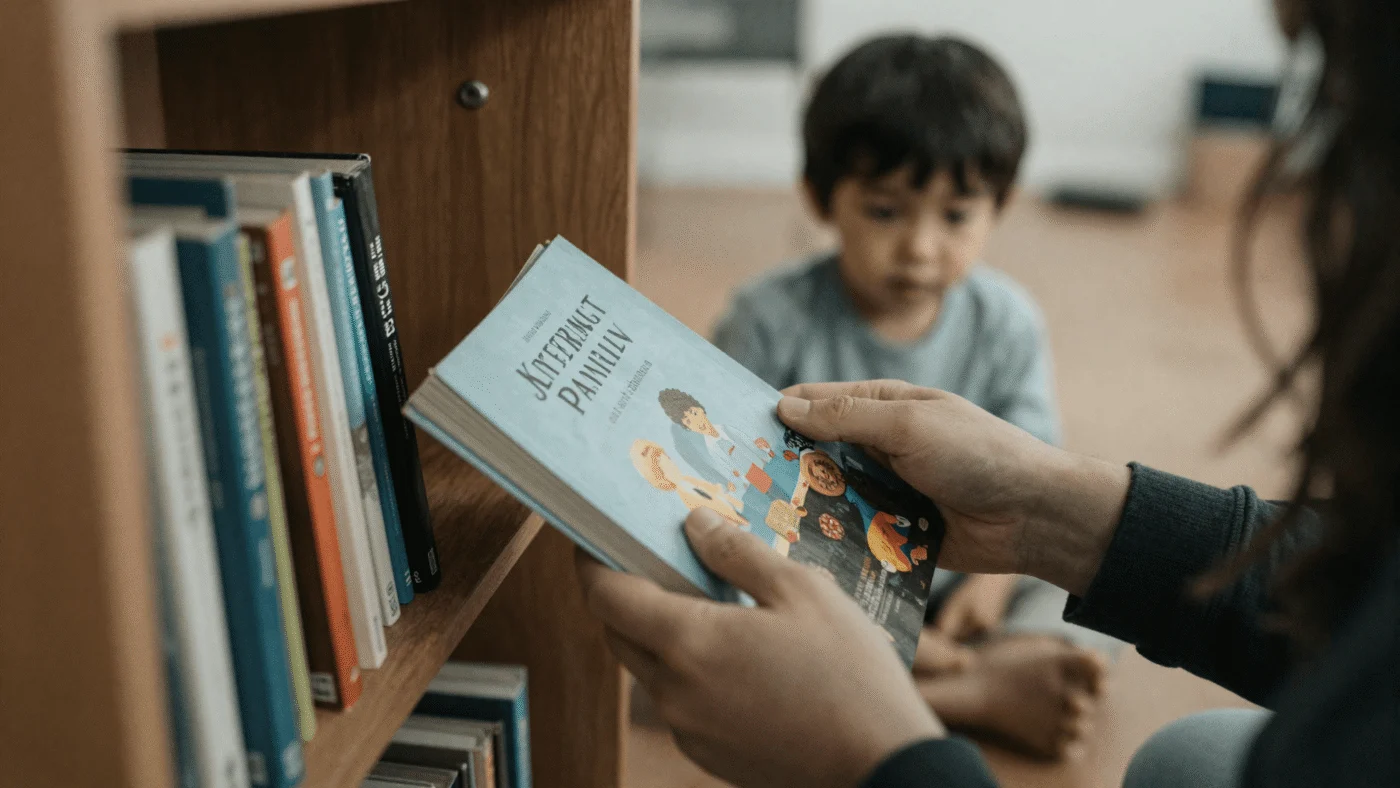
Parent choosing a parenting book from a shelf in warm natural light

You have the tab open, your child has been asleep for maybe twenty minutes, and every parenting book suddenly promises to be the one that will make tomorrow less feral.

That is how the wrong book gets bought: tired brain, shiny reviews, one hard evening still buzzing in your chest. A better way to pick a parenting book is to start with the exact moment you keep living through, then check whether the book sounds like your child, your house, and your actual energy level.

Some books are lovely and still useless for your Tuesday. Some are a bit plain and end up changing the whole school run. Anyway, the goal is not a perfect shelf. It is one idea you can use before the bookmark disappears under laundry.

The best parenting book is not the cleverest one. It is the one that meets you in the hour you keep losing.

01

Name the actual problem first

Start with the worst ten minutes of your day, not the bestseller list. Bedtime? The school run? Homework? The scream when you say no? The moment your child hits, bites, bolts, freezes, or suddenly seems impossible to reach?

Write it in one ugly sentence: “I need help with the 7:40am shoe fight,” or “I need help when my child explodes after school.” That sentence becomes your filter. A general parenting book can be comforting, but a book that speaks to the exact stuck place will earn its price much faster.

If the problem is behaviour, look for pages that talk about skills, nervous systems, routines and repair. If the problem is you feeling alone, look for a book that steadies you as much as it instructs you.

Specific beats famous when you are buying help for a real child, in a real kitchen, on a real bad morning.

02

Match the book to your child, not the chart

A book that works beautifully for a calm, flexible child may do very little for a sensory kid who panics at socks, or a child who would rather argue for forty minutes than put one worksheet in a folder. You need the author to describe a child who sounds uncomfortably familiar.

That matters with temperament too. A child who melts down from overwhelm needs different advice than a child who is testing limits for sport. A child with ADHD may need structure that is visual, short and repeated; that is why our ADHD parenting books guide leans practical instead of pretty.

Research language can help, but only when it lands in real life. Diana Baumrind’s work on parenting styles is one reason many modern books talk about warm boundaries instead of cold control. Good. But if a book turns that into a smug lecture, put it back.

Read nextIf ADHD is part of the picture The ADHD Parenting Books That Are Actually Worth It

03

Read the bad reviews on purpose

The five-star reviews tell you the dream. The one and two-star reviews tell you the catch, and that is often more useful when you are tired and trying not to waste money.

Look for patterns, not one angry rant. “Great if you have two calm adults and endless time” is a useful warning if you are solo, stretched, or co-parenting through clenched teeth. “Too much theory, not enough examples” matters if you need tonight’s script, not a graduate seminar.

Also check whether the author gives you actual language to use. When your child is mid-meltdown, a beautiful paragraph about connection may not help unless it becomes a sentence you can say out loud without sounding like a laminated poster.

If what you really need is scripts for big feelings, start with a live problem like what to do when your child hits or bites, then choose a book that gives you more of that same practical shape.

04

Check who the book is really serving

Some books are books. Some are a sales funnel wearing a soft cardigan. That does not automatically make them bad, but it changes what you are buying.

Good signs: the author admits their approach will not suit every family, mentions when professional support is needed, and gives you a few ideas you can try without buying a course. Bad signs: every problem gets traced back to one magic cause, every solution leads to a paid programme, and the tone makes you feel smaller by page seven.

For basic behaviour tools, it can help to compare a book’s advice with a neutral source like the CDC’s Essentials for Parenting. If the book makes ordinary things like praise, limits, consistency and connection sound wildly proprietary, tiny alarm bell.

This is also where you check the author’s lane. A therapist writing about trauma, a psychologist writing about ADHD, a teacher writing about classroom behaviour: each can be useful. Just notice when someone is speaking far outside what they actually know.

05

Buy one, then make it prove itself

Buy one book, not a stack. I know. The stack feels safer because it looks like action, and sometimes the buying part is the only bit of parenting that feels controllable.

Read the chapter that matches this week’s problem first. Try one idea for seven days. If it helps, keep going. If it makes you feel judged, lost or weirdly more exhausted, you are allowed to stop. The book failed the fit test; you did not fail the book.

For separated families, the “right” book may be less about behaviour and more about keeping your child steady between homes. That is where a focused guide like the co-parenting books that actually helped will beat a giant general parenting title.

Read nextIf the hard bit is parenting across two homes The Books That Got Me Through Co-Parenting

Keep one soft rule: the next book has to answer a question the last one could not. That stops the panic-buying spiral and makes the whole thing feel less like homework. Which, frankly, you already have enough of.

FAQBooks & Guides

Frequently asked questions

Start with the exact problem you need help with, not the most famous title. A book about meltdowns will help more than a general parenting book if meltdowns are the thing breaking your evenings. Match the book to your child, your house and your energy level.

Not automatically. A newer edition matters when the book is science-heavy or tied to diagnosis, ADHD, sleep or child development research. For everyday scripts, routines and reassurance, an older secondhand book can still be the better buy if it fits your real problem.

Be careful with books that blame one single cause for every behaviour, promise fast transformation, make you feel ashamed, or push you toward a paid course before giving useful help. A good parenting book has limits, examples and room for different families.

One good fit at a time. Read the chapter that matches this week’s problem, try one idea, and only buy another book when you hit a question the first one cannot answer. One used idea is better than five half-read books making you feel guilty.

Hannah Reeve, parenting writer
Hannah Reeve
Parenting writer & former preschool teacher · mum of two
WHILE YOU’RE HERE…

Making One Income Stretch: A Single-Parent Money Guide

Baby Sleeping Products Not to Buy: Safer Swaps Worth the Money

When School Suddenly Feels Too Big

The ADHD Parenting Books That Are Actually Worth It

Top 5 Sensory Tools for Kids That Actually Get Used

The Books That Got Me Through Co-Parenting

Telling Your Kids You’re Separating

Baby Sleeping Products Worth Buying: 4 Safe Picks I Would Actually Use

When Your Child Seems Numb, Not Naughty

ADHD Morning Routine Chart for Kids: A No-Shouting Setup

JOIN THE CONVERSATION

Leave the first comment

Share your thoughts

KNOW FIRST.

© 2026 DECODED KIDS — PARENTING, DECODED.