
Best Chore Charts for Kids: the Ones That Survive the Week Your Kid Stops Caring

A chore chart is the most returned-to, least-thought-about purchase in the whole parenting-tools aisle. You buy one in a burst of Sunday-night optimism, it works for a glorious nine days, and then it quietly becomes fridge wallpaper. So the real question was never “which chart is prettiest.” It’s which one survives the week your kid stops caring.
We pulled the best-reviewed chore and routine charts on Amazon, sorted them by the job they’re actually for — reusable daily routine, sticker motivation, multiple kids, looks-good-on-the-fridge, or full-family digital — and scored them on our own criteria. Here’s the honest spread.
First, the uncomfortable truth about chore charts
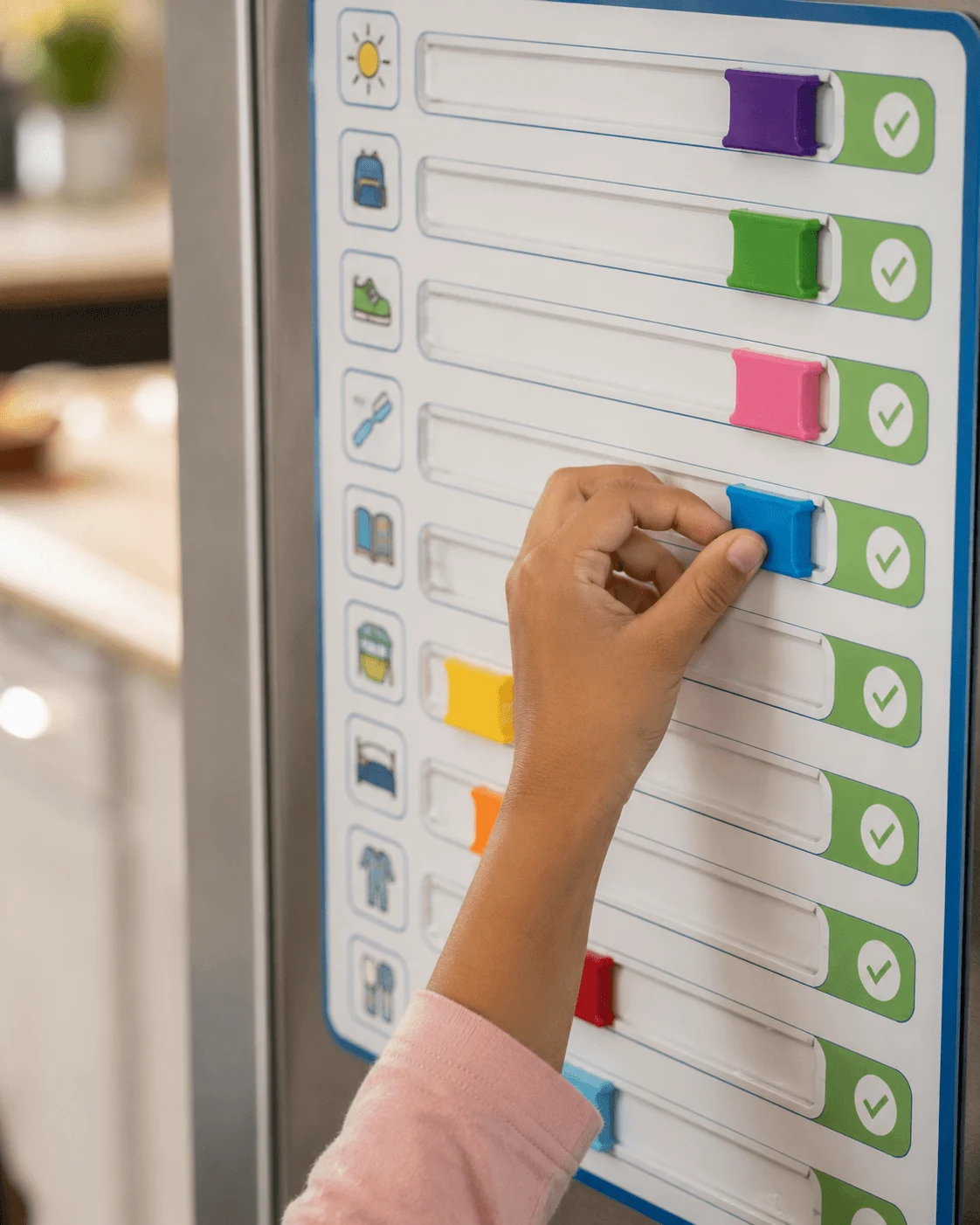
Most charts don’t fail because they’re badly made. They fail because a chart is a display, not a system. The novelty carries the first week, the brain habituates, and by week three your kid walks past it the way you walk past a motivational poster at work. The board only keeps working if the routine behind it is built to stick — consistent timing, tiny steps, and a grown-up who follows through.
So before you buy anything: if you haven’t set the routine up yet, start with our no-shouting morning-routine setup, then come back and pick the board that fits it. The chart is maybe twenty percent of whether this works. This guide is about getting that twenty percent right without wasting money.
How we scored these
One honesty note on the numbers below: a chart with a couple thousand reviews has genuinely been lived with by a couple thousand families, which is the closest thing to proof a product has. Where a pick has only a hundred-odd reviews, we say so — it might be great, it just hasn’t been tested by the crowd yet.
The best chore charts, by what they’re actually for
| Chart | Rating | DK score | Best for |
|---|---|---|---|
| Dry-Erase Slider Routine BoardTop pick | 4.5 · 1,205 | 8.7 | Reusable daily routines, ADHD, kids who read |
| Behavior Reward Chart + 2,800 Stickers | 4.6 · 2,161 | 8.3 | Younger kids motivated by earning a sticker |
| Skylight 15″ Digital Calendar | 4.4 · 6,522 | 8.0 | Whole-family schedule + chores on one screen |
| 4-Piece Sliding Chart (multi-kid) | 4.2 · 555 | 7.6 | Two to four kids who each need their own |
| Acrylic Transparent Magnetic Chart | 4.4 · 113 | 7.4 | A minimalist look that isn’t classroom-y |
1. Dry-Erase Slider Routine Board
Budget · 4.5★ (1,205)
Get it if
- You want a reusable daily routine with nothing to run out of
- Your child is old enough to read the task words
- You like the low-friction slide-to-done motion (great for ADHD)
Skip it if
- Your child is too young to read and needs pictures
- You specifically want the sticker-reward dopamine hit
- You need a separate board colour-coded per kid
Our top pick because it removes the two things that kill chore charts: running out of stickers and re-drawing the list. Ten sliders, a wipe-clean surface, a magnet for the fridge. It’s the one we’d set up first and only replace if the kid clearly needs rewards instead of a routine.
2. Behavior Reward Chart System (2,800 Stickers)
Budget · 4.6★ (2,161)
Get it if
- Your child is young and lights up at earning a sticker
- You want a visible streak they can be proud of
- You’d use the 26 pre-printed charts for different goals
Skip it if
- You hate consumables — stickers do run out
- Your kid is old enough to find stickers babyish
- You want one reusable board, not a pad
The best-reviewed of the bunch, and for good reason: for a three-to-six-year-old, the sticker is the motivation. Just go in knowing it’s a consumable — the reward that makes it work is also the thing you’ll rebuy. Many families start here and graduate to the reusable board above.
3. Skylight 15″ Digital Calendar & Chore Chart
Premium (~$299) · 4.4★ (6,522)
Get it if
- You want the whole family’s schedule and chores on one synced screen
- You never want to re-draw or re-sticker anything again
- You’ll actually use the companion app
Skip it if
- You just need a kid’s chore chart — this is wildly overkill
- A few hundred dollars for a chart is a hard no
- You’re trying to add fewer screens, not more
Genuinely excellent and genuinely too much for most people who searched “chore chart.” With 6,522 reviews it’s the most proven product here, but it’s really a family command-centre that happens to do chores. Buy it if you want the whole household on one screen; skip it if you just want your seven-year-old to brush their teeth.
4. 4-Piece Sliding Chart (for Multiple Kids)
Budget · 4.2★ (555)
Get it if
- You have two to four kids who each need their own board
- You want a reusable set, not one shared list
- You’d use it for travel or an RV too
Skip it if
- You only have one child (a single board is plenty)
- You want the most proven track record here
- You’d rather write your own tasks than use fixed ones
The honest pick for a full house: four separate sliding boards so nobody argues over whose turn it is. It carries the lowest rating and smallest review count of our reusable options, so temper expectations on finish — but for splitting routines across siblings without buying four separate charts, it’s the tidy answer.
5. Acrylic Transparent Magnetic Chart
Mid · 4.4★ (113)
Get it if
- You want it to look like decor, not a classroom
- Teens or adults will use it too, not just little kids
- You like that it comes with markers and an eraser cloth
Skip it if
- You want a proven track record — it has only 113 reviews so far
- Budget is tight (you pay a little for the look)
- You need pre-set routine steps rather than a blank board
The one for people who can’t stand the primary-colour cartoon look. Clear acrylic, wipe-clean, adult enough to leave on the fridge without wincing. Fair warning: with just 113 reviews it’s the least battle-tested pick here, so it’s a style-first choice rather than a safe-bet-by-numbers one.
You might not need to buy anything. A fridge, a dry-erase marker, and a routine your kid actually helped build will out-perform any board they didn’t buy into. Our no-shouting routine-chart setup walks through the free version first — buy a board only once you know the routine sticks.
So which chart should you actually buy?
Match it to the kid, not the aesthetic. Most families are best served by the reusable dry-erase slider board — nothing runs out, and an ADHD kid can work it alone. A young child who lights up at rewards will do better with the sticker chart. Two or more kids? The 4-piece set ends the whose-turn fights. Want it to look grown-up? The acrylic. Want the whole household synced and you’ll actually use an app? The Skylight, eyes open about the price.
And if the mornings themselves are the battle, not the chart, that’s a different fix — our no-shouting morning setup and the homework-focus tools cover the routines these boards are meant to hang onto.
Frequently asked questions
They work when paired with a consistent routine and realistic expectations — the chart is a visual cue, not the motivation itself. Reusable boards last longer for daily routines; sticker charts help younger kids who respond to earning a visible reward.
A reusable dry-erase board with sliders or checkboxes, like our top pick, works well because it’s visual, low-friction, and has no stickers to run out. Keep the steps short and pair it with a visual timer for the sense of how long each task takes.
Sticker charts suit younger kids motivated by earning a reward; dry-erase and slider boards suit daily routines and older kids because they’re reusable and never run out. Many families use a sticker chart first, then move to a reusable board as the child grows.
Picture-based charts work from around age two to three; word-based routine boards suit readers from about five. Match the format to whether your child can read the tasks yet, and keep the list to a few steps at any age.
Leave the first comment
Share your thoughts

I'm for the parent about to spend money they're not sure about. I buy the gadget, live with it, and give you the honest verdict - including the 'don't'. I've burned through enough hype to save you the cash, and when something truly earns its place, I'll show you exactly why.
More from TylerWhich tool actually earned its place - and which was a waste of money?
No right answers here - tell us how it actually went. Someone reading needs to hear it.
Join the conversation