
.dkp-wrap{padding:22px 16px 60px;} .dkp-panel{max-width:900px;margin:0 auto;background:#F04A23;border-radius:22px;box-shadow:0 50px 140px -20px rgba(0,0,0,.7);padding:clamp(26px,5vw,46px) clamp(20px,5vw,48px) 50px;color:#141414;font-family:Marcellus,Georgia,serif;} .dkp-htop{display:flex;align-items:center;justify-content:space-between;margin-bottom:26px;} .dkp-pill{display:inline-block;border:1.5px solid rgba(10,10,10,.5);border-radius:999px;padding:6px 16px;font-family:Marcellus,serif;font-size:12px;letter-spacing:.06em;text-transform:uppercase;color:#0A0A0A;text-decoration:none;} .dkp-pill:hover{background:#0A0A0A;color:#F04A23;} .dkp-close{display:inline-flex;width:42px;height:42px;border:1.5px solid rgba(10,10,10,.4);border-radius:999px;align-items:center;justify-content:center;font-size:16px;color:#0A0A0A;text-decoration:none;transition:background .3s,color .3s;} .dkp-close:hover{background:#0A0A0A;color:#F04A23;} .dkp-title{font-family:Fraunces,’Cormorant Garamond’,serif;font-weight:600;font-size:clamp(31px,5.4vw,50px);line-height:1.04;letter-spacing:-.015em;color:#0A0A0A;margin:0 0 14px;} .dkp-byline{font-family:Marcellus,serif;font-size:12px;letter-spacing:.05em;color:rgba(10,10,10,.6);margin:0 0 26px;text-transform:uppercase;} .dkp-herofig{margin:0 0 30px;} .dkp-herofig img{display:block;width:100%;height:auto;border-radius:16px;box-shadow:0 30px 70px -34px rgba(0,0,0,.55);} .dkp-herofig figcaption{margin-top:.7em;font-family:’Cormorant Garamond’,serif;font-style:italic;font-size:1rem;color:rgba(10,10,10,.58);text-align:center;} .dkp-body{font-size:1.16rem;line-height:1.82;color:#1b1b18;} .dkp-body p{margin:0 0 1.25em;} .dkp-body h2{font-family:Fraunces,’Cormorant Garamond’,serif;font-weight:600;font-size:clamp(24px,4vw,33px);line-height:1.13;color:#0A0A0A;margin:1.95em 0 .5em;clear:both;} .dkp-body a{color:#15397F;text-decoration:underline;text-underline-offset:3px;text-decoration-thickness:1px;} .dkp-body a:hover{color:#0A2257;} .dkp-body ul{margin:1.3em 0;padding:0;list-style:none;} .dkp-body ul li{position:relative;padding:0 0 0 1.6em;margin:0 0 .8em;} .dkp-body ul li::before{content:”;position:absolute;left:.2em;top:.6em;width:7px;height:7px;border-radius:50%;background:#0A0A0A;} .dkp-body strong{color:#0A0A0A;} .dkp-quote{margin:2.1em 0;text-align:center;font-family:’Cormorant Garamond’,serif;font-style:italic;font-size:clamp(22px,3.4vw,30px);line-height:1.32;color:#0A0A0A;position:relative;padding-top:.4em;clear:both;} .dkp-quote span{display:block;width:46px;height:2px;background:rgba(10,10,10,.5);margin:.7em auto 0;} .dkp-key{margin:1.9em 0;padding:1em 1.3em;background:rgba(10,10,10,.08);border-left:3px solid rgba(10,10,10,.6);border-radius:14px;font-family:’Cormorant Garamond’,serif;font-style:italic;font-size:1.3rem;line-height:1.42;color:#0A0A0A;clear:both;} .dkp-callout{margin:1.9em 0;padding:1.1em 1.35em;background:rgba(10,10,10,.08);border-radius:16px;font-size:1.04rem;line-height:1.68;color:#1b1b18;clear:both;} .dkp-callout strong{color:#0A0A0A;} .dkp-fig{margin:1.9em 0;} .dkp-fig img{display:block;width:100%;height:auto;border-radius:16px;box-shadow:0 30px 70px -34px rgba(0,0,0,.5);} .dkp-fig figcaption{margin-top:.7em;font-family:’Cormorant Garamond’,serif;font-style:italic;font-size:1rem;color:rgba(10,10,10,.58);text-align:center;} .dkp-appwrap{margin:1.9em 0;padding:1.3em 1.5em;background:rgba(10,10,10,.08);border-radius:16px;clear:both;} .dkp-appwrap h3{font-family:Fraunces,’Cormorant Garamond’,serif;font-weight:600;font-size:1.3rem;margin:0 0 .4em;color:#0A0A0A;} .dkp-appmeta{font-family:Marcellus,serif;font-size:.9rem;letter-spacing:.03em;color:rgba(10,10,10,.7);margin:0 0 .8em;text-transform:uppercase;} .dkp-panel .pk-faq{margin:34px 0 4px;clear:both;} @media(max-width:600px){.dkp-panel{padding:22px 18px 32px;border-radius:18px;}.dkp-body{font-size:1.08rem;}}

Parental Control Apps That Don’t Make You the Enemy: What We’d Actually Install

A mother and her teenage daughter talk in the car on a rainy school run, the daughter holding her phone
The app matters less than the conversation happening around it.

You typed “best parental control app” into search at 11pm after finding something on a group chat you weren’t supposed to see, and now you have eleven browser tabs open and a creeping feeling that whatever you install is either going to do nothing or turn you into the kind of parent your kid stops talking to. Both fears are reasonable. Most of these apps are built by people who have clearly never had to look their own teenager in the eye the next morning.

Short version: there isn’t one best app, because “parental control” is actually three different jobs wearing one name. Some tools manage time (how long, when). Some manage content and contact quietly in the background and only speak up when something looks wrong. And some hand you full visibility into everything, which solves the worry and creates a new one about trust. Pick the job you actually need before you pick the app.

Decide what you’re trying to solve, screen time, safety, or visibility, because that decides which app, not the star rating.

Three tools, three different jobs

This is the bit most “best of” lists skip, because it’s more useful to just rank five logos than to explain that they don’t compete with each other. Google Family Link is a time-and-app manager: screen limits, bedtime schedules, app approval, mostly for younger kids on Android. Bark is a content watchdog: it reads for danger signals across texts and 30-plus apps and only pings you when something looks like bullying, self-harm language, or a stranger being weird, otherwise it stays out of the way. Qustodio is full visibility: web filtering, activity reports, location, the works, for a parent who wants to see everything rather than be told about the concerning bits.

A family media plan works better than a blanket time limit, because what a 7-year-old needs and what a 15-year-old needs from a screen are not the same question.American Academy of Pediatrics · Family Media Plan guidance

The screen-time one: Google Family Link

Free, and if your household is mostly Android, it’s the obvious starting point. You set daily limits, a bedtime schedule where the device just goes dark, and which apps need your approval before your kid can install them. It carries a strong 4.7 out of 5 across 282,000 App Store ratings, which for a free utility with this much control over a kid’s device is unusually well-liked. The catch: it barely sees iPhones, and it’s a blunt instrument, not a safety net. It stops the phone. It doesn’t read what’s happening on it.

The one that doesn’t feel like spying: Bark
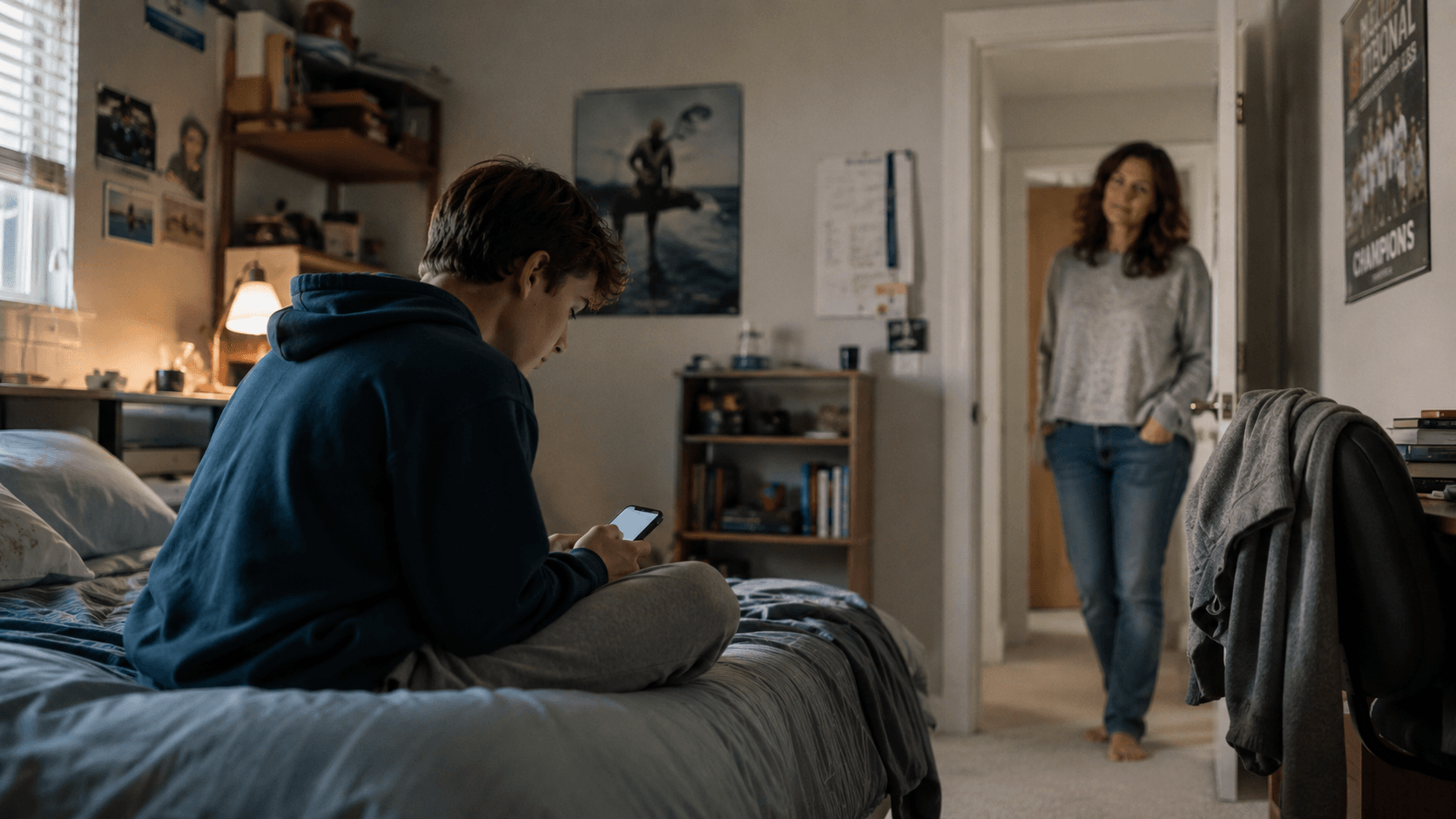
A teenage boy sits on his bed looking at his phone while his mother pauses in the bedroom doorway, present but not hovering
Present in the doorway, not reading over the shoulder.

This is the one built for the “without spying” search you probably ran right before this one. Bark doesn’t hand you a transcript of every message; it scans for patterns, cyberbullying, predatory contact, self-harm language, explicit content, across texts, email, YouTube and more than 30 apps, and only alerts you when something crosses a real threshold. Rated 4.2 out of 5 across 34,000 App Store reviews, and the honest trade-off is right there in its own pitch: your kid keeps a version of privacy, and you trade total visibility for fewer, more meaningful alerts. One parent testimonial on Bark’s own listing calls it a “cell phone seat belt,” which is about the right size of metaphor: a backstop, not a leash.

The full-visibility one: Qustodio

Qustodio is the app for a parent who has decided they want to see the activity themselves, not just be alerted to it: web filtering, screen time, location, call and message logs, a 30-day activity report. It’s the most feature-complete of the three, rated 4.2 out of 5 across 8,800 ratings, and it genuinely does more than the other two combined. The cost isn’t measured in stars, though. Buried in its own App Store reviews is a teenager’s account of what constant full-visibility monitoring did to her relationship with her parents, less trust, more secrecy, exactly the opposite of the goal. That’s not a reason to skip it. It’s a reason to use it on purpose, for a real concern, and to tell your kid it’s there rather than let them find out.

What not to do. Don’t install any of these secretly on an older child’s phone; getting caught costs you more trust than the app was ever going to protect. Don’t treat an app as the whole safety plan, the AAP’s own guidance is that tools support a family media plan, they don’t replace the conversation. And don’t reach for the most powerful, most invasive option “just in case”, match the tool to the actual risk in front of you, not the scariest headline you read this week.

Read nextIf the reason you're looking is a sudden change in your child, not just the hours on the screen, read this on when a child seems withdrawn, not naughty

What we’d actually install

For a younger kid whose whole problem is “the iPad at bedtime,” Family Link, free, and it’s already most of the way there. For a tween or teen where the worry is who they’re talking to and what they’re seeing, Bark, because it respects them enough to only speak up when it matters. For a genuine, specific safety concern, a past incident, a risk you already know about, Qustodio’s full picture earns its place, used openly and for a limited reason, not as the default setting on every kid in the house.

Whichever you pick, tell your kid it’s there and roughly what it does. The tool is not supposed to be the surprise. That’s the whole difference between a seatbelt and a trap.

Read nextManaging the rest of family life across apps too, see the co-parenting apps actually worth paying for
FAQTools & Apps

Frequently asked questions

It depends what you’re solving for. Google Family Link (free) is best for managing screen time on Android. Bark is best if you want safety alerts without reading everything yourself. Qustodio is best when you need full visibility, web filtering, location and activity reports in one place.

Bark comes closest. Instead of giving you a full transcript of every message, it scans for real warning signs, bullying, self-harm language, predatory contact, and alerts you only when something crosses a threshold, which leaves a kid with more day-to-day privacy than full-monitoring apps.

Family Link manages time and app access on Android, mostly for younger kids. Bark monitors content for danger signals and alerts you rather than showing everything. Qustodio gives full visibility, filtering, tracking, and logs, across more platforms than the other two. They solve different problems more than they compete.

Tell your child the limit exists and roughly why before you turn it on, rather than letting them discover it. A scheduled, predictable limit (like Family Link’s bedtime cutoff) causes far less conflict than an unpredictable one you enforce manually in the moment.

WHILE YOU’RE HERE…

Rejection Sensitive Dysphoria: Why a Small “No” Feels Huge to Your ADHD Kid

Referee, Judge, or Bystander: What Actually Works When Your Kids Fight

Yogasleep Hushh Review: The $25 Sound Machine That Goes Where Your Baby Goes

Children’s Reading Statistics 2026: What Every Parent Needs to Know

When You Have a Child From an Affair and a Wife You Never Wanted to Hurt

Parallel Parenting: How to Co-Parent Without Co-Operating

Weighted Blanket or Weighted Vest for Your ADHD Kid? How to Choose

The Two Weeks Before School That Actually Matter

Alpine Muffy Ear Defenders Review: Worth It for a Sensitive Baby or Toddler?

Books for When the Big Feelings Are Bigger Than Both of You

JOIN THE CONVERSATION

Leave the first comment

Share your thoughts

{“@context”:”https://schema.org”,”@type”:”FAQPage”,”mainEntity”:[{“@type”:”Question”,”name”:”What is the best parental control app?”,”acceptedAnswer”:{“@type”:”Answer”,”text”:”It depends what you’re solving for. Google Family Link (free) is best for managing screen time on Android. Bark is best if you want safety alerts without reading everything yourself. Qustodio is best when you need full visibility, web filtering, location and activity reports in one place.”}},{“@type”:”Question”,”name”:”Is there a parental control app that doesn’t feel like spying?”,”acceptedAnswer”:{“@type”:”Answer”,”text”:”Bark comes closest. Instead of giving you a full transcript of every message, it scans for real warning signs, bullying, self-harm language, predatory contact, and alerts you only when something crosses a threshold, which leaves a kid with more day-to-day privacy than full-monitoring apps.”}},{“@type”:”Question”,”name”:”Google Family Link vs Bark vs Qustodio: what’s the actual difference?”,”acceptedAnswer”:{“@type”:”Answer”,”text”:”Family Link manages time and app access on Android, mostly for younger kids. Bark monitors content for danger signals and alerts you rather than showing everything. Qustodio gives full visibility, filtering, tracking, and logs, across more platforms than the other two. They solve different problems more than they compete.”}},{“@type”:”Question”,”name”:”How do I limit screen time without constant fights?”,”acceptedAnswer”:{“@type”:”Answer”,”text”:”Tell your child the limit exists and roughly why before you turn it on, rather than letting them discover it. A scheduled, predictable limit like Family Link’s bedtime cutoff causes far less conflict than an unpredictable one you enforce manually in the moment.”}}]}
Tyler Brooks
Tools & Apps
Hi, I'm Tyler
Tyler Brooks
Tests every tool himselfbuys them, doesn't borrow themtells you when to skip it

I'm for the parent about to spend money they're not sure about. I buy the gadget, live with it, and give you the honest verdict - including the 'don't'. I've burned through enough hype to save you the cash, and when something truly earns its place, I'll show you exactly why.

More from Tyler
Your turn

Which tool actually earned its place - and which was a waste of money?

No right answers here - tell us how it actually went. Someone reading needs to hear it.

Join the conversation