The Thanksgiving Shelf Is Half Pilgrim Hats. Pick Around Them.
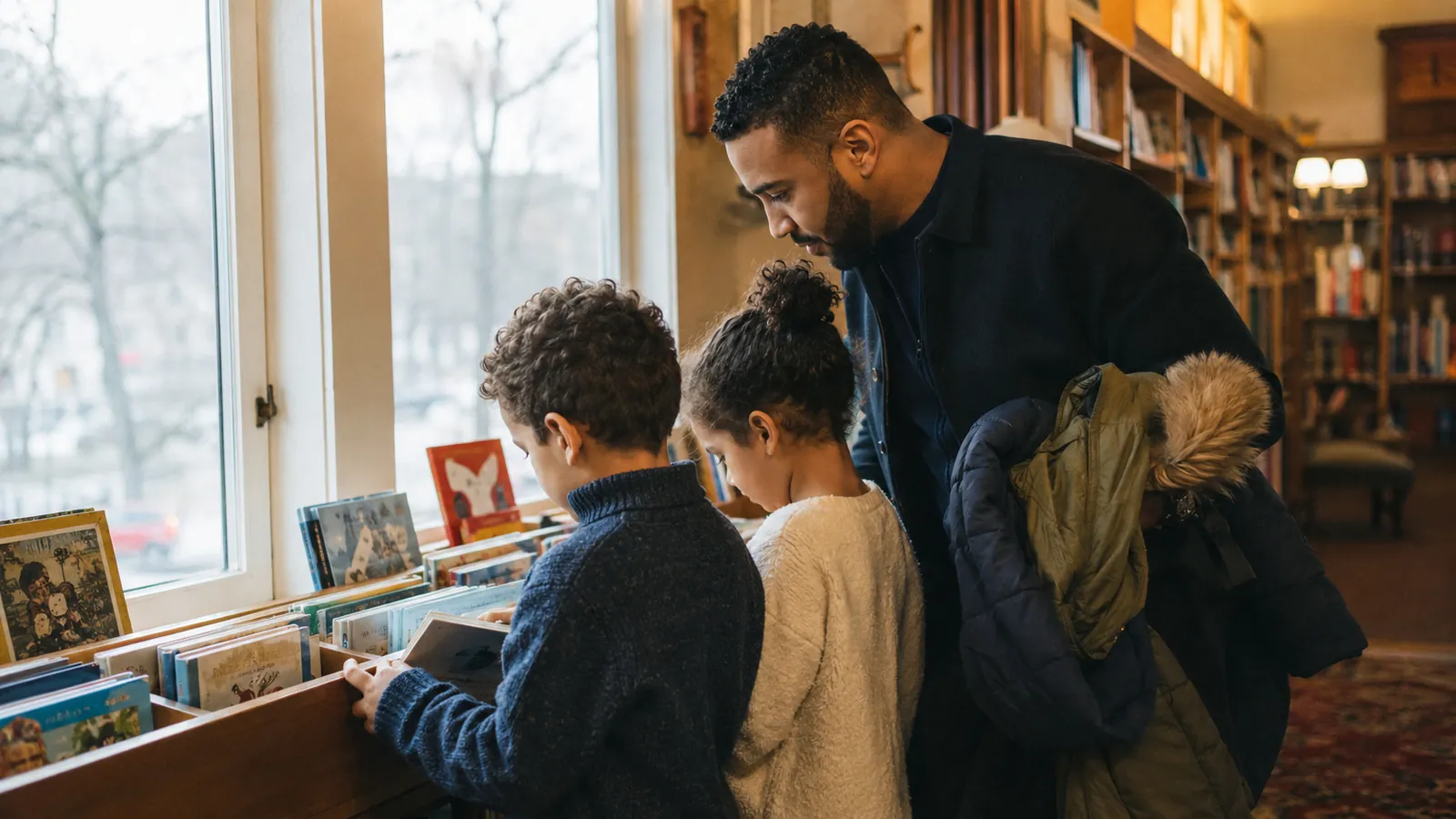
The library display has one turkey board book, a felt Pilgrim hat on a stand, and a stack of Christmas books that showed up early. You have a two-year-old on one hip. Your nine-year-old is reading the back of something else.
You need a book by Thursday that both of them will sit through. You would also like it not to repeat the Pilgrim story you grew up on.
Which Thanksgiving books work for each age?
- Ages 0 to 3. The Thankful Book is a 20-page board book, and the lines run like this: “I am thankful for music because it makes me want to dance.” Charlesbridge also lists We Are Grateful: Otsaliheliga as a boxed set of four mini board books, one per season, for the same ages. For the rest of the day, see Thanksgiving with a toddler.
- Ages 4 to 7. Thank You, Omu! by Oge Mora is listed for ages 4 to 8 and was a 2019 Caldecott Honor book. Fry Bread by Kevin Noble Maillard is listed for ages 3 to 6 and won the 2020 Sibert Medal for informational books. Duck for Turkey Day by Jacqueline Jules, listed for ages 4 to 8, follows a girl who fears her family’s duck dinner will seem odd to her classmates.
- Ages 8 and up. Few of the books here reach this far. Giving Thanks by Chief Jake Swamp is listed for ages 5 to 11 and runs 304 words, short enough for an eleven-year-old who insists they are too old. The back matter in Fry Bread covers the history behind the food, which gives a nine-year-old something the toddler will skip.
Are the old Thanksgiving books still okay to read aloud?
Some are. Some need a second look first.
Oyate, a group that reviews children’s books for how they portray Native people, once posted a list of Thanksgiving titles it did not recommend. Debbie Reese, who founded the site American Indians in Children’s Literature, reposted that list in 2014, with more than 80 books on it.
You may know a few. Alice Dalgliesh’s The Thanksgiving Story (1954) is there, along with Marc Brown’s Arthur’s Thanksgiving and Tomie dePaola’s My First Thanksgiving. Reese guesses that each book landed on the list because it repeats at least one of the myths of the first Thanksgiving. A Smithsonian booklet she shared says most Thanksgiving texts portray Native Americans at the gathering as supporting players.
She does not tell you to throw your copy out. She suggests reading the book, reading an essay on those myths by Judy Dow and Beverly Slapin, and then deciding. So read it alone first and ask one question of every page. Who is missing? If the answer is “the Native people, except as extras,” you know what to say out loud before page one. Our guide on how to explain Thanksgiving to kids covers the history, so we will not retell it here.
Which Thanksgiving books are by Native authors?
Start with three.
We Are Grateful: Otsaliheliga is by Traci Sorell, a citizen of the Cherokee Nation, with art by Frané Lessac. Charlesbridge lists it for ages 3 to 7, and it won a 2019 Sibert Honor. The title word is what members of the Cherokee Nation say to express gratitude.
Sorell said that in a 2018 interview with author Cynthia Leitich Smith.
Fry Bread is the other picture book to reach for. Kevin Noble Maillard (Mekusukey Seminole) wrote it in verse, Juana Martinez-Neal drew it, and it also won an American Indian Youth Literature Picture Book Honor. Giving Thanks is a Mohawk morning message of thanks to the natural world, first published in 1995. Oyate and Reese have both recommended it.
Which gratitude books skip the history?
Some nights you want the feeling without the Plymouth question. Fine.
In Thank You, Omu!, neighbors follow the smell of Omu’s stew one at a time. She gives each of them a portion until the pot is empty, and then her community rewards her. Hachette’s page calls it a story for “the Thanksgiving season.”
Gracias • Thanks by Pat Mora, with art by John Parra, is a bilingual list of small things a boy is thankful for, from flying ladybugs to his dad’s thick chocolate syrup. Lee & Low published it in 2005 and lists it for ages 5 to 9. It earned a Pura Belpré Illustrator Honor.
After the last page, ask everyone at the table for one thing that belongs on their own list. For more ways to use that, see our gratitude activities for kids.
How do you read aloud to kids of different ages?
Read before the food comes out. A picture book loses to a bread basket every time, so use the dead half hour before dinner.
Pick one book and read it once. Thank You, Omu! has 40 pages and Fry Bread has 48, and either one fits in a few minutes. Keep a shorter backup, like Giving Thanks, for the kid who is done at page ten.
Put the toddler on a lap and ask the middle kid to find one new thing on every page. Kids who will not sit can build or draw while you read, and our guide to books for kids who hate reading has more tricks for that. Save the games for after dessert. Our Thanksgiving games for kids work for a four-year-old and an eleven-year-old at once.
Can you get these books for free?
Yes, mostly. Look each title up in your library’s online catalog, since many show which branch has a copy.
Libby, the library app from OverDrive, lets you borrow ebooks, audiobooks, magazines, and more for free from your local library with a library card. If a title is checked out, place a hold and grab another book from your list.
A free PDF from a search result is a different thing. Every book recommended above came out in 1995 or later, so all of them are still under copyright, and a full copy online is usually one the publisher never approved. Skip those files. The library copy is free and legal, and our Christmas book stack guide covers timing your holds.
Put two on the table before anyone arrives
Pick two tonight: a board book for the smallest person you are feeding on Thursday, and a picture book for the oldest kid who will still sit. Set them on the coffee table, not on the shelf. If the day falls apart, read one page to one kid on the stairs and call it done.
Leave the first comment
Share your thoughts
Frequently asked questions
Your public library. Look up each title in the catalog, place a hold on anything checked out, and pick up at the closest branch. Many libraries also lend ebooks through the Libby app with a library card. Availability varies, so ask a children’s librarian what else is on the shelf if a title is out.
The legal free option is a library ebook. Every book recommended above is still under copyright, so a full PDF from a search result is usually an unauthorized copy. Libby lets you borrow ebooks with a library card at no cost. Skip the PDF, place a hold, and read it on a phone or tablet.
Start with We Are Grateful: Otsaliheliga by Traci Sorell (Cherokee Nation), Fry Bread by Kevin Noble Maillard (Mekusukey Seminole), and Giving Thanks by Chief Jake Swamp (Mohawk). Publishers list them for ages 3 to 7, 3 to 6, and 5 to 11. A children’s librarian can point you to newer picture books by Native writers.
Pick a short picture book with a repeating line, such as Fry Bread, and give the older child that line while the toddler sits on a lap. It has 48 pages and reads in a few minutes. Do it before the meal, when nobody is waiting on food, and stop the moment the toddler squirms.
You can keep them. Read each one to yourself first. Oyate, which reviews children’s books for how they portray Native people, once listed more than 80 Thanksgiving titles as not recommended, including The Thanksgiving Story from 1954. If you keep one, say out loud who is missing from the pictures, and pair it with a book by a Native author.
Which book changed something at home - and which did you put back?
No right answers here - tell us how it went. Someone reading needs to hear it.
Join the conversation