
The Halloween Bucket Comes Home Full. Decide Now, Not at Half Past Eight.

The bucket comes home full. That is when the actual argument starts.
Not on the street, where everybody is having a nice time, but at about half past eight in a hallway, when a child who has already eaten four things wants a fifth and you have to decide, on the spot and with no plan, what the rule is. Whatever you say next will be the rule for the next three weeks, because you will not have the energy to renegotiate it.
So it is worth deciding earlier than that.
First, the thing you are probably worried about is not the thing
Most of us go into Halloween braced for the sugar to turn our child into somebody else for the evening. We looked at that properly in the piece on Halloween candy and behavior, and the short version is that the research has been trying and failing to find that effect since the 1990s. What is actually happening on Halloween night is a child who is out after dark, in a costume, in a group, in the cold, being handed things. Any one of those would do it.
That matters here because it changes what the rules are for. They are not damage control against a substance. They are there so that a pile of candy the size of a cushion does not become the only thing anyone talks about for two weeks.
Sort it before anyone eats anything
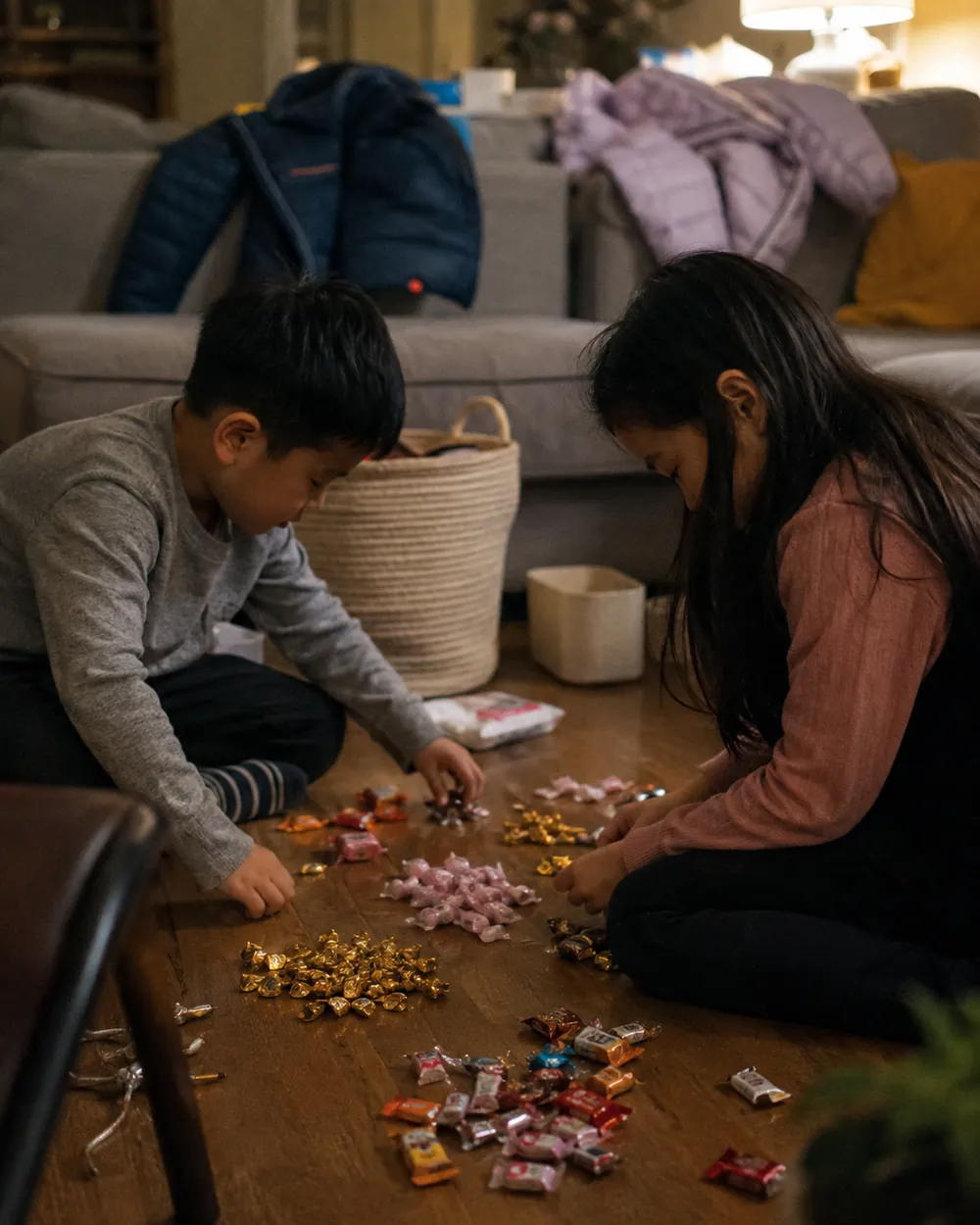
Tip the whole lot onto the floor and sort it. Into favorites and the rest, or into chocolate and chewy and the strange ones, or by color if they are four. It takes ten minutes, it is the part of the night children like best after the doorbells, and it does three quiet jobs at once. It works best when siblings sort side by side, which is one more argument for planning their costumes as a pair.
- They see how much there is, which is the moment they stop treating each individual sweet as scarce.
- You get to spot anything with a warning on it before it is opened, which matters if there are allergies in the house.
- Roughly a third of it gets voluntarily thrown into the reject pile, because no child wants all of it.
![Freshware Meal Prep Containers [50 Pack] 1 Compartment Food Storage Containers with Lids, Bento…](https://parents-and-kids.com/wp-content/uploads/2026/07/freshware-meal-prep-containers-50-1-compartment-b08g33fghx-300x256.jpg)
Freshware Meal Prep Containers [50 Pack] 1 Compartment Food Storage Containers with Lids, Bento…
As an Amazon Associate, Decoded Kids earns from qualifying purchases. Price checked live on Amazon.
Once it is sorted, get it out of the bucket. A bucket is a permanent visual reminder sitting on the counter. Small containers, one per pile, into a cabinet, and the whole thing stops being a monument.
Then pick one of these three
None of them is better than the others. They suit different children, and the one that suits yours is usually obvious once you read them.
The daily allowance. Two things after dinner, every day, until it runs out. Best for the child who copes well with a rule that never changes and badly with one that gets revisited. The cost is that it keeps Halloween alive in the house for about a month.
The three good days. They eat what they like on Halloween, the day after, and the weekend, and then the rest goes. Best for the child who finds daily rationing unbearable and would rather have a proper go and be done. It ends the whole business inside a week.
The swap. They choose ten to keep and the rest is traded for one thing they want. A book, a trip, whatever the equivalent is in your house. Best for children over about seven, who can do that arithmetic and often find it a good deal.
If the daily version is the one you pick, a visual countdown on the kitchen wall does more work than you would think, for the same reason a visual timer beats saying five more minutes.
What to do with what is left
The reject pile has somewhere to go. A lot of dental practices in the United States run a buy-back in the first week of November, and food banks will usually take sealed, in-date candy, though it is worth calling first because some will not. Bakes and traybakes eat through a surprising amount of it. Whatever is left after all of that can go in the trash, and it is worth saying plainly that throwing away candy is not wasteful. It was free and most of it was never going to be eaten.
Do the disposal with them rather than while they are at school, though. The thing children mind is not losing the candy. It is finding out afterwards that a decision about their things was made without them, which is the same mechanism behind what happens when the toys get quietly thinned out.
One more thing about the fight itself
If the candy has become the main argument in your house, it is worth checking whether it is really the subject.
Food is one of the very few areas where a young child has genuine control, and a household with a lot of other rules in it will sometimes find that all of the pushing back arrives here. Ellyn Satter’s division of responsibility, which we go into in the piece on the dinner table, is the same idea from the other direction. You decide what and when. They decide whether and how much. Halloween is easier to run when the rest of the year already works like that.
Frequently asked questions
Sort it on the floor first, move it out of the bucket into containers, and pick one system: a daily allowance, three good days and then it goes, or a swap where they keep ten and trade the rest. Leftovers can go to a dental buy-back, a food bank that accepts sealed candy, or the trash.
There is no medical number, which is why the rule matters more than the amount. Two pieces after a meal is a common daily allowance and it works because it never changes. A short unrestricted run of two or three days works equally well for children who find rationing harder than finishing.
Researchers have looked for that effect repeatedly since the 1990s and have not found it. What is far more likely on the night is the combination of being out after dark, in costume, in a group, in the cold, and excited. The sugar gets the blame because it is the visible part.
Leave the first comment
Share your thoughts

I'm for the parent whose mornings keep falling apart. I didn't train in ADHD - I lived it with three kids, then read the actual studies, so what you get here holds up in a real kitchen at 7:50 a.m. Specific, tested at home, never preachy.
More from MarcusWhat finally made your child's focus click - even a little?
No right answers here - tell us how it went. Someone reading needs to hear it.
Join the conversation