Books for When the Big Feelings Are Bigger Than Both of You
Somewhere between the third meltdown of the day and the spaghetti sliding off the table, you stop wanting theories. You start googling for words that work, tonight, at your kitchen volume. That’s usually the moment this shelf gets built.
Here’s the thing the covers don’t tell you: a four-year-old mid-storm is a small nervous system with no brakes fitted yet. No book stops that storm. The good ones do something quieter and better. They teach you to become the thing that helps it pass.
Why this shelf has two halves

Most feelings-book lists lump everything together, which is how you end up reading brain science to a toddler. If you are buying rather than borrowing, our list of gifts for an anxious child starts from the same split. It works better split in two: books that change what you do in the hard minute, and books that slowly hand your child the words for what’s happening inside them.
The order matters more than the titles. A flooded child can’t learn anything, which is why talking mid-meltdown so often backfires. Your calm comes first, the hug comes second, and the vocabulary gets built later, on the sofa, on an ordinary Tuesday when nobody is crying. That’s the whole architecture of this list.
The half that changes what you do
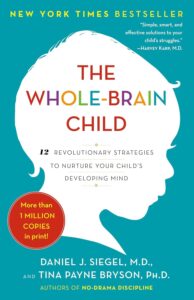
The Whole-Brain Child is where nearly everyone should start, and it’s not close. Siegel and Bryson explain what happens upstairs when your child flips their lid, then hand you twelve strategies plain enough to use at 6pm on no sleep. We put it through its paces in our full review of the meltdown strategies that stick, and it earned every bit of its reputation.
No-Drama Discipline is the sequel for the minutes after the storm, when something still has to be said about the hitting or the screaming. It reframes discipline as teaching rather than payback, and it’s the reason our editor stopped dreading the follow-up conversation; our review breaks down how to hold the limit without the shouting match.
As an Amazon Associate, Decoded Kids earns from qualifying purchases. Price checked live on Amazon.The Whole-Brain Child
The half that gives them the words

Children can’t regulate a feeling they can’t name. That’s the entire job of the picture-book half of this shelf, and it’s why these get read at calm times, not mid-crisis. December is full of those calm times, which is why a short Christmas reading shelf tends to get more use than anything else on it.
For the youngest, In My Heart is still the best feelings vocabulary we’ve found; it treats joy and fury with the same respect, and our review explains why that die-cut heart matters. For a worrier of five and up, Hey Warrior gives anxiety a face and a fixable story, which we unpacked in full here.
The one new name on this list is The Worrysaurus, and it earns its spot for the age gap the other two leave open: the three-to-five-year-old whose worry shows up as a stomachache before every birthday party. It’s gentle, rhyming, and short enough to survive the “again!” phase.
A corner for when every book stays shut
Some feelings are too big for pages, and a book can’t give a three-year-old somewhere to put the feeling at five o’clock. A calm-down corner can: a spot they go to, never a spot they get sent to. You can build one from a beanbag and fairy lights, or start with a box that does the thinking for you. The plush set below pairs each feeling with a color and a face, which is exactly how pre-readers learn to point at what’s wrong.
Read one, steal three lines
Please don’t try to inhale this whole shelf. Pick the book that matches your worst hour, steal three lines from it, and let the rest wait on the nightstand without guilt. Becoming a parenting scholar was never the point. Dreading bedtime a little less is, and around here, small wins count double.
Frequently asked questions
For parents, The Whole-Brain Child by Siegel and Bryson: it explains why young children flood and gives twelve usable strategies for the moment itself. For the child, In My Heart by Jo Witek is the strongest first feelings vocabulary for ages two to five. Together they cover both halves of the hard minute.
The Whole-Brain Child gives you the why and the what-to-do, and The Worrysaurus works well for toddlers whose big feelings lean toward worry. With under-threes, expect the book to do its work at calm times; in the moment itself, co-regulation beats any page.
Roughly two to seven, with a sweet spot around three to five. In My Heart works from about age two, The Worrysaurus from three, and Hey Warrior suits worriers of five and up who are ready for a bit of story logic. Past seven, most children do better talking than being read to about feelings.
The co-regulation core of these books helps across the board, and many neurodivergent families rate them highly. Go gently with any page that assumes a child can choose calm on demand; for some children that is the hardest ask there is, and pairing these with a neurodiversity-affirming title is worth it.
No. Mid-meltdown, a flooded brain cannot take in a story, and offering one can read as pressure. Keep the books for calm moments like bedtime; the vocabulary they build is what your child will reach for, slowly, when the next storm comes.

I'm for the parent standing in the bookshop, overwhelmed. I read them all - the wise, the smug, the single good idea stretched to 240 pages - so your nightstand stack stays short. I'll point you to what's truly worth it, and kindly, what to put back.
More from MeiWhich book changed something at home - and which did you put back?
No right answers here - tell us how it went. Someone reading needs to hear it.
Join the conversation