
Chew Necklaces for Kids: An Honest Review of the 7-Pack Sensory Chewelry (and Who Actually Needs It)

If your kid chews everything — shirt collars, pencil ends, hoodie strings, the corner of a library book — you have probably tried telling them to stop. And it probably worked for about eleven seconds. That’s because for a lot of kids, chewing isn’t a bad habit. It’s oral sensory input the nervous system is actively looking for, usually when they’re concentrating, winding up, or trying to settle.
A chew necklace — “chewelry” — gives that urge something safe and designed for the job instead of a soggy collar. We looked at the popular budget option: a seven-piece silicone set that lets you find the shape your kid actually likes without spending much to find out.
First: why is my kid chewing everything?
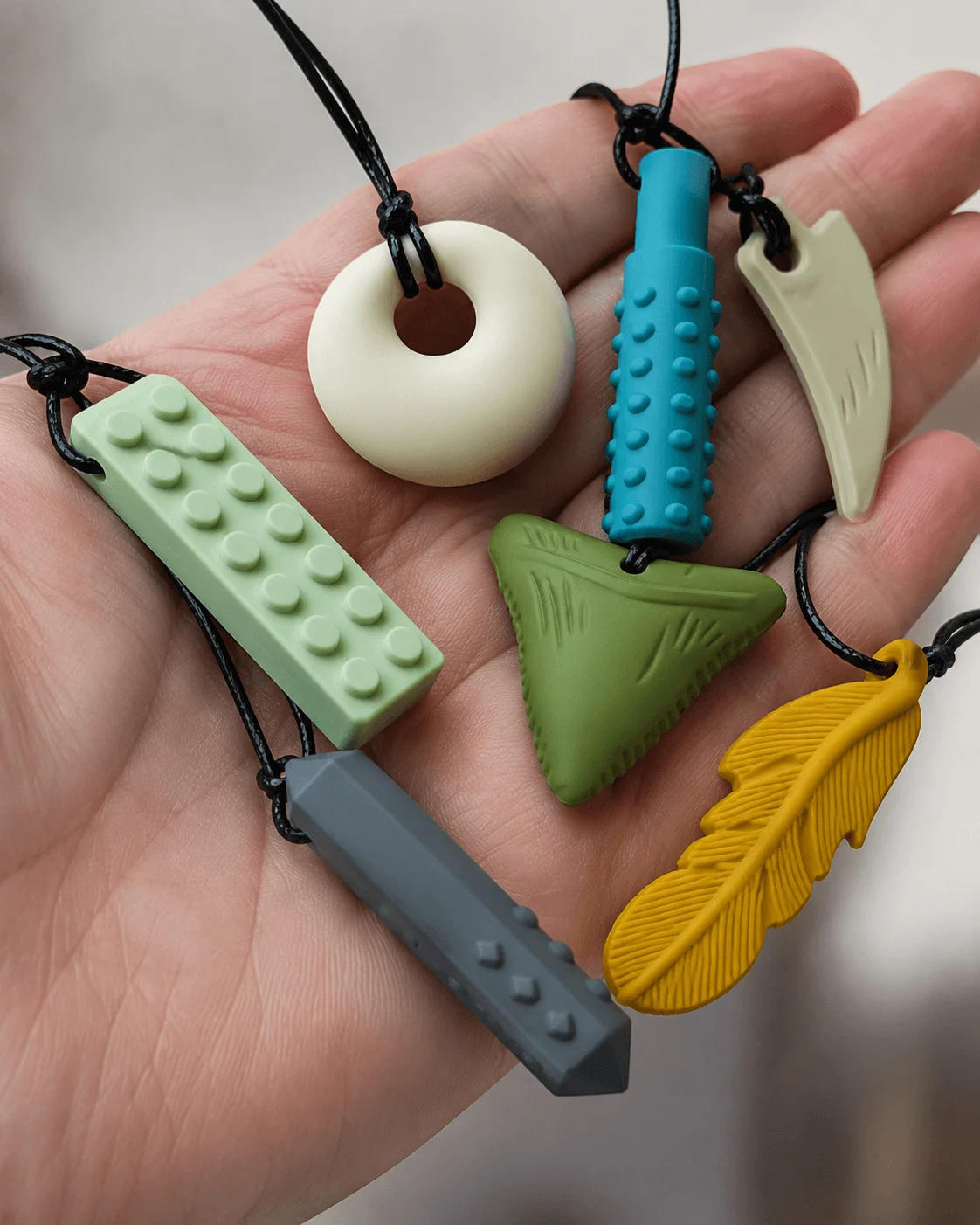
Chewing sends firm, rhythmic input to the jaw, and that input is organising — it can help a child feel calmer and more focused, the same way some adults click a pen or chew gum through a hard task. It often ramps up exactly when demands do: homework, transitions, a noisy room, the run-up to a meltdown. Occupational therapists tend to frame it simply: don’t punish the urge, redirect it to something safe. That’s all a chew necklace is — a designated, washable thing to chew so the shirt and the pencil get a break.
It’s worth saying plainly: a chew tool is a support, not a diagnosis or a fix. If the chewing is intense, sudden, or paired with other worries, it’s a conversation for your paediatrician or an OT — and a great companion to reading up on sensory-seeking versus sensory-avoiding kids, because the same child who chews may also crave (or hate) other kinds of input.
How we looked at this
The set carries a 4.4-star average from around 147 reviews. That’s a modest, honest sample — enough to show it works for a lot of families, not so many that it’s a long-proven institution. At roughly ten dollars, though, it’s a low-stakes way to test whether chewelry helps your kid at all before spending more on a specialist one.
Match the necklace to the chewer
This is the part that matters most, and the thing cheap listings never tell you. Chews come in firmnesses, and the single biggest safety rule is to match the firmness to how hard your child bites.
| Your child… | What they need | Does this 7-pack fit? |
|---|---|---|
| Mouths, sucks, or lightly fidget-chews | Soft to medium silicone; variety to find a favourite | Yes — this is its sweet spot |
| Chews regularly and fairly firmly | Medium silicone; supervise and replace as it marks | Mostly — watch for wear |
| Bites hard / has bitten through toys before | A chew rated for strong or aggressive chewers | No — size up to a tougher one |
7-Piece Silicone Chew Necklace Set
Budget (~$10) · 4.4★ (147)
Get it if
- Your child mouths or chews to focus or self-soothe (mild to moderate)
- You want to try several shapes cheaply and find the keeper
- You want BPA-free silicone and a spare for when one goes missing
Skip it if
- Your child bites hard or has chewed through toys — get a strength-rated chew
- You need one specific clinical-grade chew, not a variety set
- You can’t supervise a young child around the cord
For a mild-to-moderate chewer, this is the sensible first buy: cheap enough to experiment, seven shapes so your kid can tell you what feels right, and BPA-free. Treat it as a starting kit — once you know which shape and firmness your child gravitates to, you can decide whether to stick with it or step up to a sturdier single chew.
If your child bites hard or has already chewed through toys, a general $10 set isn’t the right tool — and forcing it is how pieces get bitten off. Look instead for a chew explicitly rated for strong or aggressive chewers from a specialist brand like ARK Therapeutic or Chewigem. It costs more, but it’s built to survive the bite your kid actually has.
So — is it worth it?
For most mild-to-moderate chewers, yes. It’s about ten dollars, it’s BPA-free, and the seven shapes do the one thing a first chew should: help you find what your child actually likes without a big spend. Just go in with the firmness rule in mind, mind the cord, and know that a genuinely heavy chewer will need to size up to a strength-rated one. And remember the necklace is only ever half the answer — pair it with the wider sensory tools that actually help and, if focus is the real battle, the right calm-down setup for your particular kid. If you’re weighing sensory supports more broadly, our weighted blanket versus vest breakdown runs the same honest, match-it-to-the-child logic.
Frequently asked questions
Yes, when matched to your child’s chew strength and supervised: use a breakaway cord, choose a firmness rated for how hard they bite, inspect it often, and replace it at the first tear. A chew too soft for a strong biter can be bitten through, which is a choking risk.
They’re used from toddler age up through school age and beyond, always with supervision for little ones. Match the firmness to the child, and never leave a young child unsupervised with a cord around the neck.
Chewing gives calming, organising input to the jaw and is often oral sensory-seeking or a way to self-regulate when focusing or anxious. A chew tool redirects the urge to something safe and designed for it, rather than trying to punish it away.
Most BPA-free silicone chews wash with warm soapy water or on the top rack of the dishwasher — check the specific listing. Replace any piece that shows bites, tears, or thinning rather than trying to clean around the damage.
Leave the first comment
Share your thoughts

I'm for the parent whose mornings keep falling apart. I didn't train in ADHD - I lived it with three kids, then read the actual studies, so what you get here holds up in a real kitchen at 7:50 a.m. Specific, tested at home, never preachy.
More from MarcusWhat finally made your child's focus click - even a little?
No right answers here - tell us how it actually went. Someone reading needs to hear it.
Join the conversation