
Handover Days Without the Meltdown
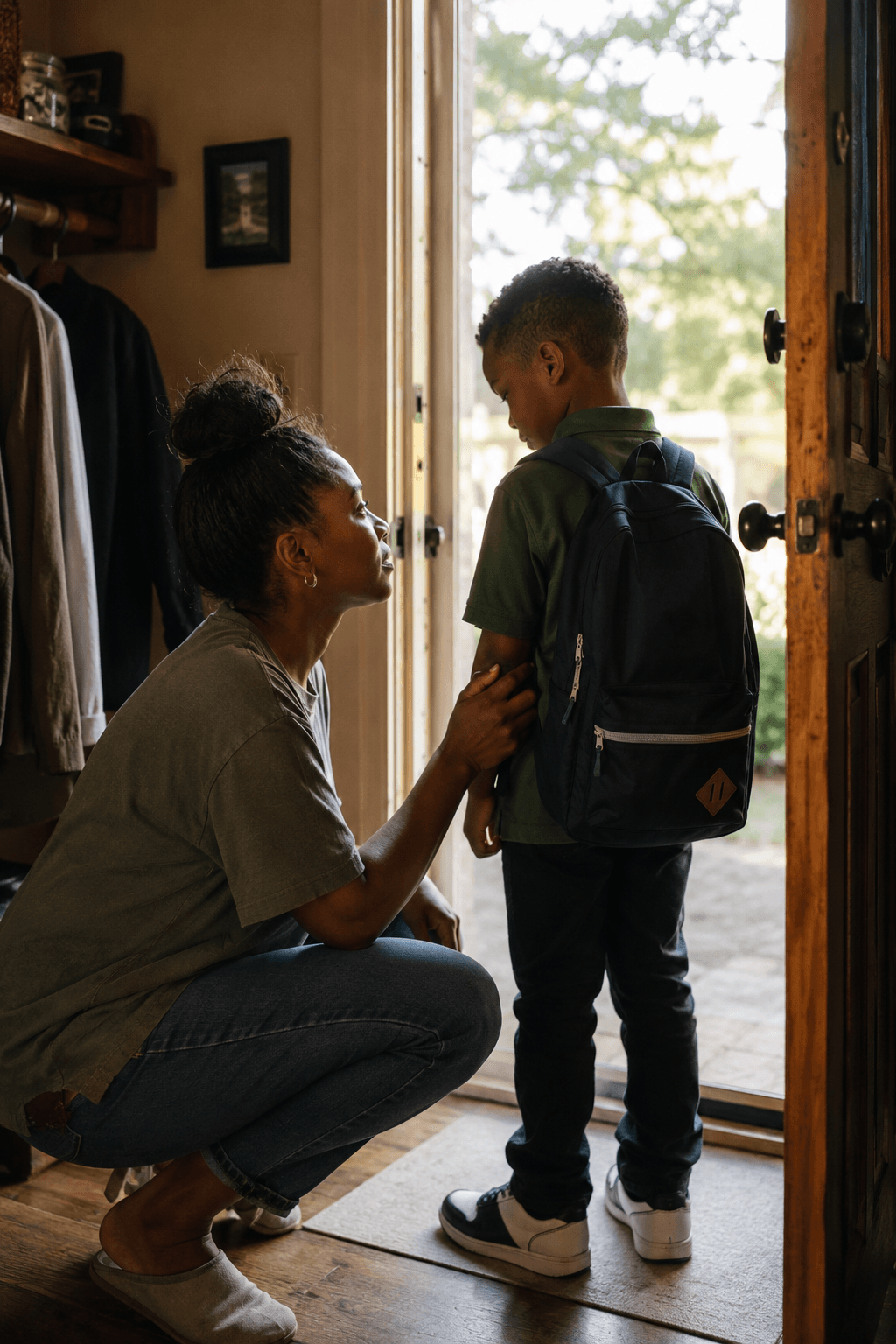
The ten minutes in a car park. The doorstep moment where one of you is trying to sound breezy and nobody quite believes it. Handover days are the part of co-parenting that catches you off guard even when everything else is holding together. Most kids can handle two homes. It’s the transition between them that’s hard.
What helps most is making the exchange almost boring: same spot, same short script, same quick goodbye. Predictable calms a child’s nervous system faster than heartfelt does.
Why does the handover feel so loaded for kids?
Your child’s nervous system is doing a lot of work in a short window. They’re switching environments, adjusting to a different set of routines, and picking up on the emotional atmosphere around the exchange, even when nobody says anything. Child psychologists consistently point to unpredictable or tense transitions as a primary stressor in shared-care arrangements, not the arrangement itself. The handover is where the difficulty concentrates.
You’re probably not at your best either. Most parents feel some version of guard-up during those ten minutes, even when co-parenting is civil. Kids are wired to read parental stress before a word is spoken. So the first thing you can actually do, before any logistical prep, is work on your own nervous system in the hour before you arrive.
What actually makes handovers easier?
Same place. Same time. Same script. That’s mostly it. Family researchers studying shared-care transitions find that children settle better when the exchange is brief and consistent, not when parents try to make it emotionally significant. A quick, warm goodbye works better than a long, heartfelt one because it signals: this is just normal now.
“Love you, see you Sunday” then go. The hug can be real. The exit should be fast. Extended tearful farewells, however loving they feel, quietly tell a child there’s something to dread about this moment. A calm, brisk departure says the opposite.
If face-to-face contact between you and your co-parent is too charged, a kerbside drop removes most of the friction. One parent drops at the door or school; the other collects. The child never has to hold both parents’ tension in the same ten-foot radius.
Should you send something from home with them?

A transition object sounds clinical. What it actually means is: a soft toy, a hoodie that smells like your house, a small photo, a comfort item that lives in their bag. For younger children especially, this gives them something to hold when the wobble hits mid-week.
According to guidance from the American Academy of Pediatrics, familiar objects that cross between homes help young children maintain a sense of continuity and security during the adjustment period after a separation. The object itself isn’t the point. Continuity is.
A weighted comfort plush works particularly well for children who are prone to anxiety or sensory sensitivity, because the gentle pressure has a calming effect beyond just the familiarity. It travels, it washes, and it doesn’t need charging.
Two things that help with the in-between
As an Amazon Associate, Decoded Kids earns from qualifying purchases. Price checked live on Amazon.Weighted Comfort Plush

What to do when they get back to you
The re-entry is usually trickier than the leaving. Don’t start quizzing them the moment they walk in. A snack, the sofa, some quiet, and no big questions works better than “so, how was it?” in the first five minutes. They will talk when they’re ready, which tends to be once you’ve stopped making space for it.
The decompression window varies a lot. Twenty minutes for some kids; a couple of hours for others. Whatever it is, let it happen. Treating the re-entry as a normal Tuesday rather than an emotional event speeds up the settling.
What is the post-handover storm actually about?
Clinginess, attitude, tears, or a meltdown in the first hour home nearly always means the transition was hard, not that something went wrong at the other parent’s house. Most co-parents interpret it as a verdict about the other arrangement. It almost never is.
Research on shared-care adjustment consistently shows that children bounce back faster when both parents can hold a “transition behaviour is normal” mindset, rather than treating every wobble as a red flag. Dr. Robert Emery, professor of psychology at the University of Virginia and one of the most-cited researchers on children of divorce, notes that the quality and consistency of the parenting environment matters more than which home a child is in on any given day.
Stay steady. Keep the routine boring. The calm is contagious. Anyway, most children settle within a day once the rhythm becomes reliable.
Frequently asked questions
Most children settle into a predictable handover routine within four to eight weeks, though younger children and those with anxiety or sensory sensitivities can take longer. The key factor is consistency: the same routine repeated calmly shortens the adjustment window more than anything else.
Wait until they bring it up. Asking directly in the first hour puts a child in a loyalty bind and often shuts conversation down rather than opening it. A casual “glad you’re home” and then getting on with dinner is usually enough. They talk when they feel safe to, not when they’re freshly through the door.
Crying at the exchange is common, especially in children under seven. The response that helps is warmth plus brevity: a hug, “I love you, see you [day],” then a clean exit. Lingering to soothe prolongs the distress. If crying continues past a few months without improving, a few sessions with a child therapist can give your child tools to manage the transition themselves.
Kerbside drops are fine for most children and genuinely better when face-to-face contact between co-parents is tense. Children pick up on parental conflict far more than they pick up on logistics. A calm wave from the car beats a strained doorstep exchange every time. Frame it as a normal thing, not a sad one, and most children follow your lead.
Toddlers and children between two and five tend to find handovers hardest because their object permanence is still developing and they experience separation more acutely. Children from around eight upward generally manage transitions better once they can hold the idea of “I’ll see you in a few days” without it feeling abstract. That said, the quality of the handover routine matters at every age.

I'm for the parent mid-meltdown - theirs or the kid's. I write from the actual floor of it: the crying that won't stop, the dinner thrown, the bedtime that unravels. Blunt because I respect you too much to pretend it's easy. Just what tends to actually work.
More from NourWhat's getting you through right now? Be honest - we're all figuring it out.
No right answers here - tell us how it actually went. Someone reading needs to hear it.
Join the conversation