
When You Have a Child From an Affair and a Wife You Never Wanted to Hurt

Somewhere in your phone there is a photo you can’t show anyone. Maybe you never even saved it, just an image in a message thread you scroll to at red lights and then lock away fast, like it burned your hand. A child. Your child. And at home, the woman you married, who doesn’t know. Or who knows, and is still deciding what to do with it.
Men in this exact spot tend to type one question into a search bar at 2am: how do I do this without destroying anyone? You can’t. The honest version has two moves and one surrender: you tell your wife the truth, you support your child openly, and what she does next is hers. It costs the most up front and the least over a lifetime. Everything else is deferred payment, with interest.
Around 20% of married men admit to sex outside the marriage, going by the General Social Survey data, and nobody counts how many of those affairs became a person. Plenty did. The counseling offices know it, and so do the DNA kits. You are not the only man carrying this. It only feels that way because this is the one thing men never say out loud.
What is the guilt doing to you?
There’s a distinction here that sounds academic and isn’t. Psychotherapist Esther Perel, who has sat with hundreds of couples after affairs, writes in The State of Affairs that “shame is a state of self-absorption, while guilt is an empathic, relational response, inspired by the hurt you have caused another.”
Guilt looks at the people you hurt and moves you toward repair. Shame looks at yourself and moves you toward hiding. Most men in your position start in guilt and slide into shame, because shame is quieter. It’s also where the double life grows: the deleted threads, the birthday visit filed under overtime. (You know the machinery. You built it.)
McAdam’s point in that video is the whole game here: accountability paired with self-compassion is what lets a man act, and self-punishment on a loop is what keeps him frozen. Frozen is the worst thing you can be right now, for everyone involved.
The child didn’t choose any of this
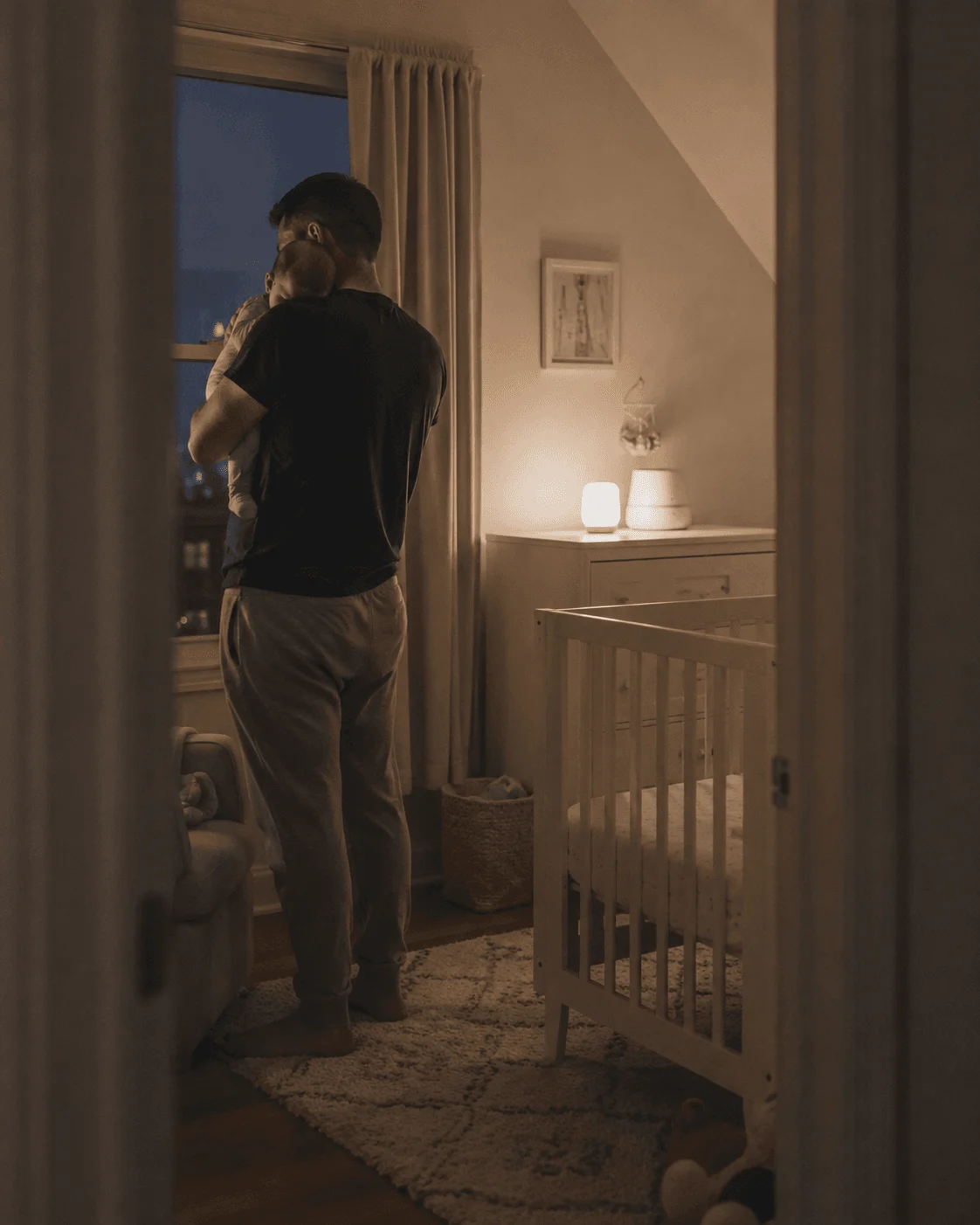
Whatever the affair was, and whatever it meant, the child is a bystander to it, the one person who wasn’t in the room when any of the decisions got made. The research on fathers is blunt about what your presence is worth, too: a large UK birth-cohort study found that children whose fathers were genuinely involved in their early years had measurably fewer behavior problems by age nine to eleven. Involved, in that study, didn’t mean wealthy or even married. It meant present and emotionally engaged.
Psychologist Ana Nogales surveyed more than 800 grown children of unfaithful parents, and about 7 in 10 said their ability to trust people took lasting damage. Sit with her findings a while and the deepest bruise isn’t the affair itself. It’s the secrecy wrapped around it. Kids can metabolize a hard truth with help from the adults around them. What they can’t metabolize is being managed.
And a kid who is somebody’s secret finds out. Sometimes at eight, overhearing the wrong phone call. Sometimes at thirty-five, with a cotton swab and a website. There is no version of you they can discover that looks worse than he knew where I was, and he stayed away to keep his life tidy.
Does your wife have to know everything?
Andrew G. Marshall, a marital therapist with 35 years of these exact conversations behind him, lands close to absolute on this: complete honesty, including the money and every channel of contact, is the only version that holds. His reasoning is practical rather than moral. Secret payments and secret messages are the affair continuing in administrative form, and wives find administrative trails.
She gets the truth for a harder reason too. As long as she doesn’t know, she is running her one life on missing information, and you already took her right to choose away once. Right. That’s the piece of the guilt that time won’t touch, and honestly, it shouldn’t.
How do you show up for a child you can barely talk about?
The legal part is the short part. In every US state, child support follows biology, and no family court grades conception. Establish paternity, pay reliably, keep it on the record. On-the-books support is also, strangely, a gift to your marriage: money your wife can see is money that isn’t a secret.
Presence is harder, and it runs on one rule: consistency beats intensity. A child does better with a father who turns up every other Saturday, every time, than with one who materializes in guilt-storms and vanishes when the marriage strains. That takes a civil, businesslike channel with the child’s mother, who is probably carrying the everyday load alone. If things between you two run hot, parallel parenting was built for exactly that.
Give your marriage the same scaffolding. A visit schedule your wife knows about beats promises, and a couples therapist who has heard all of this before beats the two of you improvising at midnight. This is roughly the heaviest thing an infidelity-literate counselor gets handed, and they have still heard it more than once. That fact alone loosens something in most men.
If the marriage doesn’t survive it
Perel’s larger finding is that infidelity is devastating and, for some couples, survivable. A minority even rebuild something more honest than what broke, once everything is finally on the table. Some wives stay, on new terms they write themselves. Some leave, and the leaving is clean in a way the lying never was.
You don’t control which of those you get. You control whether your child grows up with a father or with an explanation, and whether your wife lives with a husband or with a curated version of one. Two people are going to carry what you do next for the rest of their lives, and neither of them is you.
It starts with one true sentence, spoken out loud, to the person who deserves to hear it first. You already know who that is.
Frequently asked questions
Therapists who specialize in infidelity, including Andrew G. Marshall, consistently advise full disclosure. A child generates paperwork, payments and eventually questions, so discovery is close to inevitable, and a wife who finds out on her own experiences it as a second, deeper betrayal. Telling her, ideally with a counselor present, returns her right to choose.
Yes. In every US state, biological parents owe child support regardless of marital status or how the child was conceived. Unpaid support builds up as arrears and doesn’t expire. Establishing paternity and paying reliably, on the record, protects the child and keeps the obligation transparent instead of secret.
If you can be consistent, yes. Research on father involvement links an engaged dad to measurably better behavioral outcomes for children, and psychologists who study children of infidelity find that secrecy and abandonment do the deepest damage. Steady, structured contact helps far more than intense bursts followed by disappearing.
Some marriages do survive it, usually with professional help and total transparency. Esther Perel’s work with couples after infidelity shows a crisis can become a turning point rather than an ending. What no marriage survives well is ongoing deception: secret contact or secret payments discovered later.
Leave the first comment
Share your thoughts

For nearly two decades I was the youth mentor across from the angry kid, the silent one, the parents out of ideas. I write the way I listened - slow, steady, never from above. If tonight feels heavy, I hope this felt like having someone in the room.
More from TheoWhen did you last feel out of your depth - and what helped, even a little?
No right answers here - tell us how it went. Someone reading needs to hear it.
Join the conversation